Artificially Driving Down Crime Rates

By David A. Clarke Jr., Sheriff (Ret.) Milwaukee County

33748592_m.jpg

Keeping crime and violence in check has always been a challenge with major urban city law enforcement agencies. Agencies are almost maniacally driven about crime statistics. Staffing and deployment strategies are being determined based on how much crime is occurring and where. Neighborhood residents get nervous when news reports of crime waves set in. Safe city rankings are determined by crime rates. Insurance rates are calculated by how much property crime occurs in a particular city. Crime reduction matters.

You may recall that beginning in the late 1980s and lasting for nearly two decades, a renaissance occurred all across the country when a crime reduction strategy called Fixing Broken Windows emerged. Its authors, George Kelling and James Wilson, put forth a thesis that was based on police putting a higher priority on going after lesser crimes like property crimes and acts of disorder. The theory was that quality-of-life offenses were an indication to criminals that nobody cared about their behavior and that citizens were numb to it and were not likely to call police nor would anything be done about it. This cynicism allowed the criminal element to operate in the open as resident fear increased. It caused people to withdraw from engaging in neighborhood life. Social interaction can reduce crime. Kelling and Wilson’s thesis was that the occurrence of property crimes and other quality-of-life offenses were the precursor to more serious crimes.

When William Bratton became commissioner of the New York Police Department, a top commander named Jack Maple came up with a strategy based on the Broken Windows theory of policing. He called it Comp Stat, short for computer statistics. When crime was mapped using computers, patterns emerged. The thought was to “put the cops on the dots” thus going from reacting to crime to preventing crime. Computer generated statistics allowed neighborhood precinct commanders to get information to front line officers in real time. It allowed officers to identify the criminals on their beat where they could be focused on while targeting specific offenses. Quality of life offenses like subway turnstile jumpers and squeegee men were harassed. It brought that disorder to an end. Policing went from being reactive to being proactive. Citations began to be issued for lesser crimes and disorder. When fully implemented and over time, not only did property crime and disorder go down, violent crime was reduced by record numbers. New York City went from having over 2,200 murders a year to just over 250. Gotham went from being considered unlivable to becoming America’s safest large city based on low crime rates.

Many of you reading here might remember the period of what was called the great crime decline. It is important to have a reference point to compare what was an intolerance toward crime at the end of the 20th century to what some policy makers are proposing today.

As if ideas like defunding police, abolishing and re-imagining police is not crazy enough, now get this out of the cities of Seattle, Portland and Minneapolis. These lunatics are actually talking about reducing crime not through sensible crime reduction strategies like were done in the 1990s. No, they are actually talking about declassifying certain types of lesser crimes and inserting clauses into certain categories of crime that allow the perpetrator an escape from arrest and accountability if they can show a basic need to have committed a crime. In other words, poverty will absolve the perp along with mental health or addiction. That’s right. If you are a drug addict and you commit crime in furtherance of that addiction then you walk. So what if you throw a rock through the plate glass window of a business or damage your car? If you claim the devil made you do it, you are absolved of that being classified as a criminal act. And get this. Selling property that you stole from somebody else is now lawful if you can show a basic need like poverty.

In any other time period, this would be considered unfathomable. Unfortunately, however, we are no longer applying common sense to public policy. We are going from what worked in keeping neighborhoods safe to a model of social engineering using neighborhoods as petri dishes and human subjects as lab rats.

This is not going to end well. It never does when people in position of suggesting public policy and who should know better behave irresponsibly and in what is nothing more than an act of moral preening. As this, let’s make believe it is not crime, is being proposed, both property crime and crimes of violence are escalating in the cities I mentioned. The shame is that these policy-makers will not be held accountable for this insane policy nor are they likely to be the victims of this buffoonery.

PREPARATION: Use of Force and Self-Defense

By Lt. Robert Centkowski

2020 was a crazy year by all accounts. Police officers have had to deal with a national COVID pandemic that put a strain on officer’s health as well as on manpower. If this was a normal year, that in itself would have been a lot to deal with. Well it was 2020 and that was just the beginning.

IMG_3274.JPG

On May 25, The Minneapolis Police Department responded to a counterfeit $20 bill call at a deli. In this incident captured on video, George Floyd is on the pavement with officer Derek Chauvins’ knee on his neck. These nine minutes would set back all the hard work and professionalism 99% of us officers have been doing, igniting nationwide protests and a new call to “defund the police.

NJ Advanced Media conducted a six-month investigation of the use of force incidents involving New Jersey officers from 2012 to 2016 and found a reported 70,405 incidents. The average officer will be involved in approximately four use of force incidents a year. In NJ we receive a block of defensive tactics training in the Police Academy, but for most officers that will be the last time in their career they will receive this form of training.

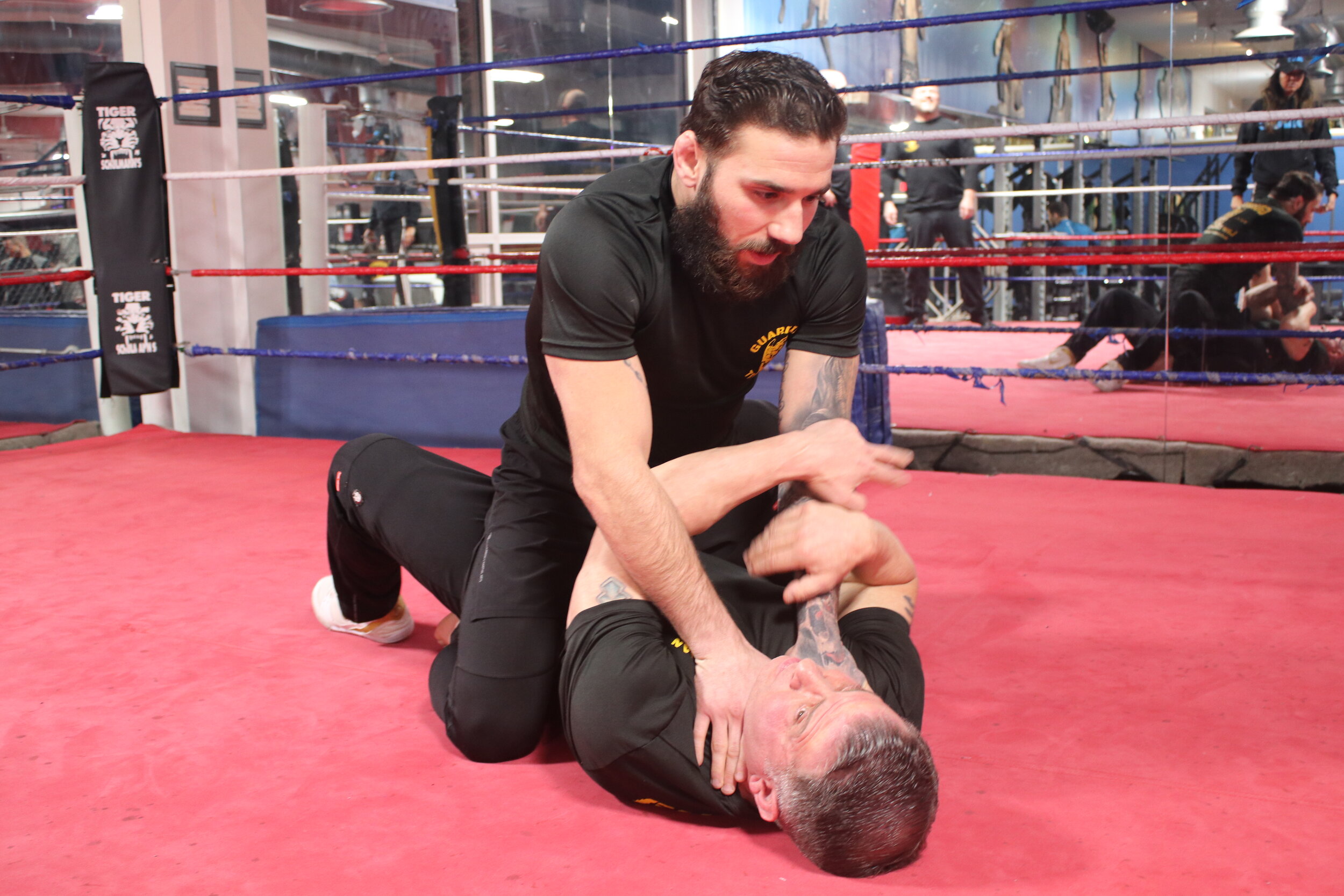
To Chief Michael Foligno of the Elmwood Park Police Department this just was not enough. He is a 31-year veteran of law enforcement who has been chief for the past seven years. He was an accomplished wrestler and has over 25 years of coaching experience, including coaching for the NCAA Division 3 wrestling team at Delaware Valley University. He continues his own training at Tiger Shulmann’s Martial Arts. While training, he met Jimmie Rivera. Jimmie Rivera is currently ranked within the top 10 of the UFC’s Bantamweight Division; Jimmie holds the record for the best takedown defense accuracy in UFC history and has been practicing martial arts for over 20 years.

IMG_3281.JPG

While training together, the two often discussed police work and the lack of defensive training offers receive. Chief Foligno is very community policing-oriented and understands that a trained confident officer is a benefit to the safety of the community, the safety of the officer involved, and even the safety of the person being detained.

This, along with Jimmie Rivera’s respect for law enforcement and the work we do sparked the beginning of a program that they developed to provide often-neglected training of defensive tactics. Each class is 90 minutes long and is broken down into three parts. After a quick warmup, officers begin the jib jets portion of the training. The officer learns how to escape from chokes and life-threatening holds, learns how to perform and defend from takedowns and learns the art of gaining control from the bottom and top positions on the ground. All the techniques are developed with the presence of the officer’s duty weapon in mind.

The second portion of this class focuses on defending from strikes on your feet. This involves bag strikes and learning defensive and effective counters to a stand-up attack.

The last part of the training involves calisthenics which helps in the officer’s fitness which is also key to his overall safety and health. The main point of this training is to provide officers with the confidence in their ability to defend themselves in a use of force situation.

We all do a lot of training in many aspects of our jobs, from domestic violence to firearms qualifications. Defensive tactics has been often overlooked. We focus on use of force guidelines that point out the things we are not allowed to do but neglect providing an officer with training and practice of useful techniques to keep us safe. This program is designed for that lack of training and strictly adheres to the Attorney General Guidelines surrounding use of force.

Officers of the Elmwood Park Police Department, for example, are expected to attend three of these classes at a minimum monthly. The program began in August 2020. Most officers have experienced positive changes in both physical fitness as well a greater confidence in their own abilities.

The opportunity to work with a professional like Jimmie Rivera is a once-in-a-lifetime experience. He takes his time to go over the moves slowly and takes time with each officer to help adjust their technique. He puts his heart into the curriculum, and his respect for law enforcement and the work we do is apparent in the time he dedicates to our department.  All of this while training for his career and upcoming fights in the UFC. So in an age where the term “defund the police” has grown in popularity, it’s great to see as an officer that there are still people who care about our safety. We are provided many tools on the job from, OC spray, Tasers, to a firearm, so why not provide officers with one of the most important tools we can, the training and confidence in our own skills to protect ourselves and the community.

MY BROTHERS KEEPER

By: Michael D. Boll

Burkert.png

During my police career, I increasingly wanted to do get more involved and really help my brothers and sisters in blue. I saw the great work done by the New Jersey State PBA and decided to run to become the local's PBA delegate. Since being new and not knowing much about my new position, my friend and fellow delegate Ken Burkert took me under his wing and immediately began mentoring me. Still to this day, Ken continues to give me advice and assists with the work we do for our charity.

Ken Burkert grew up in Hillside, New Jersey and attended Hillside High School where he was both an outstanding football player and wrestler. Shortly after graduation, Ken was hired by Union County Corrections. While employed at the jail, Ken became the local’s state delegate and was responsible for helping over 300 members. Ken has always put his members first and has helped so many brothers and sisters in blue get the fair treatment they deserved. Fortunately, Ken’s work did not go unnoticed and, in a very short period of time, he was elected to the New Jersey State PBA’s state board, where he remained for the remainder of his illustrious career.

Ken is a great family man married to his wife Renee for past 27 years and she has been his biggest advocate throughout his career. He has a daughter and twin sons who became extremely successful in their endeavors.  His daughter, Victoria, is completing graduate school at Rutgers for a (MSW) Masters in social work.  His sons Ryan and Connor were both New Jersey state finalist wrestlers, and received scholarships to continue wrestling Division I at Hofstra University in the EWIA conference.  Both sons graduated with marketing and finance degrees from the Zarb School of Business.

Ken has always made himself available, spending countless hours helping our uniformed heroes get through some really difficult times. During his time on the state board, Ken spearheaded numerous anti-suicide programs and events. He was a founding member of the PART (Peer Assistance Response Team) and served on the New Jersey Suicide Task Force. Ken also helped create a law enforcement suicide awareness walk, which brings officers and their families from all over the state together to honor our lost members to this ongoing tragic crisis.

Burkert1.jpg

This incredible work was done mostly on his own personal time and he hasn’t slowed down since his retirement. After Ken retired, he was employed by the Penn Medicine-Princeton House Behavioral Health Team. Currently, he is a liaison to first responder organizations, facilitating the smooth transition of first responders to Princeton House Behavioral Health’s First Responder Treatment Services and outpatient care within the community.

Recently, Ken and his team partnered up with the Union County Sheriff, Peter Corvelli, for employee support and counseling training. Members from the Union County Sheriff’s Office in collaboration with Penn Medicine Princeton House Behavioral Health hosted training on traumatic events in the workplace, offered Peer-to-Peer counseling and provided mental health wellbeing for officers and supervisors.

Recently, Ken has joined our team as the Peer Support Specialist, and he continues to advocate for uniformed heroes.  In the next few months, Ken will be assisting us with its first statewide PTSD awareness and anti-suicide campaign. The initiative is fully backed by the NJSPA, NJ FMBA, American Legion, NJ VFW, and numerous elected officers. Ken will be helping us build a strong mentorship program that aggressively seeks out veterans and first responders in crisis, always focused on the goal to help prevent suicide by taking a proactive approach.

Recently, law enforcement in this country has been experiencing some hard times which has resulted in some necessary changes. Throughout these changes, though, we must always assure the well-being of our brothers and sisters in blue. I know that having my friend Ken Burkert on our team will definitely have a huge impact on helping our first responders live a better life. First responders in New Jersey need to know there are people like Ken Burkert out there making a positive difference and working day and night for them. It is essential that their needs are addressed properly by those who understand their experiences.

If anyone is in need of peer assistance, please call his cell (908)346-1691.

Editors Point of View

Welcome to our final issue of 2020. As you can see on our cover, we confront the critical issue of speech suppression. As officers, we are intimately familiar with speech suppression, having worked under many totalitarian departmental policies that severely infringe upon our constitutional rights. Moreover, nowadays, citizens are getting a taste of this treatment. Social media tech giants are silencing their users, and it’s not going over well. Backlash is unprecedented, and alternative social media platforms have seen a spike in users switching over to avoid censorship. But this doesn’t address the underlying problem.  Freedom of speech is under attack in our country, and little is done to correct this assault. Blue Magazine will continue to lead the law enforcement discussion on this topic as we move ahead into 2021. Be sure to check out our cover story.


During this time of year, we must slow down and reflect on what is important to us. The value of family and real friends in your life must never be underestimated. Make sure you set some time aside this holiday season to spend time with the people who are worthy and deserving of our most precious commodity (time). At Blue Magazine, we are thankful for our writers and sponsors who have been with us for many years and the many new ones who have recently come aboard. After Pres. Trump complimented our magazine at his 2020 campaign rallies, we received a tremendous uptick in article submissions. Thank you, Pres. Trump for helping us continue to grow our influence and voice across our great nation. We are the only independent voice owned and run by active and retired officers. We are proud to be the uncensored voice of the front-line officers. We are looking forward to continued success in 2021.

And lastly, I am glad 2020 will shortly be behind us. The anxiety of 2020 has been massive for many traveling uncomfortable roads. 2020 has taught us many significant lessons, including that happiness is a mindset and attitude you control no matter what the circumstance. Material possessions, relationships and wealth can be taken from you, but only you can surrender your mindset and attitude. In every difficult situation, there is light. Seeing that light is at times our greatest challenge. Therefore, as we welcome 2021, bring a better you along for the journey. Push forward and stay focused.


Congratulations to Leonia Police Chief Tom Rowe, who recently retired after 30 years of service. Chief Rowe established an admirable reputation as an intelligent and skilled law enforcement leader who stood up for his officers and provided excellent policing services to the community. Blue Magazine wishes Chief Rowe much success in retirement!


Merry Christmas and Happy New Year!

 By: George Beck

Speech Suppression: The Erosion of Our Rights Continues

By David A. Clarke Jr., Sheriff (Ret.) Milwaukee County

34100378_s.jpg

We are entering a very precarious and dangerous time in the American history of our experiment in self rule. The Framers of the Constitution knew that if they didn’t codify what a strong central government was limited to in its exercise of power over the people that the abuse they experienced under the Crown of Great Britain would continue. We would simply have new masters. We are seeing that today like no other time in recent history.

There is nothing ambiguous in the words, “Congress shall make no law…abridging the freedom of speech found in the First Amendment to the US Constitution." 

Once upon a time, both sides of our political discourse, certain aspects of freedom and liberty like free speech practice of faith, right to protest, unreasonable search and seizure extremely sacred. Today? Not so much. What is interesting is that a half a century ago, it was the American left, liberals and Democrats who were very distrustful of a strong central government. They recoiled when they felt free speech was being infringed upon. They despised government intrusion into their lives. They were very distrustful of agencies like the CIA and FBI. They guarded their right to speak freely so closely that liberals sometimes even went overboard like protecting flag burning and hate speech. They saw that no right was safe unless taken to the extreme. Civil rights groups like the American Civil Liberties Union did not hesitate to sue in federal court when they suspected an infringement on speech no matter what the political persuasion of the aggrieved. That day is gone.

We are now in a period where speech is being not just limited, but suppressed. Only certain speech is allowable. Now certain words are called “triggers” that will get the person who uttered it fired from their jobs or ordered to attend brainwashing training on becoming woke. It gets you suspended from social media sites. Even constitutionally protected political speech is being squashed.

133819162GS_s.jpg

The difference today is that government isn’t necessarily the oppressor. They have proxies doing it for them. Twitter, Facebook, YouTube are squelching speech on behalf of government. The CEO’s of these sites are unabashed liberals who vote Democrat and hate conservatives. What makes this untenable is that they receive government protection under what is called Section 230 of the Federal Communications Commission code. Without getting into the weeds in understanding this federal bureaucratic maze, this section protects platform providers from Big Tech corporations and says they are not responsible from what others say or do online for instance. In part it says, “No provider or user of an interactive computer service shall be treated as the publisher or speaker of any information provided by another information content provider.” In other words they cannot be held responsible for what somebody else says. So the question is why does Twitter, Facebook or YouTube care what somebody posts, within limits of course, or whether or not it’s true. Section CDA 230 was created to allow free speech online to flourish but it is being abused by totalitarian speech Nazis. Instead, these corporations have turned this on its head by monitoring things said on their platforms and removing it if they find it distasteful whether true or not. They have anointed themselves fact checkers. It’s highly subjective as it appears that people on the left can say anything they want with impunity and only conservative speech is removed. In other words they are deciding who can say what.

What makes this even more oppressive is that the goal post of the media corporation’s terms of service continue to move. Nothing is clear. The rules continue to be interpreted on a sliding scale. Who is making these decisions to remove speech from the public domain, some millennial living in their parent’s basement? Do they have any First Amendment education or training? Do they have names where we can search their social media for biases?

98102562_s.jpg

What Big Tech needs to be reminded is that although they own the platform, they do not own the content. In other words the speech is owned by the person posting it. If it is simply an opinion and the person saying it is way off base, who cares? If something factual is posted with accompanying evidence that hurts Democrats like Joe Biden about what role he played with his son and selling US influence in dealing with government leaders in China and Ukraine, why would Big Tech remove it? The answer is obvious. It is a power political move to suppress information from the public.

I have personal experience in having my speech suppressed by Twitter numerous times. In one post referencing government lockdowns due to the pandemic, I posted for people to resist and take to the streets because there is no health crisis exception for government to violate my freedom of movement by putting me under house arrest without due process. Some courts have shot down some of these onerous restrictions regarding lockdowns. Twitter said that my post violated their terms of service because it promoted and advocated for suicide. I am not kidding.

This is how dictatorships are spawned. It’s straight up totalitarianism. There is only one way to stop this. We the people have to stand up to government and their proxies. One way is to build a critical mass of people to rise up and resist. If this doesn’t work, then we have to up the ante. Just like the Founders had the courage and will to in the Declaration of Independence. Our rights are God given and no man or woman can take them away through some edict. 


ELECTION 2020… An Unlikely Outcome

By: Lt. Patrick J. Ciser (Ret.)

CisrElection1.jpeg

As of this writing we are one month post-election and we still seem to have more questions than answers. I would like to give an objective view of what happened in our recent presidential election, but being a supporter of President Donald J. Trump, and his “Make America Great” policies, I confess that I probably won’t be. Let me say that Trump isn’t just a man, but also now represents a movement of approximately 74 million strong; if not more.  

As police officers, we are well aware of circumstantial evidence vs. direct evidence. While it’s difficult, if not impossible to get a conviction on circumstantial evidence, the more you have, the more it makes you want to look further. On its face, the results and outcome of the 2020 Presidential Election seem quite unlikely, perhaps even absurd. Think about it? A candidate who barely campaigned, was a career politician for 47 years and never impressed anyone, got more votes than any presidential candidate in history, including Barack Obama. That man, on his third try for the White House, beat a man who basically became a “Rock Star” and drew hundreds of thousands to his rallies. Never in the history of American politics has an incumbent (Trump) garnered 10 million more votes than he did in his first win four years ago, and yet lost a second term.

In 2005, former president, Jimmy Carter, said that mail-in balloting can’t be trusted as it’s open to too much fraud. Barack Obama said the same thing in 2008, and the New York Times agreed with both of these men in 2012. Many states sent out copious amounts of unsolicited ballots, including two to three to the same voter at times, using a middle name, middle initial, or no middle name; maiden and current names plus also former and current addresses, many in two different states. And an astounding number sent out to dead people like we’ve never seen before. Some listed the voter as old as 120 years old. Most states didn’t even bother to check signatures against voter rolls. In Philadelphia County alone, 8,000 dead people voted! Can you imagine how many voted across the country? Strangers could’ve taken countless ballots out of people’s trash, and filled them out. Illegals and ex-cons voted 90% or more Democrat I’m sure. In major cities across the country, but especially in Detroit, Philadelphia and Pittsburgh, more people voted than there are registered voters. 

Did you know that Joe Biden underperformed against Hillary Clinton’s 2016 numbers in every American city except four? Milwaukee, Detroit, Atlanta and Philadelphia, all in swing states, are the only cities that he surged ahead in on election night after 3 a.m. How can that even be possible? The rest of the Democrat cities didn’t like him much?  He just “happened” to be more popular in those cities and states where Trump was winning when I went to bed at 2:30 a.m.? Did you also know that Joe Biden got more votes than did Barack Obama in African American areas in the cities in swing states? I might’ve been born at night, but it wasn’t last night. In Democrat strongholds in Pennsylvania, Democrats were notified if they didn’t fill out the ballot properly, so they could “cure,” or fix their vote. No such option was available in Republican counties. Can you say, “Equal Protection?” Hundreds of thousands of votes in Democrat cities in swing states were tallied without Republican monitors being allowed into the polling areas. Is it odd to anyone that this practice just happened to occur again in only swing states? States that Trump won in 2016? Like Rudy Giuliani pointed out, did they all get the same idea to do this in different states at the same time overnight, after saying at about 2 a.m. that they were going to stop counting? You’d have to be a fool to believe their specious explanation.  

Did you know that the 2020 rejection rate while using mostly mail-in ballots was 30 times lower than the in-person voting of 2016? How is this even remotely possible?  

Some claim that it was the hate for Trump that drove people to vote for Biden, but I’m not buying it! I’d say that that theory could apply to about one third of the voters. Another third would support Trump no matter what. That would leave one third of the voters neutral, thereby, they didn’t vote based on hatred or love. I’ll NEVER believe that 80 million Americans would vote for a man who showed signs of dementia, and barely came out of his basement. I truly believe that Donald Trump, on election night, was headed for a landslide victory when they decided to “stop counting.”

Attorney Sydney Powell, a former federal prosecutor, and Attorney Lin Wood, have recently brought to light the “Dominion” election machine, which can be easily hacked, and/or manipulated. Many politicians in the past, including Democrats like Elizabeth Warren, and many media outlets, voiced concerns about using these machines in so many states. Texas blatantly refused to use them at all, citing security issues. Canada rejected them outright! Legal expert and constitutionalist Mark Levin concurs with Ms. Powell that this system, supposedly developed in Venezuela for Hugo Chavez years ago, should be at least looked into. Our votes were supposedly shipped to Spain and then on to Germany where “Smartmatic” would tabulate the votes. Could this be foreign interference? Stay tuned!  

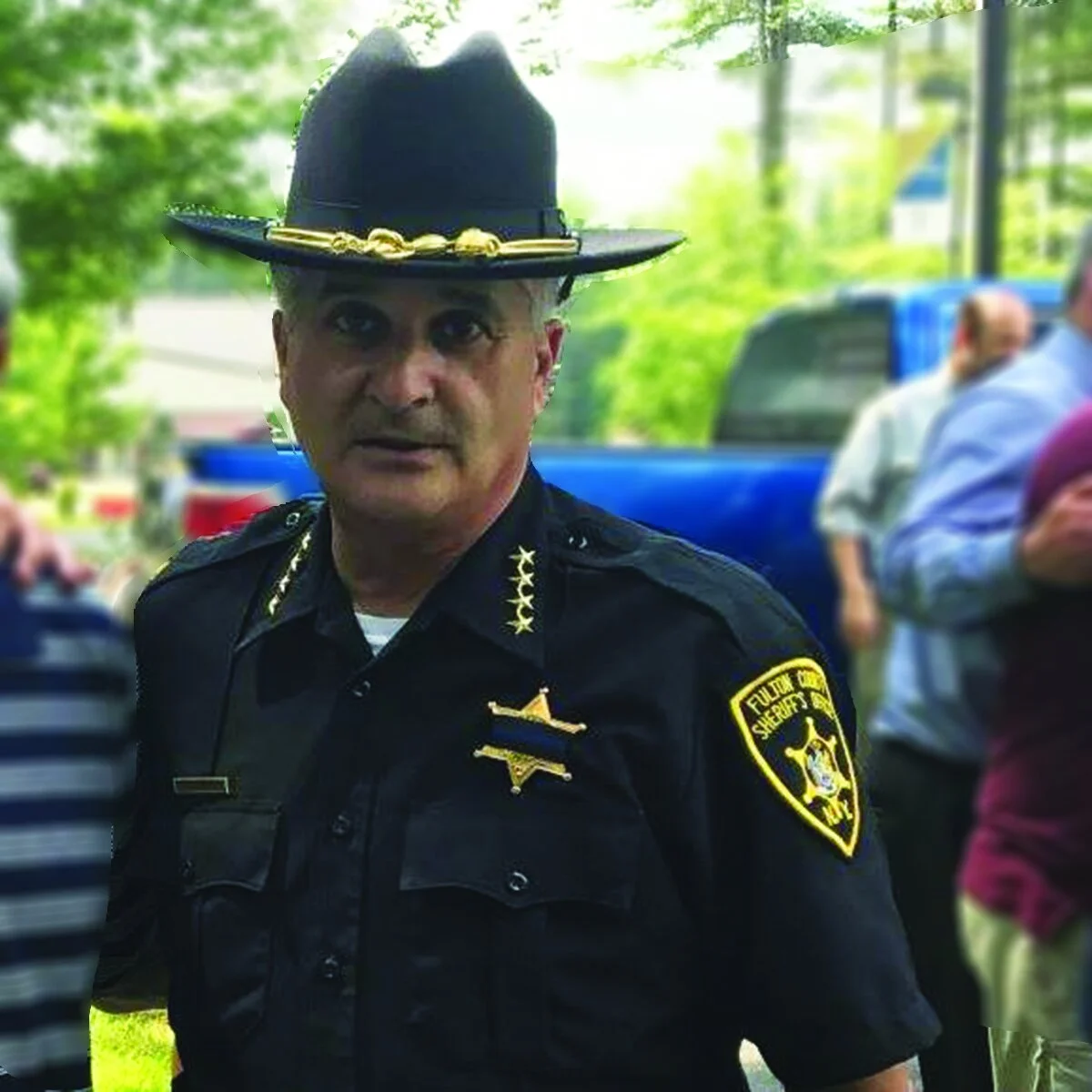
Fulton County New York Sheriff Giardino Interview on Executive Orders, Enforcement and More

Interview by Daniel Del Valle


1123200915e_HDR.jpg

The BLUE Magazine spoke with Sheriff Richard C. Giardino to hear his insights on the pandemic, executive orders, public health concerns and enforcement from his personal and professional points of view.

 The BLUE Magazine: How long have you served as Sheriff?

Sheriff Giardino: I was elected in 2015 and then re-elected in 2019 for my second term.

The first question is, why now? Why would you at this point, because let's go back to when coronavirus started when they closed down the economy. A lot of people at that time felt that law enforcement should not be enforcing these types of executive orders, and because law enforcement rolled over and let things spiral out of control, we've reached a point where the government is telling us how many people we could have in our home. When this first began, were you in agreement to close things down?

No. You have to understand. The executive orders about the number of people, face masks, business hours and separating tables are governed by the State Liquor Authority and the Health Department. They had the administrative duty to set rules and regulations with penalties. So if you are a bar or restaurant or store and do not comply, they can fine you, suspend your license, or revoke your license. So that's all constitutional and set up to balance the Constitution and the public safety elements. So that's why a governor can do those and be enforced by the administrative, right.

So that's why there is no need to speak up. Once, the Governor issued an executive order a couple of weeks ago, splitting and capping the number of people at your home at 10, making you wear masks in your own home that to me was an overreach and unconstitutional. So, I felt that with the number of people who have anxiety and mental health issues as a result of COVID and the number of people who've been bashing the leaders and bashing police for the last six months that it was unconstitutional and not a good use of resources and would further create problems with the community and law enforcement if we went to your doors.

0804201048a.jpg

I live in a rural county, in the Adirondacks, with fifty-five thousand people. I only have three deputies on a shift, so car accidents, domestic violence, larcenies, and everything else takes precedence over going and checking how many people have at Thanksgiving. I don't have the manpower and the practical reason. And second, if you don't let me in, by the time I get a search warrant, Thanksgiving will be over, and people will be on their way. And I don't even know if you can legally get a search warrant to enter someone's house on this executive order because it's not a crime. So that's the reason I spoke up.

So, sheriff, the initial closing down of the economy was therefore justified in your view? In other words, you're separating that from someone being ordered how many people to have inside their homes?

Correct. For a hundred years, the law has been clear, the case law from the United States Supreme Court, that when there's an epidemic or pandemic or medical crisis, then a governor or the president can quarantine individuals in their own house. If they refuse to be quarantined, he can get a court order to put them into a hospital or a facility until the quarantine is over. So that's already been established. So he can issue substantial executive orders. An executive order is not a law, but it can add consequences, and they can set rules for fines and suspensions based on your conduct.

Got it. In your opinion, how likely is a conviction for having too many people in your home on Thanksgiving?

I don't even see making an arrest on this. I don't think you could even arrest someone for having more than 10 people in your house. I don't think you can probably even get a search warrant because you have to say, I believe I have probable cause to believe a crime was committed or an offense. These are not crimes or offenses. These are violations of the executive law. Business is a different thing. They can tell you got close at 10. Now, I can tell you that I don't its smart closing at 10 because I think you are doing three things. You can leave a gym open twenty-four hours a day. You can stagger the number of people, and the time they can be there. That allows for more people to get out of the house, get some exercise, and clear their minds. Two, it provides for employees to be employed and get paid, and three, it allows for taxes to be paid to the government. Those are very valid reasons to keep a gym open. The reasons to close restaurants and bars it's understandable but it's devastating the economy. I'm not in a position that I can advocate for businesses other than to give them my sympathies.

The other thing is COVID is very serious, but we don't do things. We know that 99% of the people who get COVID recover within one to three weeks. We know that the high-risk people, the elderly, the older you are, the more risk to you. We know the older you are that you're more likely to catch it. We know if you have ailments like heart disease, diabetes, you're overweight, or have an autoimmune disease, you're more at risk. So, anybody who loses a life, your family hurts, their friends hurt, and it's sad. For anyone who gets sick, it can be anxiety-producing, pretty nerve-wracking.

The only thing restrictions have caused is a spike in mental health issues, people attempting suicide or debating suicide, a spike in anxiety, depression, and other mental illnesses. So what happens, what I'm afraid of is this. If you have COVID, 99%, you're going to be cured, and you'll be moving on after three weeks. If you have a mental health issue that was exacerbated by this, it will continue for decades or until the end of your life because mental health stays with you. Are you having sleepless nights? Are you drinking more? Are you getting agitated? Are you having a lot of anxiety? So we are creating a lot more mental health problems that will be long term because of some of these orders.

Has there been a spike in crime or domestic violence in your county?

There's been a little spike in disorderly conduct, domestic violence, but across the country, particularly in big cities, there's been a larger spike. Some of it is coronavirus. Mostly are judicial or administrative changes such as bail reform or discovery reform. What's ironic is city leaders, the councils, the governor 'Oh don't enforce this law! Don't enforce that… don't do this, don't do that! And now crime is out of control in the major cities. Homicides are up 50% in most big cities. There's a total disregard of the rules. We had cities where the riots were going on. There were cities where the mayors and the council told the police to stand down. Let them take over the police precinct. Let them burn buildings, let them damage property.

What do you say to that chief today who is enforcing this executive order and not only enforcing it on Thanksgiving but maybe even looking for probable cause, such as a mom buying three turkeys and having two shopping carts full in a supermarket and telling the officers take note because this family might be having a large gathering? What do you say to that chief who has that mindset today?

That chief’s got to make his own decision. Because of my background as a lawyer, and district attorney, and judge, I come from a unique background that I think the system of constitutional law and I taught constitutional law for 30 years, I taught in law school and college. I'm not telling anyone else to doubt my position, but most police have adopted the position they don't have the manpower or the resources or the priorities. So I'm not telling another chief or sheriff what to do. I'm telling people in my community that I trust you as adults to make the decisions. Everybody knows the risk by now. If grandma's sick, don't bring her to your house. If somebody got diabetes or other comorbidities, maybe don't invite them or don't have people come to their house. I'm not. What I'm saying is that it's unconstitutional. What I'm saying is, use common sense, don't invite more people than you need to, and don't invite people if you think you have high-risk people in the room, which is a lot different.

What do you say to the resident on Thanksgiving Day who has 15 people in their home and an officer knocks on their door. What would you advise them to do since you wore many hats in the judicial system?

I'm not going to tell them what to do. That's an individual choice. We can't kick in your door. We can't get a warrant. I would tell them it's their discretion.

What degree of accountability do you believe law enforcement has on what's going on today? I mean, you mentioned people are violating the law with police departments who were backing down and just pretty much allowing lawlessness.

sheriff Giardino.jpg

They are being told to back down by the civilian leadership. So it's not the police department's fault. What most people have been doing with COVID, most agencies in the country have been educating the public, saying you've got to wear a mask, here's a mask, you know you can ask to spread out a little folks. It's too close. They haven't been arresting people. They have been recommending and giving you advice on what to do.

What would you say to the families today who unfortunately lost a family member and friends throughout the world because of COVID? In other words, there's going to be families who have lost relatives and are looking at you, sheriff, and saying, "Sheriff Giordano, How would you not want to enforce this executive order? Look at us. We've lost family members, and there's going to be more people dying because of the lack of enforcement by you." What would you respond to them?

I would say I'm very sorry for the loss of your loved one, but I know the anxiety that comes along with that. So I would tell people that I'm not cold-hearted. I'm making it strictly legal. This is a legal decision based on the Constitution. I would tell them to continue to share small groups, continue to protect yourselves and the rest of your families, and remember that we have to protect the most vulnerable. Most people who get it, it's one to three weeks of inconvenience, and they will bounce out of it, and they will be fine.

Are you afraid of any pushback that maybe you could be charged with not enforcing the executive law? Are you concerned that the attorney general, at some point, can go after you for not enforcing an executive order?

I think that the only one that can go after you is the governor. The governor can overrule the sheriff if he does not do his job. I will be doing my job because I took an oath to the Constitution. So, in my opinion, I'm doing my job by taking an oath to the Constitution. So I don't feel any guilt or anything about, you know, so like can the governor remove me for malfeasance. But I argue that the Jim Crow laws allowed for segregation. I'm sure they felt that they are unconstitutional. And I didn't want to enforce them. Would you tell me, go ahead and enforce them? Or would you say that he's doing what's right. You know, I think it's unconstitutional, and it's impractical to try to enforce it, so I feel two ways. Most would go with the impracticality, which is ridiculous. But I see those as a constitutional issue.

So you're not afraid that you can be charged with conduct unbecoming.

I'm not afraid of anything, but I think if the governor tried to remove me, he'd be making a big mistake.

Has Governor Cuomo contacted you at all?

He's mentioned other sheriffs and me; he's called us arrogant. He said we're dictators. He said we were reckless and irresponsible. And what he's doing is setting us up to point the blame at us if there is a spike after Thanksgiving. But we already know it's going to be a spike because Dr. Fauci said there is going to be a national spike. We know what more people in a confined area, inside with the warmth, are at a greater risk of spreading it. We know that. So I just have faith in the people of my county, to exercise good judgment, to follow the rules and I think they’re adults and can make their decision. I don't have to order them to do so. We have a 1.3 rate as of today, which is pretty low. I don't want to jinx this. But I expect we're going to rise. We're not going to increase as high as everybody else because we've been doing what we are supposed to do.

There are a lot of officers today who are contemplating suicide. Blue Magazine is a big advocate to combat Blue Suicide. What's your perspective on this crisis we face?

The biggest threat to law enforcement officers is suicide and mental health issues. And nothing helps when everyone is condemning the police and saying that the police officer wakes up in the morning wanting to shoot someone.

What's your message to an officer right now who is contemplating suicide? What would you tell him if you had his or her ear?

Get help, talk to your peers. Talk to your supervisors. It's more important that you get help; people understand—your friends care about you. When you commit suicide, a lot of people get hurt that you don't even anticipate. Nothing is so bad that you can't get through with help from your friends and family.

Sheriff, do you have a wife and kids?

Well, no, I have a single life. I have three dogs!

What is your strongest quality you have as a person?

The ability to take my job seriously, but not take myself too seriously.

What is the weakest trait you have?

I make decisions based on facts, and I sometimes come across as maybe a little bit uncaring or not feeling necessarily because I don't make my legal decisions out of emotion. However, I'm very emotional and such, probably because I'm Italian, and we Italians have huge family Thanksgiving, Easter, and Christmas holidays. I also think that some people think that I'm not compassionate. I'm very compassionate. My father was a pediatrician for 50 years, and my mother was a Sunday school teacher and his secretary. And they raised me and my brothers and sister with compassion and understanding. My dad didn't care what color somebody was or what religion or what their politics were. He treated everybody and everybody's kid and treated them like they were his own. So I got my compassion from both my mother and my father.

For all of us that have never really known about Fulton County, what stands out in your department that you would like the whole nation to know?

I want the nation to know that Fulton County is a beautiful place to live in the foothills of the Adirondacks. That people care about their neighbors. We got the same problems as everybody else, you know, with mental health problems, with domestics, with issues. But I think that we have a community that when a neighbor needs help, everybody comes to help. I think that's a very strong marker of our community.

It's been a pleasure. Thank you so much for speaking out. I have nothing but respect for you, sir.

Thank you for interviewing me. Thank you for what you do. Thank you. God bless you.

Dysfunctional Justice System Inflicts Cruel, Unusual Sentences

By Bernard B. Kerik with Rod Blagojevich

Ross_Ulbricht.jpg

At 26 years-old, Ross Ulbricht made history, when he did something that many called genius — he wrote code and created a website called Silk Road.

It was the first modern online free market, where users could anonymously buy and sell goods and services, both legal and illegal.

As a result of his genius, 2020 marks the eighth year anniversary of his federal prison incarceration in what is considered one of the worst travesties of our criminal justice system.

Ulbricht was targeted, investigated, and prosecuted with the zeal equaled to those like John Gotti, Osama bin Laden and Al Capone.

He was ultimately held responsible for everything users listed on his site and was convicted on all nonviolent charges, including conspiracy to traffic narcotics, money laundering conspiracy, and engaging in a continuing criminal enterprise.

Following his arrest in 2013, prosecutors also alleged that he planned murder-for-hire although, curiously, he was never charged or prosecuted for it at trial (and the allegations were dismissed with prejudice by a U.S. District Judge in 2018).

On May 29, 2015, now-retired Judge Katherine Forrest sentenced Ulbricht on five counts, all nonviolent. Her judgement for this first time, non-violent offender: two life terms, plus 40 years without parole!

That sentence amounts to two death sentences, plus 40 years.

At first glance, given the government’s charges and allegations and some media coverage, some may assume that Ulbricht’s sentence was reasonable.

However, having overseen and conducted investigations such as these, the more we examined the overall case — the allegations, the trial, and end result — something just didn’t add up.

If Ulbricht’s crimes really warrant life in prison, why was Blake Benthall — arrested on the same charges as Ulbricht for running the larger copycat Silk Road 2.0 — released after two weeks by the same people who prosecuted Ulbricht?

Why were two corrupt federal agents at the core of the investigation (with unfettered access to Silk Road) aggressively hidden from Ulbricht’s jury?

Why were the largest Silk Road drug sellers sentenced to 10 years and less?

And if there were any tangible evidence that Ulbricht planned murder-for-hire, why didn’t the government charge and prosecute him?

Surely, we’d know all this and more, but no - nothing.

Additionally, based on the prosecutors’ claims, surely, there would have been a two-mile line out of the courthouse of crime victims ready to testify against Ross Ulbricht - but there were no victims at the trial either.

Ross Ulbricht was handed three death sentences, essentially for being a reckless young idealist who had the audacity to use his genius to create a vehicle where others engaged in illegal Internet sales (primarily of cannabis) undetected by the authorities.

No victims were ever named at his trial. He was never prosecuted for causing death or bodily injury to anyone.

Let us say it again. As a first-time, non-violent offender, Ross Ulbricht was given two death sentences, plus 40 additional years.

According to a recent report from the United States Department of Justice, more than half of violent offenders serve less than three years in prison.

The average prison sentence in America for a convicted murderer is 16.5 years.

Convicted rapists serve on average 9.8 years, and violent crimes like robbery, or the taking of property by force or the threat of force, the average time is 4.7 years.

In far too many cases, violent repeat offenders are under-sentenced while nonviolent first-time offenders like Ross are grotesquely over-sentenced.

Ross Ulbricht’s sentence is also an example of how wildly unfair sentencing disparities can be for offenders with similar charges.

While Ross was sentenced to die in prison, every other prosecuted Silk Road defendant received far lighter prison sentences ranging from a high of 10 years to a low of 17 months.

His case may very well be the most glaring example of how broken and deeply dysfunctional our criminal justice system is.

In our American justice system, the underlying philosophy behind sentencing someone to prison is that that the punishment should fit the crime. The United States Constitution guarantees every American equal protection under the law.

But in the case of Ross Ulbricht, who never committed a violent act and who was never convicted of any previous crime, that constitutional guarantee of equal treatment under the law — and that idea that someone should only do the time that fits the crime — is a big lie.

Prominent legal experts who support Ross’s release from prison have expressed the view that the circumstances involved in his case raise serious fourth and sixth amendment constitutional issues, particularly that of using allegations that were never proved in a court of law to support an unreasonably harsh prison sentence.

In fact, in 2018, 21 highly-respected organizations spanning the ideological spectrum joined in support of Ross’s efforts to raise these constitutional issues before the Supreme Court. These organizations include, but are not limited to, Law Enforcement Action Partnership, FreedomWorks, American Conservative Union Foundation, Cato Institute, Human Rights Defense Center and National Lawyers Guild.

Now 36, Ross begins his eighth year in prison.         He has been a model prisoner throughout his years of incarceration, teaching classes and tutoring his fellow inmates. He follows the rules and has never received a disciplinary infraction. Ross has expressed remorse and accepted responsibility for his actions.

He is the son of a loving mother of modest means who has relocated her home several times to be near the prison where her son is incarcerated.

We have each, in different ways, witnessed firsthand how unfair and dishonest our criminal justice system can be. Both of us have been the beneficiaries of President Donald Trump’s compassion.

Commissioner Kerik was granted a presidential pardon, while Gov. Blagojevich had his 14-year prison sentence commuted.

We both join over 350,000 people who have signed their names to a petition to President Trump supporting Ross Ulbricht’s release.

More than 250 organizations and prominent people from all across America — from the legal community, business community, religious community, education community, the media, Hollywood, current and former legislators, and human rights activists, have all spoken out in support of this clemency effort.

The Eighth Amendment to the United States Constitution expressly prohibits punishment that is too severe for the crime committed. It characterizes it as cruel and unusual.

Our nation extols the ideal of justice for all. But Shakespeare reminds us that there is no justice where there is no mercy, and Ross Ulbricht’s case shows us that there cannot be justice for all when there is cruel punishment for some.

We respectfully ask that President Donald Trump do what only he can do: grant Ross Ulbricht clemency, to right this wrong, and end one of the greatest travesties of justice in American history.

Rod Blagojevich served as the 40th Governor of Illinois.

Article courtesy of Newsmax

As New York City’s 40th Police Commissioner, Bernard Kerik was in command of the NYPD on September 11, 2001, and responsible for the city’s response, rescue, recovery, and the investigative efforts of the most substantial terror attack in world history. His 35-year career has been recognized in more than 100 awards for meritorious and heroic service, including a presidential commendation for heroism by President Ronald Reagan, two Distinguished Service Awards from the U.S. Department of Homeland Security, The Ellis Island Medal of Honor, and an appointment as Honorary Commander of the Most Excellent Order of the British Empire by Her Majesty Queen Elizabeth II. Commissioner Kerik hosts a weekly radio show, Behind the Badge, on 77 WABC Radio New York.

COVIDGATE Attack on Informed Consent

By Michelle Malkin

159514871_s.jpg

Patient rights and bioethics are impossible without truly informed consent. This fundamental concept has vanished from public view faster than paper towels and toilet paper from your grocery shelves. Informed consent matters more than ever because we are entering the most coercive era of medical tyranny in human history.

If the public health-industrial complex gets its way, you may not be able to work, travel, shop or go to school without proof of a COVID-19 vaccination. Who needs government to do the mandating when corporations, airlines and educational institutions will do all the dirty work for Big Brother? The unthinking surrender of our autonomy to global pandemic blackmailers is horrific. Can you really offer voluntary and thorough consent at "warp speed" with a figurative gun to your head?

Fact: Our right to self-determination cannot be protected if doctors fail to disclose all risks of treatments. The same holds true in medical research.

Ask yourselves this: In what sane world would we allow children as young as 11 to obtain the COVID-19 vaccine without parental approval — as the Washington, D.C., council decreed last month — while scientific experts are warning us that the adult subjects of COVID-19 vaccine trials were themselves inadequately told of the risks that the jabs "could worsen disease"?

Yes, you read that right. A review of COVID-19 vaccine protocols published in the October issue of the International Journal of Clinical Practice determined that an alarming phenomenon called "antibody-dependent enhancement" — which could worsen COVID-19 — "was obscured" by vaccine manufacturers. Timothy Cardozo of the New York University Langone Health and Ronald Veazey of the Tulane University School of Medicine concluded that the vaccine-enhanced disease risk "should have been prominently and independently disclosed to research subjects." The reckless omission "obviate(ed) truly informed consent."

Indeed, vaccine researchers hid the ADE risk "last or next to last" in their clinical trial consent forms and downplayed the risk as "theoretical," when evidence of the risk is in fact "non-theoretical" and "compelling." Burying adverse effects in the fine print is standard operating procedure for Big Pharma. It's exactly what they'll do with the package inserts for the shots, too. Speaking of which, did you know that the FDA's draft list of "adverse event outcomes" for COVID-19 vaccines includes: stroke, convulsions/seizures, transverse myelitis, encephalitis, narcolepsy and cataplexy; acute myocardial infarction; autoimmune disease; Kawasaki disease, Multisystem Inflammatory Syndrome in children, arthritis and joint pain; myocarditis/pericarditis, venous thromboembolism, other acute demyelinating diseases and death?

I'm sure D.C. grade schoolers will understand all that and be able to fathom the impact of Big Pharma's immunity from vaccine lawsuits. For true informed consent, they must also be made aware of the National Vaccine Injury Compensation Program's payouts to the vaccine-injured of more than $4.4 billion since 1989, not to mention boning up on the 30 different genetic mutations of SARS-Cov-2 and the troubling "inflammatory component" identified as "intrinsic to all mRNA vaccines." The kids also can't be fully informed without knowledge of the adverse outcomes reported by trial volunteers on Facebook, where screenshots I obtained showed members complaining they were "unable to lift anything" after their jab, experienced arm pain for several weeks, felt like they were "beaten with a baseball bat" and endured hours-long vomiting.

As the FDA prepares to meet Dec. 10 to consider emergency use authorization for the Pfizer vaccine, I urge free-thinking Americans to read two expert petitions calling for suspension of all COVID-19 clinical trials in both the U.S. and in Europe. One co-petitioner, Dr. Michael Yeadon, happens to be a former vice president and chief scientific officer at Pfizer Global. He and his fellow signatories warn about the unreliability of rapid COVID-19 testing (RT-qPCR). They also amplify points made in my previous "COVIDGATE" columns about how the clinical trial design does not measure whether the vaccine actually prevents virus transmission or reduction in severe illness or death.

Wait, there's more.

Yeadon and his co-petitioners raised red flags about two additives in Pfizer's vaccine: polyethylene glycol (against which 70% of people produce antibodies that could provoke "allergic, potentially deadly reactions") and mNeonGreen (a bioluminescent ingredient derived from a marine invertebrate "of unknown antigenicity"). They also warn of potential fertility-specific risks involving antibodies against "spike proteins" that could disrupt development of placenta in vaccinated women. It is "unclear," Yeadon and his co-petitioners observed, "what if any instructions/information" that clinical trial subjects received regarding the risks of ADE, allergies, or infertility.

Still more: In response to Part Two of my series on blabbermouth crusaders informally unblinding themselves online, Dr. Peter Doshi, associate editor of the British Medical Journal, told me he is "quite nervous" that zealous research volunteers who believe they got the placebo will engage in "formal unblinding" by bailing out of ongoing experiments to get the vaccine. Thus, "the trials will not contain a placebo arm for enough time to learn where the vaccines can reduce the risk of serious outcomes like ICU use or death - what any real life-saving vaccine should be able to demonstrate."

The more you know, the clearer the choice: Do not consent.

THE BIG PICTURE OR COMPARTMENTALIZATION?

By: Joel E. Gordon

84854153_s.jpg

“In order to properly understand the big picture, everyone should fear becoming mentally clouded and obsessed with one small section of truth.” –XunZi

In psychology, compartmentalization is defined as a defense mechanism where someone suppresses their thoughts and emotions. It is not always done consciously, but this can often justify or defend a person’s level of engagement in certain behaviors.

There are serious disadvantages that come with compartmentalization such as becoming disconnected, isolated and emotionally unavailable. And compartmentalizing is often a tool used by individuals who engage in deviant behavior or actions outside decent and acceptable norms.

Can there be benefits to compartmentalization? Yes … A law enforcement officer, for example, may have a family that depends on them at home, but they must rush into life-threatening situations without hesitation. Being able to compartmentalize those two realities is what facilitates the ability to perform under intense pressure.

I believe one of the biggest problems facing our society today, however, is the compartmentalized thinking that we are seeing on a regular basis which is done without regard to how our decisions impact the bigger picture.

Look at all of the negative consequences of police defunding, such as lowered morale and the overworking of our brave men and women through tunnel vision for “reimagining law enforcement” in the name of social justice. Crime rates go up and safety takes an unnecessary nosedive.

COVID-19 shutdowns have largely contributed to business failures, increased rates of unemployment or underemployment, depression, substance abuse and suicide. Did the risks of shutdowns justify themselves through lower transmission rates of this serious illness during this pandemic? There are many schools of thought on this but it has certainly been a hefty price to pay.

Where did all of this limited thought begin? I have witnessed within our educational system the tendency to isolate subject matter so that it stands on its own without a complete view of cause and effect. Too many have been indoctrinated into a compartmentalized way of thinking, and now they as individuals seem truly oblivious to the reality of so many resulting unintended consequences.

In this day and age of specialists and professional specialization, for example, many only are able to focus on a singular area of expertise. Rarely do practitioners see the problem within their specialty as a symptom of a larger problem, making it virtually impossible to see the big picture.

Sometimes this ridiculousness is truly absurd. While general manager of the Alpine Lake Community atop Snaggy Mountain in snowy Terra Alta, West Virginia, I once had a discussion with a resident who was a nuclear physicist by profession and was involved in the design of nuclear power plants. He was complaining about icy roads within the resort over a particular winter (40 miles of roads traverse the 2,500-acre resort and residential community). Terra Alta routinely experiences 200” of beautiful white snowfall annually and even recorded two inches of snow one year on the fourth of July! I found myself attempting to explain the process of melting and re-freezing to him with temperatures above freezing during the day and snow melt re-freezing overnight. I finally said that my then-5-year-old daughter understood taking an ice cube out of a freezer, letting it melt on a counter, and then putting the liquid back into the freezer would create ice. I don’t believe he ever understood what I was telling him. A common sense thought process lost? How scary is it that this man was designing nuclear power plants and failed to understand a simple concept outside his way of thinking?

As we continue moving forward, if we can open our minds to the bigger picture in the world around us, I believe that bad decisions and injustices will be difficult to come by. If we can just stop compartmentalizing thoughts, we can improve our lives and livelihoods as we work toward the common good. Let’s all reflect on moments in our past and current experiences, as it would behoove us to identify how we ourselves compartmentalize.

As we move into 2021 and beyond, it’s time that we all work to see the big picture.

Children Suffer Without Strong Families

By: David Willoughby

149988198_m.jpg

The word “change” has been pounded into our brains and seems to rule the headlines. Protesters, politicians and the media are all screaming for “change”. But exactly what kind of “change” are people looking for?

I know … an end to “systematic racism and police brutality within the criminal justice system”. That seems to be at the top of the “change” list. But should it be? According to the people I have interviewed, racism and police brutality are not the biggest threat to the Black community.

Don’t get me wrong, we have all seen videos of police officers abusing their power. This is wrong and these officers must be disciplined. That absolutely does NOT mean that all police are racist or abuse their power. The vast majority of police are not racist and take great pride in protecting the very communities in which they work. That needed to be said.

Let me get to my point.

As a former youth corrections officer (YCO) for the Milwaukee County juvenile detention center, I was often staffed in a unit where every single child being held was African American. Most children, who are picked up and brought to the facility, are African American. This bothered me. So, I started to ask questions and conduct research as to why? Were the police targeting African Americans? That seems to be a common idea in many African American communities. Or are they targeting law breakers, regardless of color?

I developed good rapport with most children, which didn’t take long because many craved the opportunity to simply talk with someone who cares. Let me tell you something, these kids spilled their guts to me. I found myself teary-eyed on more than a few occasions because of their circumstances.

In October 2018, I was chosen to attend a two-day “Juvenile Corrections Officer Conference” in Central Wisconsin. Social workers, youth workers, counselors, community program staff, law enforcement officers, school administrative and support staff, juvenile court personnel, probation and parole staff, corrections officers, attorneys and others from around the state were in attendance.

Guest speakers talked about their programs and how they related to the juvenile justice system. I learned a lot about different resources, but I was anxiously awaiting to hear from someone with real solutions. At one point, a female social worker from Milwaukee, got most of the audience to repeat the following phrase several times: “Kids aren’t the problem, racism is the problem.”

Towards the end of the conference, about 20 young adults, ages 19-23 (mostly African American) who personally experienced juvenile justice took the stage. They talked about their experiences within the system. Then, the moment which I had been hoping for finally happened …

The host of the conference asked them: “What did you need, as a juvenile, that would have would have kept you out of the system?” Overwhelmingly, they responded: Support. Each one stated that they came from broken families where dad wasn’t present, or mom wasn’t present, or both parents were not present.

Not one person on the stage said anything about racism, or police brutality. I quickly looked around the room for the speaker that had everyone chanting “Racism is the problem.” I didn’t see her. Too bad.

Out of wedlock birthrates for African Americans in the U.S. is rapidly approaching 80%. Pre 1960s, the rate was closer to 20%. Research has shown that children raised without both parents’ involvement are more likely to drop out of school, exhibit behavioral problems, end up in the criminal justice system, suffer unemployment and are at greater risk of substance abuse. Without both parents’ support, kids are five times more likely to live in poverty and commit crime, nine times more likely to drop out of school and 20 times more likely to end up in prison. Don’t believe me? Look it up, or visit your local juvie and conduct your own research. I’m confident the results will be the same for you.

The biggest threat to the Black community is not racism or police brutality. However, the voluntary abandonment of children by their fathers in Black America just might be. Some Black men have abandoned their moral and financial responsibilities and children who are our most valuable resource pay the price. Ultimately … the community suffers.

We need dads to step up. We need strong Black families to produce and raise strong children. The answer is not always “racism.” Rather than de-funding or disbanding our police departments, how about we get to the root of the real problem? Kids need fathers and a strong family to teach them to stay out of trouble and out of the criminal justice system.

I am ready for “change” and want to help. Let’s make Black families strong again.

How to Get the Most from Your Officers

By: Lt. James Rotundo

The age-old question when it comes to leadership is how do leaders get subordinates to fall in line and do the things they want them to do? The answer is simple.

You never will.

37108528_s.jpg

You will never please everyone who works for you.

Once you understand this leadership fact, you will have clarity and can reward the ones who deserve rewarding. When great leaders find that, say, 95% of their subordinates fall in line, it becomes a downfall to focus solely on the 5% outliers. Build upon strengths and the outliers will eventually fall in line, too.

Of course, leaders constantly face challenges. There will be subordinates who feel slighted. There will be subordinates who feel forgotten about. There will be subordinates who will be jealous of other officers’ accomplishments or accolades. But this doesn’t mean you can’t obtain great and worthwhile work from everyone. Let’s have a look at some good and bad motivational techniques you can employ to get the most out of your officers. In this article, I encourage you to question yourself, and some of your go-to motivational techniques. Leadership can be a part science and part art.

Fear: You could choose to motivate with fear and instill a feeling of worry of sanctions such as losing their job, writeups or tongue lashings to make your subordinates fall in line and do the jobs you tasked them to do. I want to stress that this is by far the WORST way to motivate anyone. You will get the bare bones from your officers, as well as create an atmosphere of upset and angry people. In fact, you will see a dip in production; a rise in sick time usage, and overall fewer officers will perform the job to the best of their ability. Sure, tasks will be completed, but at what cost? Everyone knows the consequences of not doing our job. It doesn’t need to be held over their heads like a guillotine. Quite honestly, the ones who choose this route of motivation do this because they were never skilled enough to be a leader in the first place to understand what this would do to the work force.This motivational “technique” is plain wrong, incredibly insensitive and a recipe for complete departmental collapse.With your officers on edge all the time the effect could cause arguments between them lowering morale. On the other hand, officers might band together ... for a vote of no confidence against you.

Money: Ah money, the great motivator! Or is it? You could pay them more money to do a certain job you tasked them to do. The problem with this is that after a while, they will want more money to do the exact same job. If they don’t receive the pay raise they think they deserve, then production will surely decrease. Pay should be fair and equitable considering the task at hand, but not the sole motivator. In private sector careers, money could serve as a better motivator in the form of sales commission and bonuses, but in a public sector career such as law enforcement, the option to pay more is solely in the hands of the governing body. Even in private sector jobs that use this technique, problems could arise such as employees fighting between themselves for a sale. In a perfect world, if the right motivation is implemented correctly, job performance will rise exponentially and pay will rise with it.

Positioning: The act of putting your officers in certain positions and specialties they want to and should be in. This is my personal favorite motivational technique that is often overlooked by many leaders. How do you find out what your officers want to do? Just ask! It’s a simple concept, but many bosses simply don’t take the time to ask their subordinates what they want to do. Why? Because they are the boss and they think know better. But therein lies the problem. Most officers with some time on the job know what part of policing they enjoy more and are better at than other parts. Officers will flourish in positions and specialties they like and are important to them. When someone is excited about the specialty they are in, they tend to learn more about it. Their work will be better because of it. This, on a department-wide level, raises the bar of the department. Encourage officers to share their knowledge with other officers. Informational emails to the department from these officers could help serve as quick reference to officers in the field. Promoting this, officers will gain confidence in each other, in turn creating an environment of much higher morale and less mistakes.

An issue that could arise with this technique is the fact that in many departments these jobs are at a premium. Not everyone who wants to solve major crimes in the detective bureau, or wants to only write summonses in the traffic enforcement squad, or longs for the days they could ride around with a beautiful German shepherd with a K-9 sticker slapped on the door as their first choice, will be able to be assigned to those limited positions. Those officers will have to express their desire to work in another specialty, but should be considered when training is offered, and a position opens up in their most desired choice. While the limits of the amount of positions creates a problem, it also offers an opportunity for officers to work harder in their assigned field as a way to prove they could be a fit in their most desired field, when the spot is opened up. It also offers opportunities for you to create new specialties the department may have been lacking. An added benefit to this is that officers will feel heard and know where they fit in the bigger picture of the department.

Officer/Leadership Development: This goes hand in hand with positioning. Give your employees and leadership the tools to prosper. With your officers in positions that are important to them, they are going to need the education and support to help them do their job. Enroll your officers in classes and allow them to suggest classes they wish to take. It is a significant factor in motivation for your officers to be confident in their knowledge of their tasks in this ever-evolving career.

The importance of your lower-level leadership should not be underestimated. They are your voice and implementers in your motivational program. They should be guided, not just for the position they are in, but for leadership positions to come. Be open to questions and offer advice and provide constructive criticism when needed. They are also the future command of the department, and a delay in a qualified officer filling an open position could cripple a department for a period of time. Once they are trained and have experience of their position as a front-line supervisor, they should begin training with their superior in the position above them. Encourage your leadership to share their knowledge of their positions with their subordinates. Doing this will help tremendously in the event a supervisor misses time for any number of reasons. Also, when the time comes for them to fill the shoes of their supervisor, it’s not overwhelming. The idea here goes past police work and toward future functionality of the department. I see this most helpful when the task at hand goes beyond regular police work and enters budgeting and scheduling.

Motivation of your officers boils down to the kind of business we are in — the people business. Relationships with your subordinates matter. Empathy to their wants and needs that you could provide matters. A clear direction and plan for your employees matters. My last piece of advice is, if you are ever in a bind on what to do to, think about what you wanted when you were the patrol officer with a desire to get the most out of your career. Think about the things you disliked most in leaders you had. Think about the things you loved in other leaders you have served under. Think about the decisions they made that affected you directly and how they affected the officers around you. Don’t forget where you came from. The answers you are looking for are usually in your feelings and knowledge of your past. Look to make the environment of your department a place where officers want to want to come to work, where officers look to each other for the answers to their questions, and where opportunities to grow as an officer and a person are available.

The suggestions above take commitment, it takes trust, and it takes knowing the officers who work for you. Rome wasn’t built in a day, but it sure toppled pretty quickly when its leaders bred low morale in its ranks, became comfortable with the status quo and stopped working toward the future.

Remote Police Training- Value added or a temporary fix?

By Lt. Joseph Pangaro

143770411_s.jpg

There was a time when the biggest concern a law enforcement officer had about training was if the instructor would bore then to death with a PowerPoint presentation and a droning voice for eight hours. 

Now, thanks to the COVID-19 pandemic, and its attendant lockdowns and shutdowns of in-person training options, we all get to sit in front of a computer screen for eight hours and do our best not to have our kids or pets walk into the room, or have our spouses yelling on the phone or participating in an online meeting of their own as we try to avoid death by video PowerPoint. The question then is clear; is this new world of remote, online training a value to us or is it just a temporary fix to a challenging situation?

The answer, from what I can see is a very simple … it depends.

It depends on who is doing the training, the topics, and how the classes are taught. All of these individual pieces of the puzzle will determine the quality of the online program, how interesting and engaging it will be and if the vehicle will have any longevity.

Let’s start with the instructor. If the instructor was a boring presenter during live training events, it’s a fair bet to say they will be even worse when it comes to presenting remotely online. That just makes sense. You can make lemonade from lemons, but if they are bitter lemons they will be hard to swallow no matter how much you mix them up.

The key here for online instructors to be successful is to always keep the student or audience in mind when preparing the class, using the right equipment to present and choosing the best digital platform to teach from.

My training company, True Security Design / Pangaro Training took this challenge on at the start of the COVID crisis. We saw the coming need for adapting to the changing environment and providing a dynamic alternative to replace the in-person training we have all become used to.

To do that we focused on these points for the instructor:

·      Be energetic and enthusiastic, upbeat and positive.

·      Ensure you engage the at-home audience by including them in discussion and question and answer periods.

·      Create interesting interaction segments in the training so they are not just sitting at home staring at the screen.

·      Make it fun by addressing the new dynamic and asking about any difficulties they are having with the format and explain the situation from the instructor’s point of view as well.  

·      Understand the platform you are using and spice up the presentation with videos, diagrams, pictures and other media to make the program visually stimulating. Being sure you know how to operate the features of the platform is crucial, so you don’t have delays or “dead air” as you flip between media.

·      Conduct a survey after each class to learn how you are being perceived and how to improve your delivery.

·      Take a presentation course if you haven’t already done so.


Next, let’s talk about the equipment we use to present online remote training. The right platform is critical as well as the cameras, speakers and monitors you use so your at-home students can see and hear you clearly. A slow platform or one with only a few features will limit your ability to be creative and make for a boring presentation.

A quality camera with a wide field is important so the audience can see you, your inflection and passion as you teach, just like a live in-person audience can. I use role-playing actors in many of our classes. Good cameras will bring that remote role play aspect to life and make for a good class.

Choose good media to add value to your program. Online remote training is a hybrid presentation that should combine live interaction by the instructor with multi-media to enhance the experience, think of yourself as a TV talk show host, teacher, video producer and director all at once. There are many elements to creating a good class that people will enjoy and learn from.

When it comes to the topics we can present successfully remotely online, we must consider our own abilities to present, our understanding of the material, our creative skills and most importantly our desire to create a great program.

Conducting a crime scene investigation course can be very difficult to pull off remotely online because of the hands-on nature of the crime scene work we are trying to teach. Things such as latent fingerprint dusting and lifting, evidence identification and recovery, crime scene photography and interview skills are difficult enough to teach and present live and in-person and almost impossible via a remote online program, but it can be done if you plan and execute it right.

The key is understanding how to make the students feel connected to the program, how they can participate in any skill development from their home and have success at it.

Here are a few planning items to do a class like this:

·      Provide a written guide for each skill taught in the form of a manual or booklet that the student gets before the class to become familiar with the skill.

·      Provide a list of materials the student will need to gather before the class, so they are ready to go on class day. These should be things like fingerprint kits, lifting tape and items to dust (Soda cans or envelopes etc.).

·      Be prepared to spend time with each student as they practice a skill remotely, that means having things for the other students to do as you work your way through the class.

·      Consider how many assistants you need to do this and if you can use “breakout rooms” on the platform you chose.  

·      The use of role players and how they will interact with the students, as a group or individually.

These things take a lot of prep work, but if you give them the due diligence they deserve, even a difficult class like crime scene investigation can be taught remotely. Besides, that might be the only way we can teach this for a while, so finding creative ways to teach is the goal and responsibility of the instructor.

And finally, for this piece let’s talk about how we teach remotely. Making the topics engaging and valuable takes effort on the part of the instructors. We have to look at this as an opportunity to continue to provide the officers we serve with quality training that will make them better at what they do and better able to serve the public we all sworn to serve.

Being an engaging personality can be confused with being funny or entertaining. Those aspects are important for a good presentation, but they should not be the main focus. Passion is the thing that makes a remote, online training program successful. Passing on our knowledge, skill and experience can come through in-person or remotely if we are genuine in our desire to teach.

Since this COVID era began, we have taught over 300 remote students in groups of 15-25 at a time. We are at the beginning of this new world of training and I have decided that it is an important process for law enforcement and many other industries for that matter. I took my energetic and passionate live performance to the remote world and so far it has worked. 

We conduct surveys after each class, and so far the reviews have all been great. The students say they have been engaged and felt like part of a real class. That is not easy to do, it takes all of the energy I can muster each and every class, but it is worth it. If you are going to conduct remote training or send your officers to remote training you should consider the positive aspects and how it will help your officers and agency.

Chiefs have said that COVID lockdowns aside, they like the idea of remote training because their officers don’t have to travel, they aren’t on the road for hours driving to and from a class, and they still get the training they want their officers to have. The students have said they like remote training for the same reasons and many of them have taken the training from the comfort of their own houses.

As I see it, remote training will be with us in law enforcement for a long time after the COVID threat passes us because it is the wave of the future. We are all online and living in a digital world. Police training is vital for the officers and the communities we serve. Bringing it to them in a convenient way like remote, online training is innovative and serves us all very well.

It all depends on how it is delivered, who is delivering it, and what we want to get from it. Using the guide points I listed should help you going forward to create great training or find a great trainer for your officers.  Either way, remote online training is the new paradigm and we should all embrace it!


THANK YOU FOR SAYING I’M ONE OF THE GOOD ONES, BUT I’M NOT THE ONLY ONE

By: Deon Joseph

deon jospeh.jpg

In recent Facebook posts, where I try to bring logic and reason to an emotionally charged issue, I usually get this response “Yeah, but you are ONE of the good ones.” or “You are one of the rare ones.” I truly appreciate the love and complements. I really do. But the fact is there are thousands of us. They may not be as vocal or well known, but throughout my career, I have worked with some of the most caring police officers to ever wear our badge.

After a civic leader dehumanized my fellow officers, I tried everything in my power not to respond. But when I looked back on my 25 years of service. I thought about the incredible men and women I have worked with in three parts of the city I serve.

I thought about my early years. My training officer was a white man who was loved by a black community in Venice. He was almost worshipped there for his dedication and fair treatment of them. He is the man who showed me that you don’t have to be an asshole to be a cop. And that people of color understand we have a job to do, but just want us to treat them with respect when we do it. His name was Bill.

Another training officer, a thin white woman from the LBGTQ community who in the heat of a tense moment with a violent mentally ill person three times her size, told me not to shoot the woman, who wrestled with her over a large knife she tried to kill herself with. She did everything she could not to shoot her, though she had every right to and should have, especially after her gun fell out. She spared her life nearly at her own expense. Her name was Vicky.

Then there was a Black training officer who defused incidents by his mere presence. He was professional and respectful. Before you called it de-escalation, we called it verbalization (it’s nothing new, most of us have been doing it). He was a master at it. His name was McCool.

Another white training officer had a suspect cursing at him when he showed up, but had them laughing in tears by the time he was done booking them. His name was Officer Goode. He used humor to diffuse situations and never lost his temper.

I then came to Skid Row, and worked with a cop nicknamed Batman. Who showed me that my muscles would not save me when dealing with troubled communities but respecting them, while at the same time taking no shit from them, would. He taught me to slow down and talk to people even at their worst. His name was Officer Greg Bateman.

A classmate of mine of German descent who wore her heart on her sleeve, who prior to me making my mark on Skid Row, laid the foundation for an initiative that would save countless lives among the homeless. She never sought honor or recognition. I learned from her to come from the heart. Especially if it was made of gold. Her name is Kathy. She also helped veterans and held community meetings with the homeless in the street.

Two Black officers who made 257 felony arrests in one year, they took guns and large amounts of drugs from Skid Row hotels and still had the respect of the community. They were Officers Fierra and Prude.

An East Side detail officer and his entire unit, who had the worst job in the city, trying to improve the quality of life in Skid Row with impossible odds. Everywhere I patrolled all I could hear from the community was “Where’s Earl?” “Is Earl here today? Please tell him we said hello.” His name was Officer Earl Wright Jr.

I then worked one of the most dangerous areas in the city for a year. I was a juvenile investigator. People were dying nightly from gang violence. While some of the hardest-working officers on Central Avenue were trying to stop the constant bloodshed, I was partnered with two Hispanic officers who took me under their wing at one of the worst times of my life personally and we rescued more missing children than I could count. They were Officers Juan and Frank.

I came back to the Row again, and became a senior lead. There I worked with an officer who helped families in the projects get financial assistance. His name was Officer Mike Fernandez.

As time passed, I found my own calling. I helped house homeless people, mentored children and tried to empower homeless women on Skid Row, while simultaneously reducing crime using my heart more than my handcuffs, and helped make a place no one thought could ever be safe, safer. When I began losing the battle, 50 of the hardest-working men and women I ever saw helped bring sanity to a place that could easily be compared to Dante’s Inferno.

A legendary foot beat officer named Lenny stood on one of the most corrupt blocks in downtown and warded off drug dealers, and violent criminals by his presence alone. No officer stayed dedicated to the Main Street beat like Junior Davis did. The community loved him and they still miss him to this day.

Another incredible SLO who is trying unique and dynamic things to bring communities together in love and peace is a blonde white office named Julie Nony. Her ideas to build trust are incredible.

Several Black officers have taken mentorship to a new level, as they created a mentoring program and football camp for at-risk youth in one of the most dangerous parts of the city. The Watts Rams to this day are exposing Black youth to the reality that they can rise above adversity and live their dreams

Another white police officer who always finds a way to save the lives of people of color. Whether it’s stopping a woman from being strangled to death or delivering babies in the street, this man has a fire in him to help people. I’m proud to call Officer Popham a brother in blue.

Several patrol officers who embraced community policing over three years, rescued children and kept the dam from breaking in Skid Row as the unit assigned to that area was depleted due to injuries. Officers Linnear, Tapia, Brunsen, Hernandez, and another who later promoted and went to South LA and earned the nickname Dr. King for how he championed of a community in south LA. His name is Sgt Delano Hutchins.

My twin brother Cleon Joseph was in charge of a community relations office. He reinvigorated his unit to buy into dialogue with the community.

And currently, I work in the greatest senior lead office in the city, with twelve of the greatest officers, who drop everything with their busy schedule to engage in Trust Talks with the homeless community and open their hearts to them.

I can go on and on. These officers from all walks of life and so many others go above and beyond for their community with no desire for recognition.

Before any civic leader dehumanizes us to pander to people, they should open their minds to the reality that we save far more lives than we take, and share that with the public. Build more relationships than we break. We are not what you say we are.

If you told the public about us, maybe they would know that the honorable rule is just that, that they do not have to fear us when something happens hundreds of miles away and that most of us are doing the right thing.

Yes I acknowledge there is a negative exception, but that’s in any profession. Don’t ask me to judge you by the content of your character (which I always will no matter what), then turn and dehumanize me based on our surface.

If today’s media showed you the thousand of officers who care just like I do, you wouldn’t be so quick to judge us all when a select few fail us all. 

We Remember Police Officer Danny Faulkner 4699: EOW 12/9/1981

By Kirk Lawless

There are two names I hate to see in print, Wesley Cook (AKA Mumia Abu-Jamal) and Colin Kaepernick.

Daniel Faulkner.jpg

Colin Kaepernick, former football player-turned-political-activist is getting attention again with his racist, rabid, anti-police agenda, by calling for the release of Cook, a convicted cop killer. Why anybody gives Kaepernick any press is beyond my comprehension. To me, he is nothing more than an un-wiped ass (and anyone who knows me knows I would say that to his face). 

I try not to use Cook’s made-up name. I suppose it makes him a more colorful and exotic figure to rally behind and I will deny him that pleasure.

Let’s start with Wesley Cook, convicted murderer. On 9 December 1981 at 3:55 p.m., near the intersection of 13th and Locust, Philadelphia Police Officer Danny Faulkner, badge 4699, curbed a vehicle driven by William Cook, Wesley’s brother. The roadside encounter turned physical and Wesley, then a cabdriver, exited his cab and went to the aid of his brother, (as brothers often do). This was not a normal intervention. He did not try to separate his brother from Police Officer Danny Faulkner or attempt to calm the situation. He could have joined the physical melee in an attempt to help his brother get away. 

Instead, Cook ran up on the scene, produced a five-shot Charter Arms revolver, and shot Faulkner in the back four times. Danny Faulkner was able to return fire, striking Wesley Cook in the abdomen. As Faulkner fell to the cold, cruel Philadelphia sidewalk, Cook stood over him and fired his fifth and final round into the face of the young officer, killing him. Cook had just made Maureen Faulkner a police widow, and himself a cop killer. Cook also collapsed on the sidewalk near the young officer’s body. Faulkner’s bullet, while not finishing off Cook, kept him from escaping, and he was arrested where responding officers found him. Cook was wearing an empty shoulder holster. The revolver used to execute the young police officer (who was just twelve days shy of turning 26), was recovered near Cook. There is, as we say, a P.S. regarding this revolver that contained five spent shell casings: It was registered to Wesley Cook.

Ironically, this article was delivered to the editor on what would be the 39th anniversary of the murder of Faulkner. I remember this murder and will never forget it. Nor will Maureen Faulkner forget being robbed of her young husband, nor Danny’s police family, another void in their roster to be filled, but never replaced.

There is more to Cook than he was “just a cabdriver, who happened to see his brother fighting with a police officer and got involved.” He was a member of The Black Panther Party (BPP) and had been recruited into the terrorist organization at the age of 14. The BPP was responsible for the murders of some 35 police officers nationwide and the injuries of many more. Cook was born in 1954 and was close in age to the police officer he killed. He was indoctrinated in the BPP mantra of hate and racism, particularly when it involved the police, especially white police officers, but it did not discriminate. They had proven their willingness to erase black officers with equal zeal.

I hope Colin Kaepernick reads this, so he can learn some things about his newly discovered “victim of the system and political prisoner,” Wesley Cook. Note the lack of the words alleged or allegedly. There will be none of that. Why? Because, he did it! He is a murderer. A racially mixed jury convicted Cook. That same diverse jury handed down his death sentence and it didn’t take them long to reach that decision. The good people of Philadelphia had weighed the evidence, and sentenced Cook to die for the murder of Police Officer Danny Faulkner.

Oh, how the word spread about this “brilliant man, who was wrongly convicted of this terrible crime,” and now languishing on death row, a political prisoner. Folks of “celebrity” status rallied behind him. Liberal Hollywood types chanting “Free Mumia” because all the “cool kids” were doing it became all the rage. Money poured in from around the globe to support this murdering cop-killing savage, including some folks from the East Coast who make over-priced ice cream. It was a good marketing strategy. The support of a business openly promoting a cop-killer sold lots of ice cream to lots of liberal under-informed fools. It’s doubtful that the folks in Hollywood were making bank by supporting this POS, but it provided them with a little face time.

It did promote Cook to instant celebrity status. Publishers clawed at the door of his cell on death row to publish his books. He was allowed to broadcast radio shows from prison. He was invited to give a commencement address to graduating students from a high-dollar university. Thankfully, opposing students excused themselves from the ceremony or turned their backs to the speakers to express their disdain. Can you imagine, a convicted cop-killer speaking at a college graduation. What sort of wisdom could a murderer give to new graduates? “Get jobs. Don’t murder anyone. Eat your ice cream!”

Cook, with the support of his followers, continued to appeal his death sentence (he had nothing but time) and in 2011 now age 57, his wish being granted, he was released from his cell on death row and his sentence was commuted to life without parole. But his situation had some loose strings. A death appeal would mean a new trial. Memories faded, witnesses died, and the hellish nightmare would have to be played out again for Maureen Faulkner and the rest of Danny’s family at a new trial. The District Attorney Larry Krasner approached Maureen Faulkner with a compromise. If she agreed to life in prison without parole (meaning Cook would die in prison) they could avoid a lengthy trial that would probably have had the same results. Maureen Faulkner agreed and it appeared as though “that was that,” but apparently, not so. Krasner did the ultimate double-cross and has helped set the stage for Cook to get a new trial. 

Enter Colin Kaepernick, born in 1987, nearly six years after Danny Faulkner’s murder. Now Colin thinks Cook should get a new trial, and the papers let him talk about the “injustices,” the murderer has endured. Cook has successfully sued the department of corrections because he claimed he received inadequate medical care while in custody. He also sued and won the case that allows him to make money from the sales of books, interviews, so yeah, let’s talk about the injustice.

Cook is now 66. Danny Faulkner should be retired off the job, but instead he’s dead, and has been dead longer than he was alive. 

Colin Kaepernick has proven himself to be a racist, cop-hater. He played a big part in all the racial turmoil since he “took a knee.” He has blood on his hands, police blood, and that includes (after the fact) the blood of Police Officer Daniel Faulkner Badge 4699 EOW 9 December 1981. 

If Cook gets a new trial, I hope he gets the death penalty again and they fast track it and I get to see it. I’ll be in the front row with popcorn. 

Colin could redeem himself if he’d start to use some common sense and throw in behind a worthy cause (or causes) instead of getting my brothers and sisters shot and killed. If he’d like to discuss this issue with me in person, I’ll gladly make myself available. I’m easy to find.


Law Enforcement’s Dance with the Devil

By: David A. Clarke Jr., Sheriff (Ret)

I am watching sometimes in stunned disbelief as police executives order front line officers to participate with state governors, local mayors and administration officials as they use the heavy hand of government in enforcing questionable rules concerning the coronavirus. It’s a game of Russian roulette. Oftentimes it doesn’t end well.

 Law enforcement officers have only one remaining support group in the United States of America and it is the law abiding public. This profession has experienced over the past five years an unprecedented onslaught of hate and physical attack from cop hating groups like ANTIFA and Black Lives Matter. A host of politicians have chimed in with their support of these insidious bastards by trying to appease them and their calls to defund the police through massive budget cuts and other measure such as prohibiting the use of tear gas, rubber bullets and other less lethal options to keep themselves safe while fulfilling their obligation of protecting life and property.

 Cities such as Seattle, Minneapolis, New York, Chicago, Milwaukee and Los Angeles have already gone ahead and reduced the size of their police budgets. The NYPD had their budget slashed by one billion dollars. Milwaukee Mayor Tom Barrett reduced the size of the police department by cutting 125 police positions. Los Angeles elected local officials approved a $150 million public safety budget reduction. Every one of these cities is cutting police budgets as the violent street crime is rising precipitously. And citizens are noticing and pleading for more police help. In Minneapolis a citizen group filed a lawsuit against the city for not fulfilling the city’s obligation to keep them safe per the city charter. A judge recently ruled that the suit can go forward after the city asked for a dismissal. That is a good sign.

 With that being said, you can understand my disbelief that law enforcement executives are ordering front line officers to be the bad guys in government’s attempt to use a pandemic to enforce questionable at best edicts that many find intrusive, offensive and a violation of their constitutional liberties. An Ohio woman was tased and arrest for refusing to wear a mask and then refusing to leave a stadium. In Oregon, a woman was arrested at a Walmart for refusing to wear a mask and then refusing to leave the store. A man in Maryland was arrested at a polling place for trying to vote without wearing a mask. Milwaukee Mayor Tom Barrett has ordered police officers to go along with city health officials to be the enforcers of outrageous COVID rules.

My advice and recommendation is that police not insert themselves into this fray. There is no upside. The cooperative relationship that remains with the law abiding public currently hangs by a thread. Once we lose them then we are finished. Law enforcement executives are always touting that they cannot succeed with the help of the public. Why then be the brutes in closing down a business for example when onerous capacity restrictions could very well mean the end for them? Most small businesses are operating on the margins to begin with and what about the employees who have to be let go due to business falling off? People are hurting all across America right now. Where is the compassion? Why would this profession allow itself to be used in this fashion? The public will long remember how we treated them when they needed understanding. I would not blame them if when moving forward and we need their help to say, get some dangerous person into custody or be a witness in some incident, if they turned their backs on us and refused to help.


When framing the Constitution that would limit government authority over people the Founding Fathers particularly spoke of people being secure in their houses, papers and personal effects against unreasonable searches and seizure without a warrant. It’s called the Fourth Amendment. Now Governors and Mayors are ordering state administrators backed by law enforcement to do home inspections to check for compliance on the limits of how many people can be in a home at one time and to check if they are wearing a mask and staying six feet apart. Some have even set up hotlines that encourage people to rat out their neighbors if they suspect someone has invited too many people over for whatever reason. This is untenable in a constitutional republic and the very thing the Founders feared.

This is why I am recommending that law enforcement stand down here. They do have discretion on how to handle these situations if they are called to the scene. Here is a chance for this profession to let the same government cutting police budgets to be pushed back against. Officers can demonstrate whose side they are on in this unprecedented time period by standing with individual freedom loving citizens. They should in a very public way, tell government officials, they are on their own. Abandon those politicians like they abandoned law enforcement.


Police Officers are called WHAT?

By: Allen Louis Hott                         

31550460_s.jpg

Without a doubt, there are many, many nicknames for law enforcement officers. Quite a few of these go back to at least the 1700s and some may go back even further.  Of course the most common and well known is “cop”. A very common belief is that cop came from the word “capere” meaning to seize. Cop has also always been thought to have come from copped (caught) by those who had the right to do so.

There are other thoughts, such as perhaps “cop” came from “Chief of Police” or even “Constable on Patrol” but there is nothing concrete to prove these thoughts. So instead of just thinking about where the name “cop” came from, here is another intriguing thought.  Many feel that cop was actually a shortened version of “copper” which identified their copper badges which they used for identification. But that is only one name that is used for the police officers. And to this day, many people feel that “cop” is an impolite or derogatory nickname.

Look at some of the names that have been used over the years, some still in use and some not. A quick look at England brings up the name “peeler” which comes from Robert Peel, who founded the British Police Service in the early 1800s.  During his term as prime minister, he created a new type of police officer who was either called a “peeler” or even more often a “Bobbie” after him and which still exists.

Other names used over the years include “beak runner” from the late 1700s which meant that the policeman’s job was to run information about those who broke the law. Another was “Elephant Ears” which meant a policeman’s job entailed listening to pleas of innocence so often, so long, and so hard that his ears grew longer and bigger and bigger.

“Fuzz” appears to have begun being used in the 1920s and actually was meant as a compliment meaning one who was “very diligent in enforcing the law”. However, about the same time a somewhat derogatory term came into being. They were called “Lizzie Lice,” which referred to the small autos (coupes) that they used in patrolling their beat.

Regardless of what they are or were called, it appears this basically began in Colonial America when “the Watch” walked the roads looking for fires and minor crimes. This group later was somewhat augmented by “slave patrols” who were organized to prevent slave revolts and even catch runaway slaves.

By the early 1800s, many large cities like Boston, Philadelphia, New York and others began creating police forces. Today there are close to a million police officers throughout the U.S. Records show that in 1890, Marie Owens from Chicago appears to be the first female police officer in the U.S.  However, more than 12 percent of today’s police officers nationwide are women.

The saddest part of many of the numbers is the amount of police officers who are killed in the line of duty. For some unknown reason, the year 1930 showed 310 officers killed. However, another terrible day for recording police officer deaths was September 11, 2001 when 72 officers died in response to the attacks that day.

Regardless of what they are called, police officers, sheriffs, constables or some other term that matches their work, all of them should be referred to with respect. Our enforcers do a great job in policing this country and keeping it safe for all Americans.       

Recruiting Quality Candidates in an Era of Police Reform is both possible and essential

By:  Sgt. Jon Greenawalt

110815395_s.jpg

 Chambersburg, Pennsylvania is a borough of approx. 21,000 people The 34-member police department has existed since 1818 and it continues to proudly serve a population which is growing in total number and diversity.  The events of 2020, which include a global pandemic and civil unrest directed toward law enforcement, should signal a clear mandate to law enforcement leaders that we must be responsive to the citizens we serve while working in the best interest of public safety. 

In order to accomplish our mission, two issues become critical for agencies, 1) community policing and 2) recruiting officers who are fitted to a service-oriented criteria which will enhance legitimacy of the police in the communities that we serve. Without quality people, the first item is a moot point. So, recruiting should become our initial focus. This begs the question, can we recruit in this era and are there still people who want to wear the badge in this society? The short answer is yes, don’t believe the pessimist.  But how? 

In Chambersburg, we believe that we have cracked the code on recruiting in terms of gaining applicants and finding diverse candidates from whom we can select for hire despite anti-law enforcement sentiment and the COVID-19 pandemic. In the 2020 recruiting cycle, we received 314 applications for testing, 124 of which met diversity targets (women and minorities) that we sought to attract as part of our overall effort. This was accomplished through a multifaceted approach which included building a recruiting team from within the agency, advertising and social media, seeking diverse candidates and community relations, which should be the heart of all policing. 

Build a Recruiting Team and Develop Relationship with Applicants

In 2018, the department commissioned a recruitment team made up of three officers from within the agency. The officers were trained on recruiting and were then sent off to find recruiting fairs and events to build their contact list. It is not enough to simply compile a list of contacts, recruiters must continue their contacts with potential applicants through an ongoing process which occurs through the testing and hiring process.

Many reading this article might believe that you don’t have the time or resources to pull officers off the street for recruiting, which is an understandable problem.  At CPD we didn’t pull officers off the street, we simply offered a job enlargement opportunity to our officers and three of them stepped up to the challenge.

Advertising and Social Media

If you want candidates to apply for positions within your agency, you have to advertise and in doing so must reach a larger audience than your local area. At CPD, we used our department website in association with popular social media platforms and job sites such as Indeed and PoliceApp. We published ads in local newspapers and their affiliated websites along with radio advertisements on multiple stations throughout the region.  We also used billboard advertisements which were featured throughout Pennsylvania, Maryland and West Virginia. Much of the advertising that the agency did during the 2020 recruiting push came at very little or zero expense to the agency’s budget.  We found that many advertising entities were willing to support their community’s law enforcement by donating advertising. 

Seek Diverse Candidates and They Will Come

If any entity wishes to diversify its staff or agency, it must go out and find those diverse targets that it wishes to offer the opportunity. At CPD, we did this via advertising and we clearly stated that we were seeking and encouraging women and minorities to consider applying for a law enforcement career with our department. We placed ads in Diversity Magazine, which is marketed to a diverse audience including people of color and women. We also targeted minority applicants on college campuses through ads on their job boards. CPD has also developed a relationship with several diverse churches in the Chambersburg area. We are using these partnerships to enhance recruiting  

The evidence of the positive effect that this had on recruiting diversity was substantial as seen through the 124 diverse targets who applied to the department during this campaign. In most previous recruiting years, 124 candidates would have been beyond the upper limit of total candidates who applied for the Chambersburg Police Department.

Perhaps many might not think of community policing as a tool that goes hand in hand with recruiting.  If our strategy on recruiting can work for Chambersburg Police Department, it can work for your agency, too. In the era of calls for police reform, we cannot afford to fail in our efforts to recruit quality people who can provide quality policing.

Operation Russian Roulette

By: Eric Caron

Caron2.jpg

 Black Lives Matter (BLM) posters are now hanging inside each city police station in San Francisco; in Austin, Texas, the mayor has suggested turning a police station into a BLM welcome center and in Providence, Rhode Island the mayor ordered the removal of the city flag while he raised the BLM flag at a public safety building. “Peaceful protesters,” many armed with weapons, shout a chant often heard in Iran, “Death to America.”   Violent crime is sweeping America and since January 2020, 186 police officers have been killed in the line of duty, standing between good and evil just as demonstrated on Sept 11, 2001.  Many politicians have begun alienating and demonizing LEOs within their communities, calling their own police forces “white supremacist institutions” before trying to dismantle them.  Unfortunately, for some officers, the psychological stress is too much. Blue H.E.L.P., an organization that offers comfort and honor to families of officers who have been lost to suicide, report 120 deaths to date, and 228 last year.  

 These “new normal” daily assaults on inner-city police officers by domestic terror groups such as BLM and ANTIFA, and these hypocritical politicians who openly disrespect and regularly expose our police officers to unnecessary risks in policing, have caused thousands of officers to retire or resign. Is this but the first step in the goal of these anarchist and liberal politicians?  

On Sept. 2, 2020, at 11 p.m., I watched as rioters and agitators in Washington, D.C. surrounded a police station and heard a chant to officers, “Take off the uniform, take off the uniform.”  Is it only a matter of time before BLM and Antifa members are welcomed and infiltrate the ranks of police departments at the demands of liberal politicians and the approval of progressives everywhere?  I believe we must take these domestic terrorists at their word; they want to wear the uniform, the badge and the guns ... the second and final step by BLM in hijacking the major cities of America.

We must not allow politicians to politicize our police. Our recruitment and hiring standards must be kept high, not lowered to allow persons associated directly or indirectly with criminal or domestic terror groups to infiltrate our law enforcement agencies. Police chiefs must now oppose political pressure to allow outside threats to enter their departments and become “insider threats.” The impacts will be devastating to our cities and country. I applauded the recent resignation of Seattle’s first female Black police chief, who said her resignation was about the, “overarching lack of respect for the officers, the men and women who work so hard, day in and day out” and the politicians’ decision to reduce the department by 100 officers. 

The number one job of our elected officials is to keep us safe but many, mostly Democrats, in America’s big cities have not!  We learned tragically on Sept. 11, 2001, that political correctness has no place in public safety and national security. 

While liberal politicians have conspired with the liberal media outlets and progressive organizations to overthrow America, “Operation Russian Roulette” is a deadly game being played with our lives. Many people including the president and myself have been victims of this overt operation, and countless have died including police officers who represent our core values and beliefs. 

Operation Russian Roulette is focused on brainwashing the American population into believing we are a racist apartheid country. Standing for the American flag and supporting law enforcement is seen as offensive, and your decision to not wear a mask is un-American and a criminal offense. This disinformation campaign is a distraction to the American people from the real threats to our civilization. Many are unaware they are even playing this deadly game.

Our liberal politicians and their cohorts have individual bullets loaded with socialist ideologies, criminals and terrorists on a table. We are told to load one bullet into an individual chamber within the cylinder of a revolver, and we even agree to spin the cylinder unaware of which deadly bullet potentially awaits us. The liberal politicians then actually hold the “weapon” to our temples, and tell us to pull the trigger. Look no further than the war zone of Chicago with 611 homicides to date.

Caron1.jpg

Operation Russian Roulette has proven very successful in just these last six months. What was wrong is now right, and America could lose this deadly game!

Sir Winston Churchill, one of the most widely revered and iconic leaders in world history said it best: “A lie gets halfway around the world before the truth has a chance to put its pants on.”

Stand up, America and support the men and women in uniform or they will continue to take theirs off for good, and their replacements ... could just be ... BLM members.

Stay “Switched On” America!


WELLNESS; STRAIN & STRESS: FIGHT BACK

By: Joel E. Gordon

 “Being in control of your life and having realistic expectations about your day-to-day challenges are the keys to stress management, which is perhaps the most important ingredient to living a happy, healthy and rewarding life.” – Marilu Henner

Feeling stressed? Reach out… you're not alone. 2020 has been a most overwhelming year. From the COVID-19 pandemic, health setbacks, to financial concerns, riots, destruction, breakage, needed repairs and a host of life and work challenges and changes, this year has been a whirlwind rollercoaster of life events sure to have had an impact on all of us.

How are you doing? See where you might fall ... The following information is adapted from: Watson, Gist, Taylor, Evlander, Leto, Martin, Vaught, Nash, Westphal, & List (2013):  Stress First Aid for Firefighters and Emergency Services Personnel - National Fallen Firefighters Foundation.

THRIVING (I’ve got this):

·      Calm and steady with minor mood fluctuations

·      Able to take things in stride

·      Consistent performance

·      Able to take feedback and to adjust to changes in plans

·      Able to focus

·      Able to communicate effectively

·      Normal sleep patterns and appetite

SURVIVING (Something isn’t right):

·      Nervousness, sadness, increased mood fluctuations

·      Inconsistent performance

·      More easily overwhelmed or irritated

·      Increased need for control and difficulty adjusting to changes

·      Trouble sleeping or eating

·      Activity and relationships you used to enjoy seem less interesting or even stressful

·      Muscle tension, low energy, headaches

STRUGGLING (I can’t keep this up):

·      Persistent fear, panic, anxiety, anger, pervasive sadness, hopelessness

·      Exhaustion

·      Poor performance and difficulty making decisions or concentrating

·      Avoiding interaction with coworkers, family and friends

·      Fatigue, aches and pains

·      Restless, disturbed sleep

·      Self-medicating with substances, food or other numbing activities

IN CRISIS (I can’t survive this):

·      Disabling distress and loss of function

·      Panic attacks

·      Nightmares or flashbacks

·      Unable to fall or stay asleep

·      Intrusive thoughts

·      Thoughts of self-harm or suicide

·      Easily enraged or aggressive

·      Careless mistakes or inability to focus

·      Feeling numb, lost or out of control

·      Withdrawal from relationships

·      Dependence on substances, food or other numbing activities to cope

Stress First Aid is a course available at https://www.firehero.org/resources/department-resources/training/#stress along with other programs. This course teaches seven core actions to help in bringing individuals from the effects of stressors to healing and wellness:

Check - Assess, observe and listen.

Coordinate - Get help; refer as needed.

Cover - Get to safety ASAP.

Calm - Relax, slow down, refocus.

Connect - Get support from others.

Competence - Restoring effectiveness.

Confidence - Restore self-esteem and hope.

The seven C’s, as it is known, is designed to help responders provide more compassionate care to one-another. By following these seven components outlined in Stress First Aid, although geared toward firefighters and EMS personnel, all responders can benefit from these steps for helpful action.

I find that it is also helpful to realize that in many aspects of our lives we DO have a level of personal control. Of significant importance is the time we go to bed and get up in the morning, what we eat, how we exercise, how and when we will do our work or schooling from home, what we choose to watch on television, who we choose to speak to during the course of the day, how much time we spend on social media and how we respond to the challenges we face. It is easy to lose sight of how much of an impact to our spirit and wellbeing all of this has in our daily lives.

We must always be open to learning from each other and leaning on one another while seeking any help we may need; especially to get through trying times. It's never too soon to reach out to someone if you or someone you know needs support.  We can and will overcome with toughness and determination. NEVER SURRENDER!