Will People Stop Calling as Police Response Times Increase Dramatically?

Will People Stop Calling as Police Response Times Increase Dramatically?
By: Leonard Adam Sipes, Jr.

The dynamics of response times have real implications for law enforcement policy. Community-based policing is promoted in just about every research study to improve relations and crime control.

But where is the time for officers to walk the streets or to have meaningful conversations with community members or the space that allows police officers to calm participants and de-escalate troublesome situations? At what point do poor response times impact crime reporting? “People have stopped calling the police because they end up on hold.”

With data and media reports stating that thousands of police officers are quitting and with violence rising in urban areas, it seems inevitable that police response times would decline. The examples below suggest some calls now take hours to respond to. There is data indicating that “reported” crime could decrease significantly because callers are not willing to wait for officers to respond.

In New Orleans, for example, a report from AH Analytics commissioned by the New Orleans City Council found it takes an average of 2½ hours for police to respond to a 911 call.

“The average response time has tripled between 2019 and 2022 for non-emergency calls for service and it has doubled for emergency calls for service over that span,” reads an information presentation of the research submitted to the City Council July 28. For comparison, Little Rock, Ark. averages a 20-minute response time; Cincinnati, Ohio’s is 22 minutes; New York City’s is 30 minutes, and San Francisco’s is 76 minutes, or about an hour and a half.

Perhaps explaining why emergency response times have increased so dramatically, departments have struggled with retention over the same time period. And with longer response times, residents aren’t receiving the help they need.

OAKLAND, CALIFORNIA

The share of “gone on arrival” calls has jumped from 19 percent in 2019 to 32 percent this year. Long waits for police to arrive — along with extended 911 hold times — have been a well-documented issue in Oakland over the past few years, but the latest data shows the problem is only getting worse as the city continues to struggle with crime and residents are increasingly vocal about fears for their safety and property. Between 2018 and 2022, the time between when residents called 911 to report high-priority incidents — which include imminent physical danger and violent crimes involving weapons — and when police showed up went from an average of 12.7 minutes to 19.1 minutes, a more than 50% increase.

Response times to calls reporting in-progress misdemeanors, disputes with the potential to get violent and stolen vehicles more than tripled, going from an already-long average of 1 hour and 25 minutes in 2018 to 4 hours and 24 minutes last year. Response times for the lowest priority calls also saw huge increases in the five-year time span.

Compounding the problem is the hold time just to speak to a 911 dispatcher.

The police department’s stated goal is to respond to all 911 calls within 15 seconds. In 2021, only about 60% of calls were answered in 15 seconds.

It has been said that people have stopped calling the police because they end up on hold.

Several past analyses — the latest in 2020 — primarily laid the blame for long hold and response times on three issues: high call volume; staffing issues related to a burdensome hiring process and comparatively low pay; and police responding to too many low-priority calls.

The Oakland Police Department said it was unable to respond to a request for comment by deadline. However, the head of the Oakland police union, Barry Donelan, said the number of calls for service in the past year has “continued to cascade.”

URBAN PREDICAMENT

Urban crime has increased considerably, with a 50 percent increase in homicides and a 36 percent increase in aggravated assaults. Responding to calls for violence takes time.

Tens of thousands of police officers are quitting. There are fewer officers to respond to calls.

Newly recruited police officers are not as qualified as veteran cops who know how to process multiple calls effectively in the least amount of time.

Calls for a police response can be dangerous requiring backup, especially during times of harsh criticism of police operations. Police officers know that many they encounter are under the influence of drugs and alcohol, making any stop perilous. If backup is unavailable because so many officers are leaving, response time can be jeopardized. 323 police officers were shot in 2022 with 60,000 assaulted per the FBI.

There are competing requirements for law enforcement agencies. Police officers are being asked to do more with fewer officers. Examples include the enforcement of red flag laws to combat shootings, increased coverage of schools, churches, and synagogues plus the growing enforcement of juvenile curfew laws.

Mayors are demanding more arrests (national arrests have fallen considerably) to control urban crime. The process of making an arrest is time-consuming.

Search for “police response times” and you will find numerous cities claiming dramatic increases. The cities mentioned above are just the tip of the iceberg.

Quality policing requires time but it’s obvious that in many cities, officers are running from one call to another. What’s lost in this equation is citizen and officer satisfaction. It takes time to look for lost children. It takes time to de-escalate potentially dangerous situations.

All this is done within the context of citizens complaining that their wait times are taking too long or that people officers encounter have mental health issues or are under the influence of drugs or alcohol. It’s obvious that thousands of police officers are quitting and there are questions about the quality of police officers replacing them.

Within the context of rising urban violence and sometimes contentious relations with community members and government demanding that police officers do more with less (police officers in schools and places of religion or red flag laws or efforts to stop mass shooters), do we continue to ask too much of cops, resulting in more leaving the job?

Leonard Adam Sipes, Jr.is a retired federal senior spokesperson. A former Adjunct Associate Professor of Criminology and Public Affairs - University of Maryland. Former advisor to the “McGruff-Take a Bite Out of Crime” national media campaign. Past police officer. Aspiring drummer. Operator of CrimeinAmerica.net. His book based on thirty-five years of criminal justice public relations,” Success with the Media: Everything You Need to Survive Reporters and Your Organization” is available at Amazon and additional booksellers. He can also be found @ leonardsipes.com

How New Leaders Harness the Power of Leading with Strong Relationships

How New Leaders Harness the Power of Leading with Strong Relationships
By: Ed McManus

Relationship Media, LLC proudly announced the issue of a training grant to Baldwin County, Alabama emergency service agencies for the online leadership training course Relationship Leadership: How New Leaders Harness the Power of Leading with Strong Relationships!

The grant is in the form of unlimited access to the Relationship Leadership online training course at no cost to the agencies and no matching funds requirement.

Through the efforts of Foley’s Director of Public Safety David Wilson, the grant was secured for the benefit of all Baldwin County emergency service agencies that chose to participate. The following agencies will receive online training.

Police                                                                                     

Baldwin County Sheriff’s Office

Bay Minette Police Department

Daphne Police Department

Fairhope Police Department

Gulf Shores Police Department

Silverhill Police Department

Orange Beach Police Department

Robertsdale Police Department

Foley Police Department

Summerdale Police Department

Loxley Police Department

Fire

Orange Beach Fire Department

Spanish Fort Fire Department

Foley Fire Department

Daphne Fire Department

Gulf Shores Fire & Rescue

Bay Minette Fire Department

Summerdale Fire Department

911
Baldwin County 911
With a total of 1,170 students, the Relationship Leadership online training course grant value is: $ 349,830.00.

Relationship Leadership training is a non-industry-specific training model that focuses on the development and use of Relationships in a Leadership role.It is a simple and powerful concept that is easy to learn and recall.

The online course uses the most current technology to illustrate the Leadership principles by bringing the audio version of the book (Relationship Leadership: How New Leaders Harness the Power of Leading with Strong Relationships!) to life through whiteboard animation. At the end of each chapter there is a short quiz that the student must get 100% correct to proceed to the next chapter. After course completion the student will receive a certificate stating that they are certified in the use of Relationship Leadership principles. Also, students that complete the course are eligible for 8 hours of continuing education credit if it is recognized by their governing training authority.

Because the principles of Relationship Leadership are so fundamental, several of the receiving agencies elected to enroll all employees in the training course.

Director Wilson said, “This training offered to Public Safety throughout Baldwin County is very much appreciated. I took the course myself and it is excellent. It covers one of the most important areas of leadership and in an area that a lot of leaders struggle with. Regardless of what business you are in, leadership is leadership, and everything rises and falls with leadership. This course will help leaders be their best and in turn, give their best to their people. In our line of work that also means giving our best to the citizens we serve.”

Retired law enforcement administrator, author, and online course creator Ed McManus (Eddie Mac) said, “I am excited for the emergency service agencies of Baldwin County to receive this dynamic Leadership and communication training.Not only will this be a great benefit to those that serve Baldwin County, butto the citizens of Baldwin County as well.This is a great opportunity for me to give back to a profession that gave me so much!”

Relationship Media, LLC annually accepts applications for the Relationship Leadership Emergency Services Online Training Course Grant from emergency service agencies around the world. The next opportunity for grant application will be in 2024.

Interested agencies can visit RelationshipLeadership.net to learn more about this dynamic Leadership training opportunity.

For more information contact:

Ed McManus (Eddie Mac)
Author/Course Creator
Relationship Media, LLC
(251) 333-0722
ed@relationshipleadership.net

David Wilson
Executive Director of Public Safety
City of Foley, AL
(251) 424-0811
dwilson@cityoffoley.org

Ed McManus (Eddie Mac) is a retired law enforcement administrator of the Paducah Kentucky Police Department. He is the author and online course creator of Relationship Leadership: How New Leaders Harness the Power of Leading with Strong Relationships! Eddie Mac’s goal as an author is to teach simple to learn and easy to recall Leadership principles.

Irish Echo held Annual Law and Order Awards

Irish Echo held Annual Law and Order Awards
Honored Leaders from across the Law Enforcement Field

The Irish Echo, the leading Irish American news publication, held its Annual Law and Order Awards at The Manhattan Manor at Rosie O’Grady’s in New York City earlier this year.

Inaugurated in 2009, the Irish Echo Law and Order awards recognize the brave women and men in law enforcement who go above and beyond the call of duty and work hard every day to keep our society safe. The 2023 honorees are distinguished leaders from across the law enforcement field including police officers, corrections officers, federal law enforcement officers, district attorneys and Justice Department officials.

This year’s honorees include Timothy Beaudette, Deputy Chief NYPD, James McCarthy, Assistant Chief NYPD, John Moynihan, Sergeant Supervisor NYPD, and Patrick Moynihan, Lieutenant NYPD. Timothy, James, John, and Patrick are cousins who have each served the New York Police Department for over 30 years.

Honorees will be celebrated by Guest Speaker: Rep. Mike Lawler, who represents New York’s 17th district.

"The Irish Echo has consistently gone above and beyond in their efforts to recognize law enforcement and the critical role the brave men and women in blue play in protecting our state and city,” said Representative Mike Lawler. “People of Irish descent have long stood for law and order and for public safety - it is part of our collective Irish heritage. I am honored to speak at the Irish Echo's 14th Annual Law and Order Awards as we recognized those members of law enforcement that have made a significant positive impact on the lives of New Yorkers."

“The Irish Echo Law & Order Awards are a recognition of the long and proud tradition of America’s Irish standing in line to preserve the peace and underpin justice in the daily life of the United States, said Ray O’Hanlon, Editor of the Irish Echo. “It is an extraordinary legacy. Beyond this specific Irish context, the awards are a salute to the men and women in law enforcement, no matter what their family background, and no matter where in the U.S. they go about their vital duties.”

Seven Years Later…The “Donut Boy” Has Spent Half His Life Thanking Police

Seven Years Later…The “Donut Boy” Has Spent Half His Life Thanking Police
Submitted by Sheena Carach

What started as a chance encounter with four local deputies in August 2016 blossomed into a nationwide mission to thank police and help bridge the gap between law enforcement and civilians. Since 2016, Tyler Carach has personally visited and thanked police officers in all 50 states, delivered well over 100,000 donuts or “power rings”, hosted numerous giveaways, purchased a bulletproof vest for a police K9 and committed his life to serving those who serve us daily.

Tyler’s mission began when he was only 8 years old and he is rapidly approaching his sweet 16th in November 2023. This means that he has spent half of his life thanking and giving back to police officers; or as he would call them … his heroes.

So what is the “Donut Boy” up to now?

With no end in sight for his mission, Tyler has some new ideas that he is working hard to implement into his mission. Beginning in 2024, Tyler plans to add the following components to his program;

1. An annual scholarship awarded to the child of a fallen/injured officer.

2. Grief Boxes to be sent to the families of fallen oOfficers.

3. A commitment to purchase two bulletproof K9 vests annually. These new components will be in addition to thank you events, giveaways, etc.

Without the support of his followers and family, his mission would not be possible. Tyler is currently hosting a custom challenge coin and patches fundraiser through his Facebook page and will be hosting a couple incredible raffles throughout the rest of 2023. He also accepts monetary and in-kind donations for his nonprofit. Coming soon, Tyler will be adding a storefront to his webpage to sell police-themed products. The proceeds will benefit his mission.

In addition to his mission, Tyler is a dedicated police patch and coin collector. He has set a special goal for himself to break the Guinness World Record for the largest police collection, which has been held since 2009 by a gentleman from the UK. Tyler is seeking the help of all of his law enforcement friends and supporters to achieve this goal. Unwanted or duplicate patches or coins can be mailed directly to Tyler to help him break the record. His collection will be cataloged on a special Facebook page, so that everyone can see his progress.

Tyler’s message to police is this; “You truly are my heroes. The sacrifice that you each make daily is something that most people would never be willing to do. You place yourselves in the line of danger and risk your own safety to serve others, even when sometimes those ‘others’ do not show you the respect or appreciation you deserve. You do this selflessly, you do this because you are serving a calling, you do this because it is your purpose, and most of all you do this because you are A HERO. For all of these reasons, I thank you, although ‘THANK YOU’ does not seem like enough.”

To learn more about Tyler’s mission or to make a donation/participate in a fundraiser, contact us:
https://www.facebook.com/IDONUTneedareasontothankacop/ (Non-Profit Page)
https://www.facebook.com/profile.php?id=100094635710571 (PATCH COLLECTION)

SELF CARE IS NOT ALWAYS SELFISHNESS

SELF CARE IS NOT ALWAYS SELFISHNESS
By: Deon Joseph

If you are a first responder, do not forget self care. Most officers I know are selfless. I know I’ve dedicated 27 years of my life to thinking about others; how to keep people safe from criminals. How to reduce the chances of taking the life of a dangerous soul who wants to hurt me. Trying to make sure my reports were honest and accurate so victims could have closure. Mentoring people, protecting abused women and traumatized children, housing people, sheltering people and being a voice for those with a figurative and sometimes literal gun to their head keeping them front telling the much-needed truth that could save their communities. It took its toll on me physically and emotionally. Stress, injuries, frustration, disappointment and heartbreak. If you are a first responder, listen closely as I’m learning the following lesson late in my career (not an original quote):

“To be there for others is the noblest thing in life. Just don’t leave yourself behind.” 

Don’t forget to take care of your physical and mental well-being. Remember to love on those who really love you. To tell them you love them, and let your guard down for them to love the best of you. Not what’s left of you. Go coach a little league team. Go volunteer somewhere. Create a space in your life for peace and goodness; a sanctuary that the world can’t corrupt. Eat better, stay in shape. 

You cannot help broken people as effectively if you become broken.  So empty your cup every now and then so you can make room for more good works. 

This is not a message of selfishness. In fact, it’s the opposite. If you are one who shoulders the world with love driving you, you can’t do it with a broken back or spirit. 

I’m going to take up this challenge with you. For the next 30 days, do the following:

- Get some sleep (at least 7 hours)

- Sit in a peaceful place for an hour 3 times or more a week

- 30 minutes of any exercise every day. (Walking, running, biking, swimming)

- Cut down on your food consumption (as many of us stress eat and don’t know it.)

- Pray and give your worries to God. 

- Find one thing you and your family can do together at least once a week. 

- Smile and laugh more

I’m going to try it with you. Because when we are whole, we are a whole lot of wonderful to others who need us.

Deon Joseph is a 27 year veteran of law enforcement in Southern California - 23 of those years working in the homeless community to create an environment conducive to change for those in recovery, as a Lead Officer. He’s been recognized for his work locally and nationally, and news stories and documentaries surrounding his work in crime fighting and community relations, featured him. www.deonjoseph.org

The Road to Hope

The Road to Hope
By: Chris Amos

As the seasons of warmth arrive, I am always reminded of my years as a rider in the Police Unity Tour, and later Law Enforcement United. In case you don’t know, both groups raise money for various organizations by riding bicycles 200-plus miles to Washington, D.C., during Police Week. As I write this, Law Enforcement United is just hours away from beginning their “Road to Hope”, traveling north to D.C. from Norfolk, VA. If you have ever made the trek in a car, you might think it’s a pretty flat route that can be made, traffic permitting, in 3 ½ hours, big deal. Having made that journey by bike and car, let me assure you, it is an absolute beast by bike!

I have almost 10 rides under my belt, between PUT and LEU, and I can remember 2 or 3 being relatively easy. The others were exhausting, mentally as well as physically. The small fleet of ambulances that accompany the riders aren’t window dressing. I can’t think of a single ride in which our volunteer medics weren’t put to use, early and often. Everything from dehydration to broken bones, lots of broken bones, kept the medics busy. One year, it was unusually cold and wet. As we arrived at one of our hotels, the medics were herding several riders into the hotel’s heated swimming pool to head off the early stages of hypothermia that had set in.

As for the “flat” terrain, the running joke on many of the rides, often at the newbies expense, was the bold-faced lie of “just one more hill.” Newton was wrong when he stated, “What goes up must come down.” At the very least he hadn’t ridden a bike from Norfolk to Washington, because if he had he would have discovered large portions of the way involved riding up a small hill only to realize the at the top of the small hill was the beginning of a much larger hill!

Eventually, a hill would really be the last hill and we would make it to Washington only to be greeted be family members of those officers killed in the line of duty. There is no better feeling than arriving in D.C. only to be greeted by the family members whose hearts were truly overflowing with gratitude, blown away that an LEO had ridden in honor/memory of their slain family member. Perhaps the only feeling that comes close to that is when 200+ riders from LEU and PUT converge on D.C., and at times each other. One group will always pull to the side making way for and cheering on the other. I’m getting goosebumps even thinking about it, as many of you know exactly what I mean.

So what? Someone might be thinking. Who cares about my trip down memory lane? Great point. Friends, at times as cops, we feel like we are a part of the most dysfunctional family in the world. I’m talking a reality TV clown show or the stuff of a “Jerry Springer” episode. We see so much craziness, stupidity, sucking up, and drama and that’s in roll call, before we even hit the street. We all know that supervisor with a vendetta, the co-worker who works harder than anybody you know to get out of having to work. Or the officer who rides messages, while you bounce from call to call.  We know the diva who gets all the prime details, the guy who makes more money part-time than at work. Then there is the officer who is an expert on all things you do, while he does little to nothing himself. This can be a grind and take its toll.

And then you take part in something like LEU or PUT. Suddenly you are reminded of why you became a cop. You see the best of your fellow riders. Men and women cheering one another on, at times physically pushing their peers up “one more hill” after another. Men and women helping complete strangers change flat tires and other repairs. You see a REAL family and you realize, what a blessing it is to be a part of the “Blue Family”. You realize you are a part of a very small fraternity, of men and women who are unlike any group of people in the world. You, at the risk of sounding like a knuckle-head, really are very, very special.

Friend, the next time you feel like the sanitation block in the bottom of a urinal, remember, God has called you to a needed, necessary and noble vocation. And you have answered that call. Do you know what that makes you? Obedient, faithful, and yes… special, very, very special.

I personally want to thank you for your service and encourage you to check out Law Enforcement United and The Police Unity Tour. They both have chapters throughout the country. DO yourself a favor and participate in their respective rides at least once. You can sign up as a rider or a support team member. You will be glad you did! It might be a few days or weeks after the ride, but I guarantee you will be glad and thankful you were a part of something so much greater than yourself.  God bless my friend and I hope to see you at the finish line.      

Chris Amos is a retired officer and former spokesperson for the Norfolk Virginia Police Department. He is currently the pastor at Chr1st Fellowship Church in Norfolk. He is married for over 30 years and is the proud father of three children, two of whom are police officers. He serves as the volunteer Chaplain for Norfolk Police Dept. and Norfolk Sheriff’s Office.

Remembrance - Sergeant Cory Maynard

Sergeant Cory Maynard

On June 2 2023, West Virginia State Police responded to report of an individual who was shot with a rifle in the Beech Creek area of Mingo County. As soon as the troopers arrived on scene, the gunman involved in that shooting immediately ambushed them. West Virginia State Police Sergeant Cory Maynard was fatally wounded in the attack. The gunman fled the scene and was eventually captured following a six hour manhunt.

Sergeant Cory Maynard was a 15-year veteran of the West Virginia State Police and leaves behind a wife and two children. He is remembered for his dedication and loyalty to those he loved and served, for his generous heart and for always lending a helping hand.

The trooper was an amazing investigator who always fought for his victims. He was also notorious for taking great pride in styling his hair. He was an avid fan of baseball, especially the Baltimore Orioles; he loved traveling to Ireland, and enjoyed listening to jazz music.

In 2015, Sgt. Maynard was presented with a Lifesaving Award for saving a pursuit suspect’s life. After crashing his vehicle, the suspect stabbed himself in the neck with a knife. Trooper Maynard quickly administered first aid, applying pressure and dressings to the wound to control the bleeding, ultimately saving the man’s life. Sergeant Maynard was 38 years old

An American Success Story: Lieutenant Peter Kwon

Blue Magazine SPOTLIGHT
An American Success Story: Lieutenant Peter Kwon
By: Joel E. Gordon

May was Asian American & Pacific Islander Heritage Month, and October will be Korean American Heritage Month. Regardless of the time of year, it is with great honor that we feature Lieutenant Peter Kwon of the Hudson County Prosecutor's Office. His family's journey to pursue the American dream is a story replicated in many facets by families immigrating to America from all over the globe.

As a 4-year-old, Lt. Kwon came from Korea in 1977 with his mother, father, and younger sister. They settled in Green Point, Brooklyn; his mother worked as a seamstress, and his father worked at a grocery store. They could not afford babysitting, so they left him and his sister in the apartment while they were at work.

Concurrent with the time the Kwon family arrived in America, the economy in South Korea was developing at best — nowhere near what it is today. Lt. Kwon's father didn't have a formal education and desired to do something better for his family. So the family packed their belongings and made the journey to America, where opportunity and a shot at the American dream were possible.

Over time, Lt. Kwon's parents saved money and opened their fruit and vegetable store in Utica, Brooklyn. His father would leave the house before 4 am to purchase products for his store from the market, and his mother would then open the store in the morning. The store did well, and they saved money to buy the commercial property where their store was located. Ultimately, success allowed Lt. Kwon's parents to stop working and become landlords. All the years of hard work allowed them to make sound real estate investments.

Lt. Kwon graduated from Benjamin Cardoza High School in Queens and attended NYU. After graduating, he attended John Jay College's Management of Public Administration Graduate Program. During his 2nd semester, he accepted a position with the Office of Public Management (OPM) as a background investigator. The position involved conducting extensive background checks for individuals who will be or are currently employed with the federal government and who required secret and above clearances. OPM was responsible for conducting updated background checks and initial checks for agencies such as the DEA, DOE, Air Force, Secret Service, etc.

During this time, Lt. Kwon applied to Suffolk County Police and the NYPD. While going through the processes, he noted that he did not see any other Asian American candidates, which made him second-guess his decision to enter law enforcement.

While still working for OPM, Lt. Kwon relocated to Fort Lee, NJ, where he submitted resumes to both Hudson and Bergen County Prosecutor's Offices, which led to interviewing for both offices. Eventually, BCPO offered him an agent position and HCPO offered him a detective position. These offers came in the same week, making a decision harder. He eventually accepted HCPO's proposal and has been employed with them since July 2001. He was only one of two Asian Americans in his academy class. 

Upon graduating from the DCJ academy, the young detective was assigned to the Narcotics Task Force in February of 2002, falling in love with the job immediately. Later, he was promoted to sergeant in July 2012 and took over the Municipal Task Force, investigating narcotics, violent crimes, and gangs. He became the first Asian American sergeant in HCPO's history. This supervisor position joined him with a minimal number of other Asian Americans who held the rank of supervisor in NJ in the field of law enforcement. He was then transferred to the sexual victims unit in 2018 until being promoted to lieutenant in December of 2021, becoming the first Asian American to hold that rank in charge of a field unit. Upon that promotion, he was transferred back to the Narcotics Task Force.

In 2011 Lt. Kwon joined a small organization called the Korea-American Law Enforcement Association (KALEA). This was a small social group composed of mainly law enforcement officers from federal, state, and local agencies of Korean descent. Later that year, KALEA became KABLE (Korean-American Brotherhood in Law Enforcement), with Lt. Kwon and two other individuals becoming the organization's founders. He served as their first president. KABLE's goals were to help other individuals enter the law enforcement field as they saw it essential that the new generation needed to serve their adopted community. They also strived to spread the message that Asian Americans are not only stereotypically private business owners but are also civil servants who want to help their respective communities.

"Being a cop or a fireman is a calling that matches your personality," Lt. Kwon said. "Being the oldest son of a Korean-American family, I was expected to be a doctor or lawyer, but that wasn't me. I went down the law enforcement path – working nights, working off-hours – it fit me."

Lt. Kwon's younger sister, Lucie Kwon, has similar law enforcement interests. She graduated from law school and accepted a position with the Suffolk County District Attorney's Office, where she moved up in rank and ultimately became the chief of DA for their white-collar crime unit.

"Law enforcement is a noble profession," Lt. Kwon said. "I would like to encourage more Asian Americans to consider it a career, and we are so much more diverse than people stereotypically think about us. I want to encourage the new kids coming into the profession to realize you represent your people, not just yourself. So, do the jobs well, do them with integrity, and do your best."

Joel E. Gordon, Managing Editor of BLUE Magazine, is a former Field Training Officer with the Baltimore City Police Department and is a past Chief of Police for the city of Kingwood, West Virginia. He has also served as vice-chair of a multi-jurisdictional regional narcotics task force. An award winning journalist, he is author of the book Still Seeking Justice: One Officer's Story and founded the Facebook group Police Authors Seeking Justice. Look him up at stillseekingjustice.com

Managing Editor’s Message

Managing Editor’s Message

It takes a special person to dedicate their life to one of service as a first responder. Whether serving in law enforcement, fire or emergency medical services (EMS) the toll of witnessing human tragedy can be enormous. Not only scenes of death and destruction being frequently witnessed firsthand but often seeing people in despair over their own involvement in tragic incidents becomes a heavy load to bear.

Sometimes a single event can be so traumatic that it results in unbearable memories for those who are dedicated to being of help to others. Many times, due to the cumulative effect of bearing witness to human suffering, it results in post-traumatic stress disorder (PTSD), feelings of helplessness and hopelessness and/or suicidal thoughts or actions. Often, too, is troubling second guessing if more could have been done at a scene for a better outcome.

The BLUE magazine in conjunction with our partner Moment of Silence recently held an outdoor event in honor of all first responders awarding recognition to our brothers and sisters while enjoying each other’s company and companionship.

It is of vital importance that we stand together, share stories of our challenges, victories and triumphs as a needed encouragement to those among us. It is events such as these which are depicted in this special issue of the BLUE magazine that facilitate such camaraderie.

Moment of Silence Inc, is a 501(c)(3) nonprofit charity, providing resources, education and professional crisis intervention services for those who are in need of assistance. Help us help those who put their lives on the line every day so all can continue to protect and serve while living a healthy life free from depression and suicidal thoughts. Want to join the movement to prevent blue and first responder suicide? Visit https://momentofsilenceinc.org/

Reach out to us at any time. We are here for you. If you or someone you know is in crisis needing immediate support or intervention, the National Suicide Prevention Hotline 908-232-2880 is available at all times of the day and night and is ready to take your call.

As The Blue Suicide prevention group Moment of Silence, our nonprofit partner’s, motto says: “Never give up; stay in the fight.”

Joel E. Gordon, Managing Editor

STAYING IN THE FIGHT

STAYING IN THE FIGHT
By: BLUE Magazine Staff

Blue Magazine once again partnered with Moment of Silence to bring an event like no other here in the tri-state area. With over 200 attendees, and many powerful discussions, the goal toward de-stigmatization of officer mental health issues moved closer to achievement.

First responder suicide is an emerging crisis. First responders are taking their own lives in numbers that are not only shocking but also higher than many other professions. Moment of Silence, Inc., a nonprofit charity, was formed to combat the stigmas and barriers faced toward seeking mental health, and to advocate for law and policy changes to achieve wellness.

Suicide can strike quickly. It is not always committed after long, intensive battles with depression. First responders routinely deal with more death, tragedy and negativity than most people face in a lifetime. They carry immense responsibility and are always under the scrutiny of the public. This work is stressful.

With communication and understanding, stigmas and blockages toward overcoming suicide can be eased, and progress obtained.

It is with this in mind that on Friday June 2, The BLUE magazine along with our partner Moment of Silence held our first ever annual outdoor first responder appreciation, networking, and mental health awareness night. Food, friendship and camaraderie ensued. Although rain had been in the forecast, miraculously and seemingly by divine intervention, skies cleared in time for attendee arrival and the beautiful springtime weather remained most pleasant for the full event.

The well-attended event was emceed by BLUE magazine’s editor-in-chief and Moment of Silence executive board member George Beck.We thank George for his continued leadership, intellect and commitment to first responders. We were honored to have Special Guest Sheriff David Clarke on-site to lend his support and we are grateful for his leadership and expertise.

Sheriff David A. Clarke Jr. is the former sheriff of Milwaukee County, Wisconsin. He has also been part of our organization for many years. We thank him for always supporting our magazine and charity. Clarke is a passionate and strong advocate for first responder mental health. His leadership and dedication have helped many first responders overcome their mental health challenges. Sheriff Clarke has found innovative ways to serve the public that give him the freedom to reach millions of Americans with his message. Sheriff Clarke developed a passion for political commentary. He is fondly referred to as the “People’s Sheriff” because he has the natural ability to explain complicated national controversies in a way that everyday people can understand.

If an “image is worth a thousand words,” then the images to follow in this special magazine edition will chronicle the event along with this synopsis of earned awards bestowed upon many who have demonstrated that they possess a “heart of gold.”

AWARD RECIPIENTS:

Dr. Aleksandr Martirosov, DO
TRI-STATE HEALTH and WELLNESS
Excellence in First Responder Health Care and Wellness

Dr. Robert A. Kayal
KAYAL ORTHOPEDIC CENTER
Excellence in First Responder Surgery and Wellness

Dr. N. Bill Aydin, MD, FACS
AYDIN PLASTIC SURGERY
Excellence in First Responder Patient Care and Wellness

Dr. Ningning He, MD
WE CARE MEDICAL SPECIALTY GROUP
Excellence in First Responder Health Care and Wellness

Victoria Mota
Excellence in First Responder support and advocacy

NJ Blue Soccer Team
Excellence in Athleticism and Support
Victor Hurtado - US Marshall Service
Luis Alvarado – NY/NJ Port Authority
Paul Tarnswski – Piscataway PD
Devon Newton –NJSP
Luis Valle – NJSP
Josue Argusta – NJSP
Robert Rosario – NJSP
Saba Gostynski – NJSP
Steven Dejesus – Newark PD
Renan Lopes – NJSP
John Trujillo -  NJSP
Michale Wherley – Monmouth County Prosecutor’s Office
Robert Shalikar – NJSP
Steven Sabogal–NJ/NY Port Authority
Mike Encarnacion – NJSP
Walter Delson – Trenton PD
DiawaraAboubacar – Hudson County Sheriff’s Office
Diago Ocampo – Wayne PD
Roberto Chernez – NJ Transit
JashLopuski - NJSP

Passaic County Pipes and Drums
Excellence in First Responder Leadership and Support

Borough of Haledon NJ
COURAGE UNDER FIRE – Mayor Michael Johnson
Excellence in First Responder Support and Advocacy

Jamar Rouse
Ralph Feliciano
Outstanding Leadership in Community Service

New Jersey State Police
Excellence in Law Enforcement, Resiliency, Advocacy and Support

Also recognized for their generous support:
Fette Ford
Dr. Robert Ghalil
PBA Local 1
State Troopers Association
Wayne PBA Local 136
PBA Local 197
PBA Local 286
Michele Hendershot

Want to join the movement to prevent blue and first responder suicide? Visit us at https://momentofsilenceinc.orgwww.bluesuicide.org and at thebluemagazine.com

Once again, reach out to us at any time. We are here for you. If you or someone you know is in crisis needing immediate support or intervention, the National Suicide Prevention Hotline 908-232-2880 is available at all times of the day and night and is ready to take your call.

As The Blue Suicide prevention group Moment of Silence, our nonprofit partner’s, motto says: “Never give up; stay in the fight.”

MANAGING EDITOR’S POINT OF VIEW

MANAGING EDITOR’S POINT OF VIEW

Critical thinking is self-guided, self-disciplined thought which attempts to reason at the highest level of quality in a fair-minded way. To think critically, you need to be able to put aside any assumptions or judgments and merely analyze the information you receive. Unfortunately, in our current era, when an exchange of ideas is attempted it is often met with prejudiced ideologies and those attempts become devoid of any openness to a critical thought process.

Imagine if we could replace cancel culture with critical thinking. We would have conversations of value instead of emotional reactions which are often filled with toxicity and hate.

Here at BLUE Magazine we are committed to truth, justice, and honest dialogue for a healthy exchange of viewpoints from a variety of perspectives of interest to our readers. We believe this is the foundation in our base of knowledge and is conducive to growth through maximized understanding of the world around us.

Our writers come from a variety of backgrounds both in civilian life and within the criminal justice and law enforcement world. While we may share common experiences and observations our perspectives are often varied shedding light on a multitude of views.

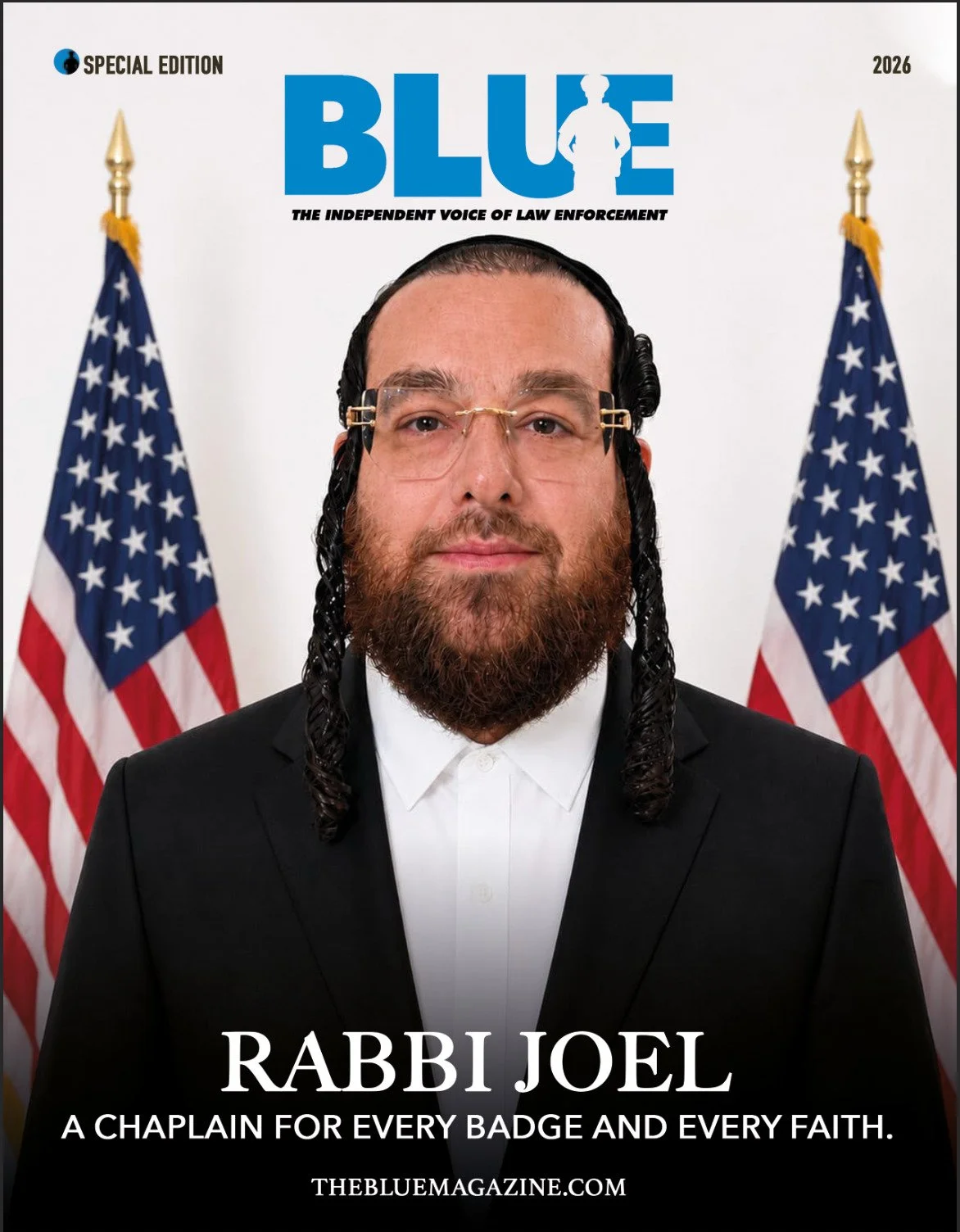
In this issue Professor Peter Marina explores overcoming wokeism and cancel culture in Police: Can You Forgive the Wokeists? Chief Ron Camacho continues to share his leadership wisdom with Mentorship and Coaching: A new tool for recruiting and retaining law enforcement personnel. And don’t miss our first ever dual COVER STORY interviews. Rabbi Abe Friedman tells us about his work as a rabbi working with the law enforcement community. Out front is our interview with thoughts of interest from NewsMax’s Greg Kelly. Keep watch for more interviews of national significance that we are working toward!

As our never ending mission of gathering useful knowledge through learning proceeds, perhaps Dr. Martin Luther King, Jr. said it best when stating “The function of education is to teach one to think intensively and to think critically. Intelligence plus character – that is the goal of true education.”

Reach out to us. We are always here for you as we continue to push forward, always improving, learning, and looking out for our fellow humankind. Be careful and stay safe as we all have so many who are counting on us.

Joel E. Gordon Managing Editor

Greg Kelly INTERVIEW

The BLUE Magazine recently spoke with NewsMax broadcaster and author Greg Kelly. He is the son of former NYPD Commissioner Ray Kelly. In this intriguing cover story interview, we discuss his latest book Justice for All: How the Left is Wrong About Law Enforcement, the current status of law enforcement in modern society, growing up the son of a law enforcement icon, his military service, spirituality and much more. In this candid interview, you will find that Greg Kelly’s passion, humbleness, and support for law enforcement are unmatched. Thank you Greg Kelly and NewsMax for standing up for law enforcement and the rule of law. 

Here are some highlights of our discussion…

The BLUE Magazine: We wish to congratulate you on your newly released book Justice for All: How the Left Is Wrong About Law Enforcement. Let’s begin. Who is Greg Kelly?

Greg Kelly: Well, thanks for asking. Greg Kelly is a broadcast journalist based in New York City, married, father of two girls, ages three and one. I have been in journalism. I call myself actually a talk show host, not a journalist, quite frankly, for a number of reasons. I've been doing this for 23 years. Prior to that, I was a Marine Corps officer for nine years — active duty, flew Harrier jets, deployed all over the world. I grew up in the suburbs of New York City with my mother and father. My father, of course, Ray Kelly, is the longest serving police commissioner in New York City history. And that's a little bit about who I am. And I am very grateful to God for putting me in a position where I can pursue the truth without fear.

What was it like growing up in a law enforcement family?

My father wasn't strict. Some people have this idea that a cop is going to be really strict in an authoritarian type figure. He wasn't. He was very funny and we all had a great time. I write in the book about how I was only vaguely aware of what he did until I saw him in action one day take out his gun pursuing a purse snatcher. It was like the wildest thing I had ever seen, and I thought he was the coolest guy in the world. And I was especially impressed that by the time he got home after this episode, which I still remember, and he was done talking about it, I mean, he had moved on to like, you know, do we need milk? So it was a very small part of his life. I was proud of him and I was very intrigued by his line of work. It's interesting, it was somewhat looked down upon at the time. 

What led you to journalism?

I was always interested in current events. I always would as a form of escapism, really, just not escapism from anything negative. But it was an adventure. Read about things in faraway places and watch TV and things outside your scope and outside your world. And I was just drawn to it. It was very interesting and I thought maybe I could do that myself someday. But it seemed very silly to pursue journalism as a 22-year-old and sit there asking questions when you don't know anything. You haven't lived life, and too many people in media have just spent their time kind of critiquing and judging and shooting their mouths off without ever having been responsible for anything. And so I went into the military and I’m very grateful that I did. I got so much out of it. 

Law enforcement officers often feel like they're involved in a strict censorship where active duty officers can't say much in terms of opinion. Officers really have to toe the line and be real careful with what they say. As a journalist, have you experienced censorship and are people trying to actively censor your opinions? 

Well, anybody who works for anybody is an employee, and that has to be respected to a certain degree. I understand that you can't have everybody or you shouldn't have everybody out there just saying things online and that kind of thing. I feel like Facebook and Twitter present real challenges to law enforcement management. I don't know what the benefit is really to have everybody sounding off like that. Look, censorship is alive and well. We all know that. And people are scared and cancel culture is real and that's very un-American. Now, having said that, let's face it, 30 years ago, 40 years ago, cops, citizens, you know, we weren't writing letters to the editor all the time. You know what I mean? We just weren't, like only certain individuals do that — it's become so easy to express your opinion. So there is censorship and it is wrong. But it's very easy to put your opinion out there more than ever before. And sometimes some of those opinions probably should have been maybe curated or honed a little bit.

Tons of misinformation. We see that all the time with social media, even in the aftermath of law enforcement events — right away, misinformation usually dominates all the feeds. And then we release body camera footage or a public information officer or the law enforcement executive comes out front trying to scale some of that back. Misinformation is a real problem. How do you get around it without curtailing free speech?

You know, it's always been a problem, though. Like I remember watching the news with my father and sometimes being on the inside of a story where he knew something and just shook his head. So I learned very early on that most of the time the information out there is wrong about almost anything. And I learned this firsthand. I was interning for Rudy Giuliani in 1989 when I was in college, and I was on his campaign when he was running for mayor, his first losing campaign for mayor. And I was just amazed at how often the media just had it totally wrong. They did not know what they were talking about. And also just about all of their stories were about who's up, who's down. You know, a poll came out, this endorsement, that endorsement. It was not about policy. It was not about substance. It was all horse race. So they've been wrong and superficial and dumb mainstream media for a very long time.

Speak directly to the police officers who are going to read your book. Tell them what your book is about. 

Directly to the police officers. I would say, number one, thank you for your consideration. Thank you for your service. I would say I'm heartbroken by the moment that we're in the middle of right now. Society has completely lost its way. All of the problems are being put on the backs of cops. It's ludicrous. It's been done for cynical political advantage. It’s been around for decades. But the person who put it into overdrive was Barack Obama, somebody I actually voted for in 2008. I admit that.

Where do you see law enforcement headed in, say, the next five years from where we've been? 

Where are we going? They know that defund the police is not a catchy slogan. Nobody likes that idea. But their policies are still very much in line with defund. And what happened in Memphis not too long ago has renewed what had been a somewhat moribund kind of movement. They are the instruments of a racist authoritarian state, white supremacy. The fact that they were black cops gave them even more of an opportunity to say, huh, the entire system is racist and must be dismantled. And they are embracing really crazy groups. They're being a bit more sophisticated in how they articulate it. They don't say defund, but if you look at the fine print, it's about defund. I don't know what's going to happen short term. I'm very pessimistic. Long term, I'm somewhat optimistic. But law enforcement, as you know, has been essentially delegitimized in the eyes of a very powerful interest in America. And I don't know what's going to happen next.

What's your advice to some law enforcement executives considering our current climate?

I was asked a similar question recently. And, look, I'm not a law enforcement professional, but I would speak to the political leadership and that they must remain committed to appointing the very best people for these positions. And I have seen the opposite and optics, racial politics, all this stuff about, you know, it would be nice to have a woman, it would be nice to have this. It would be nice to have that. I think that shortchanges everybody. If you focus on the exterior, you miss the important stuff. And I see a lot of people being put into senior roles in law enforcement that don't belong there.

Any reason why you didn't choose to join the force?

I thought about it rather seriously. By the time I was eligible, my father had already been a two-star chief and he was already really making a name for himself. To go into that career I thought would be tough with him as such a star, you know? And I was also really intrigued by the Marine Corps. And once I was in the Marine Corps, I realized my dad had actually joined the police department before he joined the Marine Corps. It was almost too late for me. And so I followed his footsteps into the Marine Corps, but not into the police department. It was basically that I needed to kind of cut my own path.

The safety of the New York City is a big topic lately. We speak to a lot of officers and they'll tell you that things are getting out of control here and many cities across the country. Let’s say Greg Kelly is now the mayor of the city. How does he fix this?

Well, number one, I'd get the right police commissioner and I would talk to my father about that. I think you need a police commissioner with a great deal of administrative managerial experience for a city this size. I think you have to have somebody, possibly a lawyer. 

Are you going to run for mayor one  day here in NYC?

So, look, I was seriously thinking about it. Here's my why I probably won't. I feel like the mail-in voting — the systems are such that post-2020, they're rigged. I mean, an up or down vote on one day in November with a year and a half lead up mano a mano — Greg Kelly versus Eric Adams, I could beat him. But in this culture where you send out the ballots to everybody. You can't, you can't compete with that. I mean, that's just so it's kind of a shame. 

How do you prepare yourself on a daily basis to be resourceful, to actually do what you do every day?

I just spent a lot of time thinking and reading, thinking, thinking

About?

Kind of everything. I mean, it's a lot of thought. It's a lot of thought, and it's a lot of wondering, to be honest.

Do you ever do the wrong thinking? And then you take it back. Do you ever add things up wrong?

Every now and then, I think I missed an opportunity. Or maybe I should have thought more about something. For instance, COVID, I kind of like, went along with the restrictions. I came here every day. I worked through COVID, so I didn't feel the pinch. It wasn't like I was home not working. If I was, I think I would have been really fired up. So I didn't have that. The vaccine. My wife said, you should take it. I took it. I had a horrible reaction to the first one. I mean, really bad. She's has a degree in microbiology. I trusted her and I think that's something I could have possibly gotten more involved in and I could have been more skeptical of it. I asked Fauci, though, a very key question. Early on, Fauci was telling everybody that this was nothing to worry about. And I got him to basically say that on January 28th of 2020, I said, we don't have to worry about this one, right? And he said, no, you really don't. Actually, Greg, it's we have it well in hand. He said that. So yeah, I arguably I missed the boat on COVID. I wish I was a bit more vigilant.

Many officers are taking their lives, and if they're not taking their lives, a lot of them are living unhealthy lives — domestic violence, depression, PTSD, though some are not as drastic as others — but we have seen that many are living unhealthy lifestyles today. And if the next step after that usually will become suicide, what would you tell the cop today facing these challenges? 

Well, get help right away, number one. If anyone's obviously suicidal, don't do it, make the call. But I was living a very unhealthy lifestyle not very long ago, six, seven years ago. I was drinking way too much. I was eating terrible, terribly. I was just going from one casual situation to the next. But I started reading the Bible out of the blue. Quite frankly, somebody had given me a Bible 10 years earlier. I'm like, whoa, what's this? I don't need this. When did you become such a church lady? I felt I was insulted that they gave me the Bible. And long story short, I started reading it. And out of curiosity, and it's like just your miracles started happening. And I realized, like, God is real. He's talking to me. And he'd been trying to get my attention for a very long time. And I had been ignoring him, going my own way. So I would say that all your answers are available. God wants to help. And He’s right there. And the most powerful, the ultimate force knows you, knows all of your problems, knows exactly what you're going through, knows what you've been—knows the good stuff you've done and the bad stuff you've done. He still loves you, wants to help. So that's what I would say, get into the Bible. 

What would you want your kids to remember you for?

It's my primary concern and wish that they get close to God, that they don't make the mistake that I made the mistakes thinking I could do it on my own. He makes everything easier, everything better, and He's right there. And it's so easy to listen to the world and say, well, that's not cool or that's not fun, I don't want any part of that. I know that part of their lives are going to have to go through that—it's just human nature. Maybe that will make their faith stronger one day. And I just hope I, I hope they love me and I hope they also like me, you know.

Solutions to the Tragedy of Baltimore’s Violence Problem

Solutions to the Tragedy of Baltimore’s Violence Problem
By: Leonard Sipes

I grew up in a working-class neighborhood in Baltimore. It was clean with good schools and relatively low crime. As a child, I was able to travel miles through adjacent neighborhoods on my bike without incident.  Beginning at age 9, I hopped on a streetcar on my own to visit my meat cutter father at Baltimore’s famous Lexington Market, a trip of 10 miles. Fear of crime was minimal.

It all ended when a next-door neighbor screamed for help while being robbed. My father ran to his assistance and had a gun pointed at his head. He stood on our front porch roof and pointed out the assailants as police arrived. Within a month, he told us that we were moving to a rural area of Baltimore County.

After a progression from being a cop to going to college to being the senior specialist for crime prevention for the U.S. Department of Justice’s National Criminal Justice Reference Service, and then becoming the director of informational services for the National Crime Prevention Council, I became the director of public information for the Maryland Department of Public Safety for 14 years and was inserted into the crime discussion in Baltimore hundreds of times.

Crime and Cops
With a population of around 600,000, Baltimore ranked second in the country for homicide per capita in 2021. The murder rate in Baltimore is 58.27 per 100,000.

Baltimore Police officials have reported the department is down 455 sworn officers. In 2022, the department hired 103 new officers; however, 277 sworn officers left the department. Baltimore residents are complaining of a lack of a police presence. I’m told that hundreds of additional cops are contemplating leaving over a lack of support from residents and officials.

Critics
It takes a certain amount of audacity to make observations and suggestions about urban crime and violence. Criminologists will correctly tell you that there is no consensus as to urban crime, why it increases, and what we can do. There is little from the researchers at the U.S. Department of Justice as to a specific game plan. What I suggest will create strong disagreements and criticism. Regardless, there needs to be a strategy and a list of considerations. There needs to be a starting point that the U.S. Department of Justice is unwilling to provide.

Progressive Pundits and Commentators Will Say That Baltimore:       

·         Must address its social problems and income inequities through good schools, meaningful jobs, drug treatment and social services.

·         Should embrace common-sense gun control.

·         Must emphasize moderation as to the justice system. The city cannot arrest itself out of its crime problems. Incarceration simply exasperates social inequity.

·         Needs prosecutors more in line with alternatives than harsh prosecutions and incarceration.


·         Must back off of “failed” aggressive crime policies. Arrests and enforcement fall on mostly low-income people, further punishing the powerless.

·         Needs to make its police officers community-oriented protectors rather than warriors.

·         Must make its police department responsible for improving police-community relations and lowering crime.

·         Should use former offenders as violence interrupters as a primary focus of crime control.

The result of these strategies has left the city I love as being world-renowned for violence and dysfunction. I watched a BBC television program where an actor was complaining about U.K. crime. Another stated with vigor, “Well, at least we’re not Baltimore.” Residents claim to live in war zones. Businesses and jobs are fleeing. School scores are abysmal. Poverty is climbing. People are leaving. Children are traumatized.

Yet well-funded and numerous progressive groups will insist that the way out remains economic and social development and social workers or former offenders acting as violence interrupters and cops who are protectors rather than warriors.

From a data-driven, methodologically sound, replicated (multiple research projects leading to a conclusion) point of view, there’s little evidence offered by the U.S. Department of Justice or any well-known independent research organization confirming any of the progressive policies above as being effective. National advocacy groups will tell you otherwise.

Understand that citizens control crime. This is criminology 101. Without citizens taking the lead, there is little law enforcement can do to establish a safe city.

Every community has the right to the kind of policing it wants; it’s why elected sheriff departments control many of the nation’s law enforcement agencies. Citizens voting for sheriffs get the right to express their views on their crime control policies every four years. Why shouldn’t this philosophy be extended to urban residents?

There are demands from citizens to city halls to “fix” crime problems. That’s not how it works. Every community should decide for itself what kind of policing it wants and to do the heavy lifting as to crime policies.

What Baltimore Needs to Realize:

·         The city needs to dramatically increase police salaries and hire hundreds of additional police officers. Baltimore’s reputation for protest, progressive values and unsupportive citizens will be a challenge.

·         The city needs to bring in paid, off-duty officers from other jurisdictions to supplement police numbers (if they are willing to come).

·         The city needs to hire police officers based on a limited five-year time commitment like the military, with benefits after service.

·         Every citizen needs to be supportive of the police officers who patrol their communities. There is nothing beyond the public’s support holding police officers in place. They don’t have to be in your community when they can easily transfer to jurisdictions wanting and embracing them and probably paying them more.

·         The city needs to invest in innovative technologies (i.e., drones responding to all sounds of gunfire, putting all released from prison on GPS monitoring, shot spotters, facial recognition, DNA and rape kit analysis).

·         There should be publicly available lists of current violent offenders (i.e., those on parole and probation) in communities.

·         Hire prosecutors who will hold criminals accountable for most charges. It doesn’t mean jail or prison or parole and probation or even guilty verdicts for all, but accountability is a must to send the proper message. Note that traditionally, urban prosecutors dismiss charges for approximately 20-30 percent of arrests for a wide variety of reasons. The federal government can dismiss up to 50 percent depending on the category. Prosecutors have the power to dismiss charges and expunge records for minor crimes and for those without an extensive criminal history in exchange for community service.

·         Hire retired cops to review unsolved crimes.

·         Do podcasts and create blogs on unsolved crimes.

·         Enlist the assistance of the true crime community to help solve unsolved crimes. Publicize their findings.

·         The state should offer Baltimore drug and mental health treatment on demand. Citizens need to realize, however, that treatment strategies rarely work or work quickly and must be repeated multiple times, thus becoming very expensive.

·         Parole and probation agents are underutilized resources. They know who the criminals are and what they are doing. They should be embedded with law enforcement daily. City police officers should have a computerized system where they can poll parole and probation agents daily as to possible suspects.

·         There needs to be weekly or monthly polling of Baltimore communities as to their perceptions of policing and crime and suggestions as to what the city could do. Results should be published immediately and analyzed over time.

·         There should be numerous apps or text messages or anonymous crime reporting opportunities.

·         Child abuse and neglect is the primary root cause of crime and violence. Baltimore through the state needs to create social workers and nurses to intervene early for family and child welfare.

·         Bail reform should have provisions as to the level of violence involved and the offender’s criminal history. If you beat your wife with a frying pan and have physically assaulted her several times, you have lost your right to presumed release without bail.

·         The state should fund a victim and witness protection program to make sure that people can safely report what they know.

In conclusion, the citizens of the city of Baltimore need to understand that they control crime, not the police department or any other aspect of the justice system. Without personal involvement in keeping communities clean and orderly and without setting community standards for what’s acceptable behavior, crime control will not happen.

People may suggest that I ignored the root causes of crime beyond child abuse. There are correlates of crime like poverty or drug use that cannot be easily remediated. But I am unaware of any jurisdiction in the country that was able to eliminate social and economic inequities.

But regardless, what I suggest remains valid.  The city needs to hold offenders accountable. Citizens need to take control of their communities. Proactive policing needs to return. Citizens need to openly support law enforcement officers and make them feel welcome in their communities. Citizens need to decide for themselves the kind of law enforcement they want or are willing to tolerate.

Without citizens and communities taking the lead, and without sufficient funding, the unbelievably high rates of violence in Baltimore and elsewhere will continue for decades to come.

Leonard Adam Sipes, Jr.is a retired federal senior spokesperson. A former Adjunct Associate Professor of Criminology and Public Affairs - University of Maryland. Former advisor to the “McGruff-Take a Bite Out of Crime” national media campaign. Past police officer. Aspiring drummer. Operator of CrimeinAmerica.net. His book based on thirty-five years of criminal justice public relations,” Success with the Media: Everything You Need to Survive Reporters and Your Organization” is available at Amazon and additional booksellers. He can also be found @ leonardsipes.com

THE BREW CREW

THE BREW CREW
By: Sgt. Jeff Stewart

The Boilermaker Brew pop-up coffee shop is not just about selling coffee, it is about empowering special needs high school students and preparing them for life after graduation. The program, which is a collaboration between the Garfield School District's LifeSkills program and the Garfield Police Community Affairs Division led by Sgt. Jeff Stewart, allows students to gain hands-on experience in the food industry while also learning valuable life skills such as financial literacy.


The program was entirely funded by grants and community members, and volunteer George Leles of Arabica Coffee Co. helped the students source beans, experiment with flavors and roast the coffee. The students even had the opportunity to create their own logos and take lessons on financial literacy provided by a local TD Bank branch office.


The Boilermaker Brew pop-up coffee shop is located at the Century Field House kitchen, located at 60 Elizabeth St. in Garfield and operates in spring, summer and fall. During the winter, it moves indoors to the local YMCA located at 33 Outwater Lane, Garfield, NJ 07026, with winter hours of operation on Tuesdays and Thursdays from 9:30 to 11:15 am. Both the Century Field and the YMCA host the students free of charge.


The coffee shop has received positive reviews, and cups sell for $2 small and $3 large. The second year of the program has been fully sustainable by coffee sales, and the goal is to one day have a brick-and-mortar location.


The Boilermaker Brew pop-up coffee shop is a shining example of what can be achieved when the community comes together to support special needs students. The Garfield Police Department, Police Chief Rich Uram and the Garfield School District should be commended for their innovative approach and for the positive impact they are having on the lives of these students. We hope that other communities will take note of this program and be inspired to create similar opportunities for their special needs students.


More Information:
Sgt. Jeff Stewart
City of Garfield Police
Community Affairs Division Commander
DM @officerstewart Instagram

I Retired for This?

I Retired for This?
By: Kimberly Stratman

Did I work 30 years for this? Did I leave a job I loved for this? Did I leave my friends and coworkers for this?  Did I leave a respected position for this? Did I turn in my uniform for this?

I loved being a lieutenant in the Dallas Police Department patrol. It was by far my favorite assignment, but the admin or support assignments mattered too so I always gave it my best.  Committee appointments were good and bad; nothing worse than “solving” the same problem over and over. I enjoyed being part of the Baker to Vegas Women’s Relay Team back in the day. Running with the DPD Women’s Running Team and then the DPDNPW 5k Team was both exciting and emotional.

Witnessing my officers promote was awesome. They have so much talent, passion and dedication.

Leading classes at the Academy, in-service and basic, was an honor. I always wrote my personal cell number on the board and made the promise that I would help anyone who called me, and I did. Sometimes it was a serious situation that required additional support.  Sometimes the officer just needed someone to bounce ideas off.  Sometimes they needed a, “What the heck are you thinking? You know better! Let’s fix this.”

But, rookies younger than my boys were on the streets. I was being called, “ma’am” off duty by folks who didn’t know who I was. That last footchase at 50 years of age was a bit rough. The cameras and other technology were intimidating. My back was hurting more than it wasn’t.  The losses were getting harder to compartmentalize. It was exhilarating being at the same scene with my SWAT husband! But only after I knew he was OK. Does that even make sense? Apparently not to my gut, because that was getting a bit stressful too.

One of the classes I was invited to lead at the Academy was “Dave Ramsey’s Financial Peace” and included Chris Hogan’s “Retire Inspired.”  We all must retire someday, so I put emphasis on the “Inspired.” As I interacted with the weekly class members over the two-year TCOLE cycle, I noticed that some officers had a plan and were excited. They had ideas of how to spend their time after they retired. Others expressed a feeling of concern and even overwhelm, while others stated they couldn’t even think about retirement. When leading this same type of class for officers/employees of various agencies, I saw the same reactions. Which group seemed most likely to retire confidently? I decided to have a plan. It was time.

What did I want to do if I wasn’t a cop? I wanted to do our oil business full time. I wanted to work with plants. A solid workout schedule was a must! I wanted to attend a ladies’ daytime Bible study. I wanted to build and strengthen relationships with other women.  I wanted to read for fun and garden.

Even with some great opportunities, and with great pay, I knew I did not want to put on another uniform. I did not want to drive in rush hour traffic.

My plan came together rather organically. Sharing my ideas came naturally because I was excited! Valuable advice and suggestions were offered.

I retired! The pandemic and the riots proved that I was not in control. But my plan was still solid.  It was not a ridgid schedule but more a list of, “I want this in my life.”

Even when “life is good,” things change. Who knew that I would find the need and the time to do more? I added Yin Yoga to be still and slow down my brain. I enrolled in various online classes to challenge myself. I realized I missed a more active role in serving others. Seriously missed serving others. While I didn’t miss the Job, I missed my people.

Again, an organic plan fell into place once I identified/acknowledged what I wanted to do. I am a Certified Life Coach and a Certified Retirement Coach specializing in Retirement Longevity.

What? Yes! I help first responders, and others, retire confidently so they can live the life they worked for. Topics discussed include health, hobbies and fun, relationships and support systems, career, future endeavors, an action plan and more. I am called to this service because life after “the job” can be, should be, full and rewarding. We can each find our purpose, no matter what that might be.

Should you approach retirement with a well-thought-out plan that focuses on your mind, your body and your spirit? I would strongly suggest you do so.

Yes, I did retire for this.

Kimberly Stratman retired as a lieutenant from the Dallas Police Department after an exciting and fulfilling 30-year career. She and her husband, an active SWAT officer, have two grown sons and two dogs that get lots of attention. Kimberly is the owner of To the Point Coach, a Certified Retirement Life Coach and Certified Life Coach service that focuses on first responders. Her goal is to ensure our law enforcement community thrives. She can be reached @ tothepointcoach.org

Police: Can You Forgive the Wokeists?

Police: Can You Forgive the Wokeists?
By: Peter Marina

The dark specter of “wokeism” is upon us, serving to further divide the American people from developing the solidarity needed to take back control of our country.

We’ve reached an end stage of modernity where corporate oligarchy has finally secured power and control over our entire society. The American people, largely disenfranchised from the decision-making processes that shape our lives and future, are impotent to impart real material, structural change. Years of media propaganda, culture wars and identity politics further aggravate divisions among the people and prevent any form of class consciousness that can challenge our political and economic elites from arising.

“Wokeists” take their frustrations out on those who can be a helping hand, like police officers, in advancing a better world built on the 1948 U.N. Declaration of Human Rights.

As the last remnants of our democracy vanish, the elite on both sides of the political spectrum collude with their corporate masters to secure endless wealth, profit and power. These clever elites’ preferred strategy to secure endless power is class division — with ever newer and more creative ways to divide us.

Wokeism is their useful and divisive ideology, along with their other ill-conceived concepts like diversity and inclusion (which are almost never truly diverse nor inclusive). Those who refuse to submit to their secular gospel get censored and banished to purgatory.

Many privileged media pundits and woke, liberal, feminist academics (who are usually neither woke, left nor feminist) serve as the tools of corporate oligarchy — “useful idiots” who exacerbate class division.

In what public intellectual Chris Hedges calls “woke imperialism,” identity politics and diversity serve as “gimmicks” mainstream journalists and academics use to further their careers exploiting the suffering of “Black” and “brown” people while doing “boutique activism” that never solves our structural problems and furthers division among the people. As Hedges states:

The militarists, corporatists, oligarchs, politicians, academics and media conglomerates champion identity politics and diversity because it does nothing to address the systemic injustices or the scourge of permanent war that plague the U.S. It is an advertising gimmick, a brand, used to mask mounting social inequality and imperial folly. It busies liberals and the educated with a boutique activism, which is not only ineffectual but exacerbates the divide between the privileged and a working class in deep economic distress. The haves scold the have-nots for their bad manners, racism, linguistic insensitivity and garishness, while ignoring the root causes of their economic distress. The oligarchs could not be happier.

Among the American people, including police officers, we have an “us against them” mentality that is real but misplaced. We’ve learned to resent or distrust our own brothers and sisters based on concepts like race, gender, sexual orientation, sex, ethnicity, documentation status, political affiliation and so forth. While the political and corporate elite pull the strings, wokeists happily play their tune.

Many universities (especially within the humanities and liberal arts), that once stood for debate and critique, now cower to power, evade real debate and refuse to confront the great challenges facing our civilization while they descend into the emptiness of identity politics and cancel culture. According to the great banished scholar Norman Finkelstein, identity politics lacks intellectual substance, and further, prevents class solidarity from emerging that unites people to create real structural change. In his latest book on cancel culture, Finkelstein argues that Barack Obama and his “obedient followers” serve as the quintessential example of identity politics’ final product, that is, standing for nothing except skin color and a hip veneer (and an ingenuine, plastic smile, I might add) while supporting the “corrupt status quo.” This status quo is the support for those political and economic elites that Adam Smith calls the “masters of mankind,” who abandoned the American people.

While identity politics serve as a tool to divide us, our real enemies are those political and economic elites who use these tools to wage class warfare against the American people. They seek endless profit, war, power and domination — whatever the cost.

Working- and middle-class Americans are on the same team. We need to put aside our relatively petty differences and unite under common causes that advance our collective interests.

Journalist Glenn Greenwald explains what became of our mainstream journalists — an explanation that can be further applied to mainstream academics:

They have insufficient talent or skill, and even less desire, to take on real power centers: the military-industrial complex, the CIA and FBI, the clandestine security state, Wall Street, Silicon Valley monopolies, the corrupted and lying corporate media outlets they serve. So settling on this penny-ante, trivial bullshit — tattling, hall monitoring, speech policing: all in the most anti-intellectual, adolescent and primitive ways — is all they have. It’s all they are. It’s why they have fully earned the contempt and distrust in which the public holds them.

It's unfortunate, and breaks the heart of this romantic liberal arts scholar, but many of my fellow academics have fallen into these sophomoric, churlish acts of “tattling, hall monitoring, speech policing: all in the most anti-intellectual, adolescent and primitive ways.” They do this in the most cowardly fashion behind the backs of their own colleagues, just like they do to the police who protect them. As English philosopher Aldous Huxley stated: “The surest way to work up a crusade in favor of some good cause is to promise people they will have a chance of maltreating someone. To be able to destroy with good conscience, behave badly and call your bad behavior 'righteous indignation,' the height of psychological luxury, the most delicious of moral treats.”

Attacking police and unorthodox scholars have become the delicious moral treats wokeists devour. In their performative, sacramental rituals and chants, they want to force their “wokeist” secular faith on the masses and cast out the demons who challenge their dogma and orthodoxy. But we will not waver until personal belief meets objective reality.

While I’ve personally, as an unconventional scholar and Cuban American, experienced this passive-aggressive, cowardly, “behind your back” bullying and maltreatment, I know that so-called wokeists are not my enemy; indeed, we are on the same side. They are my brothers and sisters, too, in class solidarity. They are our brothers and sisters.

Wokeist liberals, a misnomer, attack real leftist and unorthodox academics, Trump supporters and conservative scholars, as well as their favorite targets today: police officers and conservative Americans. They attack anyone who does not agree with their political orthodoxy, identity politics, anti-intellectual ideology and virtue-signaling.

Police officers, while these wokeists might be annoying, and perhaps worse, they are not our real enemy. They, like many of us, have lost control of their ability to shape the world beyond their cultural milieux and the private orbit of their own lives. They, too, are concerned about an uncertain future where nothing is guaranteed. They, too, fight desperately to hold on to all the fading securities and promises many of us once enjoyed.

I’ve forgiven the wokeists for their unwarranted attacks and baseless accusations. I believe police officers too must forgive and find common ground with the people — including those you police and the wokeists scapegoating you — to develop a sense of solidarity to confront the challenges of an increasingly uncertain world. You can rise above their pettiness and serve as examples of what true solidarity looks like in this age of discontent. With class unity, we can put aside our differences and fight together against our true oppressors to create a world in our collective image.

I’ve been working on the idea of transforming policing from mainly an institution of social control to a human rights organization that protects and serves the American people — all of us. I believe police officers can spread their wings to usher in meaningful change in the world. Just like the best teachers do the hard work of giving the youth life-changing, mind-blowing critical educations that foster new ways of thinking, the best police officers can lift up their communities while keeping people safe and protecting their human rights from those who seek to prevent the enjoyment of these rights.

My message is to forgive and lead through example.

We must rise above identity politics to understand that diversity means nothing when used as a tool against the people. As Hedges states, “Diversity when it serves the oppressed is an asset, but a con when it serves the oppressors.” Let’s not fall for the con. Let’s forgive our wokeist brothers and sisters and extend a hand in solidarity to solve structural problems that cause crime, homelessness, addiction, domestic abuse, inequality and exclusion. They might still attack us with their misguided, anti-intellectual views (indeed, they show little desire to reduce the gap between their personal beliefs and objective truth), but eventually, with effort and strong example, they may one day join us in solidarity. Remember, people are verbs, highly fluid, constantly changing and always able to become more. If we lead by example, perhaps they will put down their cancel culture and identity politics, and all the “tattling, hall monitoring, speech policing” and, perhaps, they will become serious adults and join us in doing the business of making the world better for us all. I don’t ask what I’m not willing to do myself. I will join you in solidarity, and for this humble scholar, my belief in you is unwavering. Our promised land is human rights and solidarity is the path.

Police officers, can you forgive and become exemplars of unity? If so, we can end division, and together, unite the people to the promise land.

Dr. Peter Marina is a sociologist and criminologist at the University of Wisconsin – La Crosse. Along with his father, (retired) Lieutenant Pedro Marina, he teaches human rights policing to law enforcement professionals throughout the United States. He is author of the Human Rights Policing: Reimagining Law Enforcement in the 21st Century with Routledge Press (2022).

Memphis lesson: Character Content is Most Important

Memphis lesson: Character Content is Most Important
By Joel E. Gordon

I look to a day when people will not be judged by the color of their skin, but by the content of their character. - Martin Luther King, Jr. (1963)

In my effort to resist any rush to judgment and in the spirit of due process and "innocent until proven guilty" I have been reticent to comment on the Memphis case involving the death of Tyre Nichols as recorded in the viral video beating he received at the hands of five Memphis police officers. As facts continue to be exposed, it is my most sincere hope that justice is served for all involved. But the question remains…

How have we strayed away from Dr. King’s wise open-minded philosophy? The “LEFT” today says we need to hire Black cops to police Black neighborhoods. In reality, color shouldn’t matter … how about hire cops with great moral character? The goal should be good, law-abiding cops — irrespective of race. All five officers charged in the beating and death of Tyre Nichols in Memphis are Black, as is Tyre Nichols, but this isn’t about race but rather it is about character and standards.

Did the Memphis PD lower standards to hire these cops for “diversity” and/or because cops are now maligned as “systemically racist”— resulting in early retirements, fewer applicants and therefore lower hiring standards to maintain manpower?

According to a source within the Memphis PD, not all of the five charged officers were hired through the customary PD structured hiring process. City leaders felt the existing process was too strict and kept certain individuals from getting jobs at the department. City leaders then began their own hiring process and pushed new hires into the agency bypassing the rigorous and time tested background requirements and testing procedures in place at the department in order to fill vacancies. “They would allow just pretty much anybody to be a police officer because they just want these numbers,” said Alvin Davis, a former lieutenant in charge of recruiting before he retired last year out of frustration.

The department phased out requirements to have college credits, military service or previous police work. All that’s now required is two years’ work experience — any work experience. The department also requested state waivers to hire applicants with criminal records. And the police academy even dropped timing requirements on physical fitness drills and removed running entirely because too many people were failing.

Many young officers, before ever working with more experienced colleagues, were assigned to specialized units like the high-crime strike force involved in Nichols’ arrest. It was reported that some young officers who transferred back to patrol didn’t even know some basics such as how to write a traffic ticket or respond to a domestic call. “They don’t know a felony from a misdemeanor,” Davis said. “They don’t even know right from wrong.”

Police Director Cerelyn Davis, who took over in June 2021, has said supervision of less-experienced officers is an urgent need, questioning why a supervisor failed to respond to Nichols’ arrest despite a policy that requires a ranking officer to go to the scene when pepper spray or a stun gun is used.

According to an Associated Press report, of the five officers now charged with second-degree murder in Nichols’ beating, two had only a couple of years on the force and none had more than six years experience.

One of the officers was a former tight end on the Bethel University football team and appeared to have had at least one arrest, according to files from the Peace Officers Standards and Training Commission, a state oversight agency. But the date and details of the case had been redacted.

The section for arrests in the agency’s file for another officer who worked at a Shelby County Corrections facility before joining the force was also redacted from the state records. He was sued for allegedly beating an inmate there, which he denied, and the case was dismissed because papers had “not been properly served.”

This is not about training any more than it is about race, but it is about character, mindset and decency as prerequisite qualities in the evaluation of those under consideration for hire. At its core it’s not a police culture issue but criminal culture one. By opening the hiring process to those who are potentially a product of the inner-city drug gang culture, where the value to human life is often seen as diminished, it would seem the lower hiring standard increases the chance for bad decisions, incompetence and misconduct.

“I asked them what made you want to be the police and they’ll tell you it’s strictly about the money,” Davis said, adding that many recruits would ask the minimum time they would actually have to serve to keep hiring bonus money. “It’s not a career for them like it was to us. It’s just a job.”

Why the superficial diversity goal of “cops who look like the community,” especially if it means lowering standards? Why should it be a benefit to hire, promote, assign or retain officers from an expanded pool based upon gender, skin color or cultural diversity rather than being based upon candidates of the highest personal character, skill set and potential for success? To maintain integrity and fair and just application of our laws by those given the responsibility for enforcement merit, above all, must be our primary guide.

Joel E. Gordon, Managing Editor of BLUE Magazine, is a former Field Training Officer with the Baltimore City Police Department and is a past Chief of Police for the city of Kingwood, West Virginia. He has also served as vice-chair of a multi-jurisdictional regional narcotics task force. An award winning journalist, he is author of the book Still Seeking Justice: One Officer's Story and founded the Facebook group Police Authors Seeking Justice. Look him up at stillseekingjustice.com

DEPARTMENTAL CULTURE: Maintaining Integrity

DEPARTMENTAL CULTURE: Maintaining Integrity
By: Monica Eaton

As a young police recruit, I remember being terrified of the background investigation process. Wracking my brain to make sure every piece of information was in the packet, the location and municipality of my first speeding ticket as a 16-year-old driver, every single address I ever lived at, and any type of office supply I had ever mistakenly taken home and not returned. I was terrified that anything could disqualify me from the job of my dreams. 

Recruits go from being terrified to make a mistake or get their academy “smoked” with conditioning to figuring out how to be lazy and cut corners. One will sit in a parking lot watching Netflix, while another stays “tactically 10-6” all shift but magically appears on every in-progress call. Many will be inconvenienced by regular in-service training and fail to do more than the minimum to get by.

Granted, this does not dismiss the officers who keep their integrity and hard work and continue to do the right thing. But in light of the recent events that call officer integrity into question, how do we go from one extreme to the next? I’d like to propose a theory: the work environment. Another thing we take note of as recruits are the stories of officers from the  past: The one who had sex on duty and never got punished. The one who continuously talks himself out of taking reports and is rarely heard on the radio. The one you get told to leave alone because he doesn’t like to be bothered. The one who got away with some questionable tactics but was seen as the badass who caught the bad guy anyway.

Recruits come in the new starry-eyed little brothers to the many new big brothers they look up to and want to be like. They get enmeshed in the culture of the department, who show them how to do things, and what things you probably shouldn’t do, but might get away with anyway. The administration often reaffirms some of the norms by sweeping some punishable things under the rug for the well-liked “good old boy.”

It’s all fun and games until someone gets hurt. Due to a lack of training or often a slippage of department integrity, an officer, civilian or suspect gets hurt or killed. The media storm swirls yet again into questions of the people behind the badge and who we really are. How do we stop the cycle? We speak up.

We speak up for the good and well-intentioned officers who do this thankless job daily and always to the best of their ability. We speak up to continue to serve and protect the people we took an oath for. We speak up to encourage and maintain positive work environments that encourage continued training and punish the misconduct equally and fairly. We speak up to help weed out those who lack integrity and who should never be there in the first place. At the end of the day, we can only control what we do. Will you be the next to speak up, or will you sit back and watch the storm continue?

Monica Eaton is the owner/CEO of Five-0 Fierce and Fit which creates online nutrition and fitness programs designed to help female first responders lose fat, gain strength and take back their confidence in 90 days because “your family depends on you to be fit for duty.” Using her six-year Oklahoma law enforcement experience along with her 15-year background in fitness and nutrition she helps female first responders reach their full potential in life and career. Look her up on Instagram @five0.fierce.and.fit.

A RUSH TO JUDGMENT? PLEASE WAIT FOR THE FACTS

A RUSH TO JUDGMENT? PLEASE WAIT FOR THE FACTS
By: Deon Joseph

There are many people asking me to comment on a recent in-custody death. I want to so badly to dispel disinformation. But I can’t because it happened on my agency, and I have to wait until the investigation is complete.

But what I will say is this; have we not learned across this country from previous incidents about falling for carefully selected portions of videos, activists who exploit dead Black people, clout-chasing celebrities who try to emotionalize the incident to put more credit on their “woke card,” politicians looking to score political points with their voter base by aligning themselves with activist groups, ambulance-chasing lawyers who want to try the case in the court of public opinion only to try to get the biggest payday they can and biased media personalities fanning the flames for ratings?

My friends, the most revolutionary thing anyone can do when these incidents occur is watch the entire footage (not the part you can use to stir people up) and wait for all facts to come out before vilifying the officers or the person they contacted.

It is beyond time for us to think critically and objectively when these things occur.

I literally cannot wait to talk about this incident based on my training, experience and observations over 27 years. Many who know me are aware that I’m not afraid to say when cops are wrong, and will also stand up for them when they are justified no matter how controversial it may seem to people with no experience in policing. Unfortunately, I have no choice but to wait as policy dictates. But you can do several things:

Think objectively.

Don’t allow anyone to emotionally exploit you or guide you to a thought on the guilt or innocence of the officers involved, or the young man who passed away while judging this incident.

Wait until all facts including medical reports and witness statements come out.

Stop sharing edited or carefully selected portions of the incidents, and at least share the whole video without captions that paint anyone involved in an unfair light.

Deon Joseph is a 27 year veteran of law enforcement in Southern California - 23 of those years working in the homeless community to create an environment conducive to change for those in recovery, as a Lead Officer. He’s been recognized for his work locally and nationally, and news stories and documentaries surrounding his work in crime fighting and community relations, featured him. www.deonjoseph.org

Remembrance - Police Officer Geoffrey Redd

Remembrance - Police Officer Geoffrey Redd
Article & Artwork by Jonny Castro

On Feb. 2, Memphis police officers responded to a public library around 12:30 p.m. regarding a man who was causing a disturbance inside. Officer Geoffrey Redd was a Field Training Officer and was training his rookie partner when they received the call. Just as the pair attempted to talk to that individual inside the library and de-escalate the situation, he pulled out a gun and shot Officer Redd.  The rookie partner returned fire and killed the gunman. The suspect was identified as a career criminal who had been arrested over 30 times in the past. The wounded officer was transported to the hospital in critical condition. For 16 days, he hung on and fought for his life sadly succumbing to his wounds on Feb. 18.

Officer Geoffrey Redd was a 15-year veteran of the Memphis Police Department, and had proudly served his country in the U.S. Marine Corps. He also worked as the director of security at his church. A few years ago, Officer Redd was struck by a vehicle on a traffic stop. He was thrown into the air and landed on his face, nearly losing his eyesight. His injuries were so severe that he had to learn to walk again. Despite all of that, he overcame the odds and recovered, returning to the job that he loved.  Officer Redd leaves behind his wife, who he just married a few months ago, three daughters and four grandchildren. He was 49 years old.