Malkin: Why Some of Us Can't Dine in Peace

Malkin: Why Some of Us Can't Dine in Peace
By: Michelle Malkin

Fifteen years ago, when I still lived in the D.C. swamp, I took my elementary school-daughter and toddler son out for one of our regular weekend breakfasts at IHOP. But we couldn't be left alone to enjoy our meal. As my kids dug into their funny-face pancakes, a fuming-faced liberal marched to our booth and started ranting about my anti-open-borders commentaries on Fox News. The incident occurred not long after Geraldo Rivera told a Boston Globe reporter that I was the "most vile, hateful commentator I've ever met in my life" and that, "It's good she's in D.C. and I'm in New York" because "I'd spit on her if I saw her."

Fifteen years later, I'm blacklisted by the "fair and balanced" network, while fork-tongued cable news reptile Geraldo Rivera remains a heavily promoted Fox News contributor who regularly attacks everyone else (including his former friend Donald Trump) for inciting violence. File under "chutzpah."

Fifteen years later, organized mobs in the nation's capital are targeting Supreme Court justices in their homes.

Fifteen years later, the goons of ShutDownDC, leading instigators of "direct action" (translation: domestic terrorism) against the far left's political enemies, have now offered bounties of up to $200 on Twitter to stalk and harass Justices Brett Kavanaugh, Samuel Alito, Clarence Thomas, Neil Gorsuch, Amy Coney Barrett and John Roberts. In a Twitter post that brazenly violates the social media giant's own rules against targeted harassment and incitements to violence, ShutDownDC called on D.C.-area service industry workers to expose the whereabouts of the conservative justices who overturned Roe v. Wade. The call to arms came after Kavanaugh was hounded out of Morton's steakhouse in D.C.

In a rare display of business defiance of the mob, Morton's responded in a statement that Kavanaugh and other patrons "were unduly harassed by unruly protestors" and that politics "should not trample… the right to congregate and eat dinner."

Or to eat an IHOP breakfast with children!

One outlet characterized the latest intimidation campaign against the SCOTUS judges as a "troubling escalation." But I know from both professional and up-close-and-personal experience that all this ugliness is a continuation of years and years of abuse of, and violence against, conservative public figures in both public and private spaces. See, for example, my 2006 encyclopedia of left-wing loons, "Unhinged: Exposing Liberals Gone Wild."

Naturally, militant abortion zealots cheered the Morton's ambush and mocked the justices who are under siege — even as Kavanaugh's would-be assassin faces attempted murder charges after flying from California to the judge's home in the D.C. area to kill him. On cue, the Biden administration defended and encouraged more such protest for abortion on demand. But ShutDownDC's summer of staged rage isn't about any sincerely held despair over the right to murder unborn babies, just as the attacks on Trump officials at their homes and in restaurants in 2018 weren't really, in the end, merely about Trump or America First populism or borders. Remember: ShutDownDC is a full-time, deep-pocketed front group for wealthy woke heiresses like Aileen Getty and Rory Kennedy who hop from "progressive" cause celebre to cause celebre. As I've reported previously, their compadres in the invasive Sunrise Movement are a parallel disruption outfit backed by the Sierra Club that agitated for the Green New Deal, Black Lives Matter and the Defund the Police movement before mobilizing to attack the private homes of Senate Republicans who confirmed Trump's judges. Even more alarming: the presence of ShutDownDC subversives embedded in federal government agencies including Takoma Park Mobilization, Alt U.S. National Park Service, Alt Ed, Alt FDA, Alt NOAA, Alt U.S. Forest Service, Alt EPA, and BadHombreLands National Park Service.

Reminder: The Sierra Club (annual budget: $100 million; top donors: Michael Bloomberg, George Soros) provided five-figure initial seed grants to Sunrise's educational arm, as well as Beltway office space. Other original funders of Sunrise: The Rockefeller Foundation and Wallace Global Fund (which also contributed to the George Soros-subsidized Tides Center, Color of Change cancel culture guerilla warriors, and far-left legal policy groups Alliance for Justice and the Brennan Center for Justice). The Sunrise Movement's co-founder, Evan Weber, is a former Occupy Wall Street organizer. Two others, Sara Blazevic and Varshini Prakash, are Green New Deal zealots and Sen. Bernie Sanders activists. Prakash serves as an advisory board member of Climate Power 2020 along with Soros-funded Center for American Progress head John Podesta, former Obama administration environmental czar Carol Browner, former Obama administration science czar John Holdren, former Obama administration Secretary of State John Kerry, former Obama administration EPA head Gina McCarthy, and former Obama administration U.S. Ambassador to the United Nations Samantha Power. Some of us can't dine in peace because our simple existence is a threat to the "liberal world order." If you can't be controlled, you must be de-personed. "Tolerance" is only for the intolerant. The rules of civility don't apply to the self-righteous monsters sporting "empathy" bumper stickers on their cars and "love is love" banners in the windows of their homes and businesses that will always be safe from pot-bangers, Molotov cocktail-hurlers and billionaire-funded dissent-crushers.

Bon appetit, end-stage America.

Michelle Malkin is an American conservative blogger, political commentator, author, and businesswoman. Her weekly syndicated column appears in a number of newspapers and websites. She was a Fox News contributor and has been a guest on MSNBC, C-SPAN, and national radio programs. Malkin has written several books. She founded the conservative websites Twitchy and Hot Air. E-mail: Michelle MalkinInvestigates@protonmail.com


MANAGING EDITOR’S POINT OF VIEW

It has been said that leaders think and talk about the solution; while followers think and talk about the problem. When all is said and done, it is results that matter and our writers here at the independent voice of law enforcement are all about leadership with actionable solutions to problems.

We persevere in our attempts to avert one crisis after another, remembering that kindness in humanity still does exist. We are the living proof of that. While some politicians may exploit the emotional impacts of events of violence we present fact-based and proven methods.

You have the right to be informed. Why can't we, as a society, implement solutions when so many know the truth?

At the end of 2018, we ran a cover story Active Killer Coming Soon exploring active shooter behaviors which often precede attacks and outlining the importance of the police and community working together to stop the killing. In the summer of 2019, I outlined the nationally acclaimed program enacted by then-Huntington West Virginia Fire Chief Jan Rader THE DRUG CRISIS Making a Difference: One Life at a Time. And in March 2022 we published a solutions-oriented article by Chief Ron Camacho on Training, Culture, and Discipline: The Keys to Navigating the Current Turbulent Waters of Policing.

Check out our past issues online for these and other articles worthy of another look, including a call for training in the prophetic Are you prepared to order your officers into a deadly encounter? by Joseph Pangaro.

In this issue, you will find Dave Willoughby asking if you will be Assisting the Predator? as it pertains to policies, procedures and officer actions when gender issues become questioned. Leonard Sipes explores that Foreign Criminals are Coming to America and what message this is sending to criminals everywhere. Ken Dye cites references of recent cases involving police which may be an answer to Is the Tide Turning for Cops?

As the pendulum swings from “woke” to solutions based upon reality, the truth behind the badge is that the burdens law enforcement continues to carry, the price we pay, is in keeping with our mutual desire to keep all safe, free and the continued promotion of fact-based justice for all. Thank you to our new and established contributors alike. Reach out to us. We are here … we’re truly all in this together!

Joel E. Gordon

Managing Editor

The last trial of my career

The last trial of my career
By: Dale Gabriel

Score one for the good guys. My faith is restored!!! Well friends, I just completed a very diffi-cult four-day jury trial for a DUI! Not a murder, but a DUI… yes, believe it or not, FOUR DAYS. The defense attorney was beating me up terribly, slinging mud, accusing my partner and me of all kinds of heinous things… lying about the case so we could get promoted, making things up to support the charge… out and out calling us liars during his closing argument. liars! It was extremely hard keeping my composure being on the stand for a full day and a half, with the personal attacks. But I did my best to stay calm, smile at the jury, and tell the truth! It was tough watching him slam the breath test reliability, even though it was the defendant who screwed it up (although we were not allowed to say that).

It was tough watching as he questioned the blood draw, the submission of evidence, the trans-portation of evidence to the lab, the testing of the sample, the criminal complaint, the traffic stop, the field sobriety, the actions of me and my partner, the report, making everything look improper! everything!

I had to sit through three witnesses (two of whom were RN's who know these things) testify that in no way, shape or form was the defendant under the influence of any alcohol, despite a blood test more than twice the legal limit. It must be a mistake, or fabricated by me and my partner! I had to listen to the defendant's mother testify with lie after lie after lie, even telling the jury that she does not care if her daughter was found guilty or not, because she always taught her children that there was consequences for their action, but that she was not guilty.

I had to listen to the defendant tell straight out lies about things that occurred during the time in custody, total lies, crying to the jury how she was mistreated!!!! To be honest, for the first time in my career, I was really worried that I might lose a trial.

For the first time in my career, I really just felt totally defeated. Totally unappreciated! It was a long and tough four days and I was wiped out!!!

Then, the ADA had a phenomenal closing argument and the jury saw through all the crap. They saw through all the grandstanding, the dog and pony show, the lies, and the false accusations. They came back with a guilty verdict of not one, but both DUI sections. I am ecstatic… actually giddy.

I have never really showed much emotion on my cases throughout my career. But because of the way I was treated during this trial, I wanted this one badly. When the verdict was read, I smiled at the jury, acknowledging their hard work… their common sense, their verdict! I felt like a retir-ing member of the Super Bowl winner going out of my career on top! Maybe I should go to Dis-ney. One small step for man, one giant leap for Truth, Justice, and the American Way!

Dale Gabriel is a retired patrol and community services officer with the Pennsylvania State Po-lice. After 25+ years of service, in retirement, he has been working on a book of his many PSP memories. He also coaches a baseball team in a Miracle League for those with special needs. He holds a communication degree with English minor from Saint Vincent College in Western Penn-sylvania.

UNCLAIMED VETERANS ASHES RECEIVE FULL MILITARY HONORS

MONMOUTH COUNTY SHERIFF SHAUN GOLDEN, THROUGH HIS VETERANS SERVICE COUNCIL, ENSURED UNCLAIMED VETERANS ASHES RECEIVE FULL MILITARY HONORS FOR THEIR SERVICE
By Michael Ferraro, Coordinator, Veterans Service Council, Cynthia Scott, Public Information Officer and Ted Freeman, Executive Undersheriff Monmouth County Sheriff’s Office

On June 23, 2021, with leadership and coordination by Monmouth County Sheriff Shaun Golden, Veteran’s Service Council Coordinator Michael Ferraro, the Sheriff’s Office Veterans Ser-vice Council, and in partnership with the Vietnam Veterans NJ Shore Area Chapter 12 of the Vietnam Veterans of America, the cremains of 23 United States military veterans and two spouses began a long-overdue journey to their final resting place at Brigadier General William C. Doyle Memorial Cemetery in New Hanover, New Jersey. The cremains of these American military veterans had been sitting on shelves in funeral parlors, forgotten for years or decades, in tin cans or cardboard boxes, unclaimed by family members. These veterans served in the United States Army, United States Navy, United States Army Air Corps, and the United States Merchant Marine. Nine served in World War I, eleven in World War II, one in Korea, and one in Vietnam.

At a quarterly meeting of the Monmouth County Veterans Service Council, Golden and Ferraro first learned of the plight of these long-forgotten veterans when representatives of the VVA Chapter 12 explained the Veterans Cremains Program and how across the nation veterans’ remains are stored unclaimed and without the honor of a proper funeral. Following the presentation by VVA Chapter 12, and the video that showcased the Cremains Program in detail, Golden committed the entire Monmouth County Sheriff’s Office to spearheading the Veterans Cremains Program. Golden immediately commenced weekly meetings with Monmouth County law enforcement agencies, first responders and local support resources to ensure a proper public response to honor these veterans. At a meeting in May 2021, the burial date of June 23, 2021, was designated for the motorcade and burial of these cremains, at which point the motorcade to the cemetery and proper route were fully developed.

Organizations taking a lead role in putting this concept together included: Monmouth County Sheriff’s Office, the Vietnam Veterans NJ Shore Area Chapter 12, the Monmouth County Sher-iff’s Veteran’s Service Council including American Legion Posts, Veterans of Foreign Wars Chapters, Jewish War Veterans of Deal, the Freehold and Manasquan Elks Lodges, CentraState Healthcare System and the amazing support of law enforcement agencies and first responders throughout Monmouth County and beyond.

The Manalapan Township Police Department served as the storage locations of the cremains and served as the starting point for the motorcade to the cemetery. A dignified service was held at Manalapan Township Police Headquarters at which first responders, in pairs, one holding the cremains, the other a folded American flag, carried each veteran and flag to the transport vehi-cle. Manalapan Mayor Jack McNaboe offered remarks followed by Police Chaplain Julius Cooper, of St. James AME Church in Manalapan Township. During the service at Manalapan Township Police Headquarters, Dave Drummond, an active member of Chapter 12 of the Vi-etnam Veterans of America, and a POW during the Vietnam War with the late U.S. Sen. John McCain, read the name of each veteran as each of the veterans’ cremains were individually es-corted to the Sheriff’s Office transport van. Bagpipers from Manalapan Township Police De-partment and the Friendly Sons of Shillelagh - Belmar, participated at the Manalapan Police De-partment and cemetery locations.

Once the cremains were properly secured in the vehicle, the mile-long motorcade left Ma-nalapan Township Police Headquarters enroute to the cemetery with a brief stop at the Mon-mouth County Hall of Records in Freehold Borough. The motorcade had approximately sixty law enforcement vehicles, twelve EMS vehicles, six sheriff’s vehicles, approximately one hundred motorcycles and a flyover by the New Jersey State Police helicopter plus a 21-gun salute. Over 40 law enforcement agencies from three counties were involved in the motorcade including the sheriff’s offices of Monmouth, Ocean and Burlington counties.

Arriving at the Brigadier General William C. Doyle Memorial Cemetery, the motorcade was es-corted to the committal service shelter on the cemetery grounds with approximately 250 law en-forcement, first responders, and various veterans’ organizations in attendance.

During the service at the cemetery, Richard Gough, Chairman of the Cremains Project of VVA Chapter 12, read the names of the veterans as they were moved from the host vehicle to the committed service shelter where they were placed on a covered table, each with an American flag. Once set, a rose was placed next to the cremains of each veteran and a hand salute ren-dered to each deceased veteran. Just prior to the conclusion of the funeral service, the mournful sounds of Echo Taps permeated the air.

Ernie DiOrio, Vice President, Vietnam Veterans of America Chapter 12 said, “When I heard about veterans being abandoned on shelves at funeral homes, I couldn’t believe it and I knew I had to do something, so it became my mission.”

“It is truly an honor and privilege to be part of the Veteran Cremains Program for me.” said Fer-raro. “As a retired Air Force Veteran, I feel the public needs to know there are hundreds of veter-ans who have been cremated and are resting in basements of funeral homes unclaimed after serving our country.”

“The debt that we owe our military veterans is one that can never be repaid, nor can we truly ap-preciate the sacrifices that each of them endured,” said Golden. “That is why it is our solemn du-ty that the remains of these veterans are provided with the dignity and honor of a proper burial. The entire Monmouth County Sheriff’s Office is proud to be a part of this event.”

Golden thanks Chapter 12 of the Vietnam Veterans of America for their commitment and tireless work to ensure that these forgotten veterans receive full military honors, as well as the outpour-ing of support from our law enforcement and first responder partners, in making these Veteran Cremains Projects observances memorable events.

On October 27, 2021, seven additional cremains of military veterans were transported to the committal service center at Brigadier General William C. Doyle Memorial Cemetery by the Monmouth County Sheriff’s Office accompanied by VVA Chapter 12 and about 25 motorcy-clists. Continuing the mission started by the Vietnam Veterans of America Chapter 12, assisted by the Monmouth County Sheriff’s Office, a brief but moving ceremony was held at the commit-tal service center as these brave souls completed their long-awaited arrival at their final resting place, now resting in peace with their brethren.

For information about the Veteran’s Service Council of the Monmouth County Sheriff’s Office, or the Veterans Cremains Project, please contact Veteran’s Service Council Coordinator Mi-chael Ferraro at 732-431-6400 extension 1806.

Michael Ferraro, Command Chief Master Sergeant, U.S. Air Force (Ret.) Coordinator of the Monmouth County Sheriff’s Office Veterans Service Council, Cynthia Scott, former Emmy Award Winning Journalist, Public Information Officer, Ted Freeman, Executive Undersheriff.


Are you training for the fight of your life?

Training for your RED LINE
Are you training for the fight of your life?

By: Monica Eaton

If not, what do you expect to happen when that day comes? It’s not if, it’s when. At some point in your life, a youth sports coach pushed you to the point of dry heaving, maybe even throwing up. I remember those days as a competitive gymnast growing up. I dreaded cardio, because I sucked at it. But it made me better. Enduring long cardio sessions in the gym successfully prepared me for competition. When I saluted the judge and began my routine, I was confident in my abilities to perform as I had practiced.

Practicing for competitive sports seems like a no-brainer. Everyone knows it is hard to be successful in athletics without putting in the hard work.

As adults, we somehow lose the mentality of, “practice makes perfect,” and we begin to do the bare minimum. We groan at the thought of the next in-service training day and grudge through death by PowerPoint with caffeine in hand.

How sad is it that most cops hate training days? We neglect to train for a job that can kill us on any given day. It becomes harder to train for life, rather than a competitive sport. The two don’t seem to compare when put into that perspective.

Just like competitive sports, you have to push your limits in training, to know what they are. You need to know what your shooting accuracy is in a perfect setting to know that under stress, accuracy will diminish. You need to know how long you can last in a ground fight in training, before you can successfully win a fight on the street.

This is training for your “red line.” Your red line is your ultimate limit of your physical and mental capacity.

When going for a run, you get to the point where your brain says, “Stop, I need a break.” That is your red line. Being able to find that place and continue to keep going is how you train to win the fight. It is just as much mental as it is physical. When the time comes to fight for your life, you will recognize what the red line feels like, and you will be able to assess whether you can keep going or need to reach for lethal force.

If you grew up training 20 hours a week for competitive sports, you can devote an hour a day toward training for the profession that could kill you. Get in a daily workout, go roll or spar in a martial arts gym, hit the gun range once a month, prioritize sleep and a healthy diet.

Taking one hour each day to better yourself isn’t much. Small habits add up over time. You deserve to invest in yourself. To ensure you go home at the end of each shift. Don’t wait. Start now.

Monica Eaton is the owner/CEO of Five-0 Fierce and Fit which creates online nutrition and fitness programs designed to help female first responders lose fat, gain strength and take back their confidence in 90 days because “your family depends on you to be fit for duty.” Using her six-year Oklahoma law enforcement experience along with her 15-year background in fitness and nutrition she helps female first responders reach their full potential in life and career. Look her up on Instagram @five0.fierce.and.fit.

Post ‘Woke’ Era - Is The Tide Turning For Cops?

Post ‘Woke’ Era
Is The Tide Turning For Cops?

By: Ken Dye

Writing in my blog, “copsperspective.com,” I had the pleasure to write three consecutive stories about police officers who have been accused of excessive use of force. Fortunately, these officers were subsequently found to have been within the department’s guidelines and the law. The officers were fired, suspended or sued by a resisting/deceased suspect or their families.

Officers fired/suspended for doing their jobs by spineless city leaders had to endure months, even years before the issue was resolved.

Let’s take a look at the three cases I referred to:

1. Wauwatosa, WI: Officer was involved in three fatal shootings. The last one in 2016. After being investigated by local, state and federal authorities no charges were filed. A state judge reinstated the case and it was investigated by former prosecutors. In June of this year, he was finally given a clean bill. He is currently serving honorably, as a deputy sheriff in Waukesha County, Wis.

2. Six Atlanta officers were fired by the mayor and police chief after they took two curfew violators into custody during the George Floyd unrest. Their bargaining unit’s attorneys got them reinstated. Once again, this June all the officers were not charged after a final investigation. The officers’ actions were within department guidelines and laws. The actions by city leaders, however, leave them open to costly and time-consuming civil suits.

3. In Topeka, Kansas, an officer was sued by a resisting suspect. After hearing the evidence in federal court, the wrongly accused officer was found not guilty and the plaintiff was ordered to pay the officer’s cost of counsel.

Earlier this year, Oklahoma officers had their case dismissed by a judge who questioned why the case was filed in the first place. Once again it involved an overzealous prosecutor.

There seems to be a movement afoot in the country to once again look at these, and other cases involving cops a bit more seriously. We have all seen the newsreaders look at the camera and bemoan police brutality. Oh please!

Our nation’s cops deserve the right to be heard and judged appropriately. No one will stand for abuse of power by cops… or by chiefs and mayors.

Ken Dye is the author of five books about crime, cops and bad guys in the St. Louis area. He blogs under “Cops Perspective” and has over 20,000 followers. Ken served with the St. Louis County Police Department for 13 years and finished his LE career with the Illinois Criminal Justice Authority as the administrator for the statewide MEG’s and Narcotics Task Forces.

THE REALITY OF MANHOOD AND STRESS: Put Down your pride

THE REALITY OF MANHOOD AND STRESS: Put Down your pride
By: Deon Joseph

I’m an old-school man, one who once believed that people who claimed to be stressed were somehow weak. I saw a guy at the gym who looked like he had a lot on his mind. I asked him to spot me on the bench press. He did. When I was done I asked him “Are you good?” He put his hands on his hips and said “Not really.”

We started talking a bit and he told me some issues he was having with his son and wife.

His stressors were affecting him at work and he felt horrible that he was asked to take some time off to get himself together. He was clearly embarrassed and ashamed.

With no real solutions for him, because he did not go into detail about his problems, I drew from personal experience to reach him.

I told him the story of when my mother-in-law passed away. How I had just bought a house at the time. How broken my wife was and how I was now taking care of two families on a single income as my wife stopped going to work.

I was one of the most competent officers on the police force prior to that. I ended up at a new division called Newton. It was a run and gun division. I reveled in the challenge, until tragedy struck.

Between worries about my wife taking her own life and making ends meet, I began breaking down from the weight of it all, but my pride would not allow me to acknowledge it.

In the streets I did some downright stupid and sometimes dangerous things that I would never have done prior to the tragedy.

I could not broadcast or remember where I was on during investigative stops. I would get lost responding to calls for service. I even got lost one night going home. I’d misplace documents. Write the same reports twice, forgetting my partner had already written it.

Yet my pride would not allow me to quit. It was foolish. It got so bad that one day my supervisor brought me in to the station and told me “Joseph. I have to take you out of the field. Clearly you have to get your personal life in order. It’s nothing to be ashamed of.”

I was offended, but as I tried to plead my case the thoughts of my wife crumpled on the floor in tears, the memories of overdue car payments and barely making the mortgage. The coming home one day to a man trying to turn off my electricity. Worries about my wife’s family as well all came bubbling up, and in the middle of my rant, tears began falling from my face uncontrollably because I was supposed to be “the rock.” I paused, hung my head and admitted he was right.

I was assigned a desk job for a couple of months. This once-capable officer was now pushing papers. It was during that time I was able to slowly get my house in order, and once again became the cop I knew I was.

But I had to take the time.

To all men, please hear me and ladies as well. At some point, when your stressors are getting the best of you, you must put down your pride and listen to those who see it.

Then if you can, take that time to get yourself right. Yes I’m an alpha male, but I am one who is strong enough to tell you that being stressed is real and nothing to be ashamed of.

The shame comes when you are so prideful that it destroys you and your loved ones. Remember, pride always comes before the fall. To those who see someone struggling at work, or in your personal life, don’t judge them. Reach out.

God bless.

Deon Joseph is a 26 year veteran of law enforcement in Southern California - 23 of those years working in the homeless community to create an environment conducive to change for those in recovery, as a Lead Officer. He’s been recognized for his work locally and nationally, and news stories and documentaries surrounding his work in crime fighting and community relations, featured him. www.deonjoseph.org

Uvalde Tragedy: An Honest Assessment

Uvalde Tragedy: An Honest Assessment
By: Sheriff David Clarke (Ret.)

One of the most difficult things to analyze in law enforcement is an after-action assessment of what went right, what went wrong and how we can learn from it after a critical incident. The first step is to be honest about what happened. Life is not perfect in anyone’s world, but that is no more evident than in the imperfect world of policing. If we could script it ahead of time like on TV, then we would be perfect every episode. But we don’t get to script what happens in our world. Often we are dealt a bag of crap and we are expected to make it taste good.

Police operate in a realm of uncertainty. Officers in exigent circumstances have to cobble together incomplete bits and pieces of information to decide an appropriate course of action, and do it fast. Then it gets reviewed in slow motion by people who were not there. They get time to examine every moment frame by frame in the safe space of a conference room. Let’s be honest. Their conclusions are arrived at in a second-guessing environment with all of the information handed to them, not just bits and pieces.

I am prefacing the observations I have following the horrific mass murder of 19 children and 3 teachers at a Uvalde, Texas school for a reason. It’s because no matter how many times an incident like this occurs, the reaction following it turns into the same ritual. We do the same thing. We go from shock and horror at what just happened, memorials and GoFundMe pages get set up and that is understandably appropriate. The next phase involves politicians using it for face time, fundraising for their campaign, to virtue signal and maybe score some cheap political points off the backs of the dead and their survivors. The third phase of the ritual is that people start looking for someone to blame for the incident. Attempts are made usually by the media and other agenda-driven people. Somebody has to be to blame for this other than the perpetrators themselves. And what better entity to hyper-analyze than the law enforcement response.

I am very familiar with what occurs in the early moments of critical events like this: mass confusion and pandemonium. There is little information available, and in many cases partial information. The media monitors police call scanners, so sometimes they beat police there and want something said. They’ll settle for anything. New information continues to roll in as the incident unfolds. I get it. But unlike many people including current and retired law enforcement officials who blurt out comments without knowing all the facts and information that undermine law enforcement, I won’t do that. I’ll take a different approach.

Life is not perfect. Neither are law enforcement officers. That scene at that Uvalde school was an old-fashioned cluster-you know what. Hint, it rhymes with suck. Nothing that was happening was in law enforcement’s favor to aid their decision-making. It is reported that a door at the school that was supposed to be locked was propped open. A high-ranking officer at the scene is reported to have made a command decision that it was no longer an active shooter but a barricaded subject as the shooting was still going on. Those two situations, active shooter and barricaded subject, would involve a very different response. Sometimes all you have to work with ends up as a best guess. But decisions still have to be made in exigency nonetheless.

In these events, information rapidly evolves. I know from experience that often the first so-called facts coming through are those most subject to change. The military refers to it as the fog of war. That phrase is defined as the uncertainty in situational awareness experienced by participants in military operations. You simply don’t know. Look, I still don’t know what to believe with all the reported events in the media, two weeks after the Uvalde shooting happened. Some reports said officers delayed entry for an hour while waiting for equipment. Other reports had officers going in immediately. I don’t know, but at this point that is irrelevant. What is relevant is what does law enforcement do going forward. In more specific terms, the question this profession has to ask themselves is what can it do better in the future to influence a different outcome, a better outcome that instills confidence in the public that we can do this and that we can be counted on. Let’s face it, this was not our finest hour as a profession. We need to publicly admit it. The public doesn’t expect perfection from us. They do and should demand a level of excellence from us if we want to be considered a profession. That is what professionals do. They expect more of themselves. It’s a behavior issue.

From a technical issue, there is this. As sheriff of one of the 50 largest sheriff’s offices in the country and a state of Wisconsin certified law enforcement training center, I always had this complaint about our training. Too much of it occurs in controlled, static and sterile environments. I don’t know how to create real life chaos and pandemonium, but those two elements change things. Tabletop exercises are done in a controlled environment. Additionally, we too often fall into the trap of preparing for the last event. School buildings have not changed much. One of the most notables that set the stage for active shooter incidents in the last half-century occurred at Columbine High School in Colorado in 1997. Police were criticized for a slow response to that active shooter. They were staging and waiting for equipment as the shooting was going on. That was nearly 25 years ago, and here we are again. The questionable police response issue reared its ugly head again during the Parkland, Florida High School shooting a few years ago and here we are dealing with the same criticism about the school shooting in Uvalde. We are better than this, and it’s time we show it at these incidents.

In critical incidents, time is not always on your side. If the shooting is still underway, it’s go time. You don’t always have time for the static response of setting up a command post, implementing the incident command system (ICS) and waiting for more resources to arrive. A rapid response is required. Look at how first responders of the NYPD and NYFD performed during the attacks on the World Trade Center on Sept 11, 2001. They rushed into a burning building. They instinctively put themselves in harm’s way to evacuate people out of those towers. They didn’t have time to neatly set everything up first or think about their own safety. Then the buildings collapsed, trapping them inside and killing hundreds of first responders. They epitomized selflessness.

In these active school shooter incidents, we are expected to immediately rush in, locate and confront the shooter whether we have all the equipment and personnel we need or not. The objective is to have the shooter turn from shooting teachers and children and turn his sights on shooting at law enforcement officers instead. They are at least armed and have a better chance at surviving than unarmed kids and teachers. Is that gut-wrenching? Hell yes, it is. One’s fear cannot override their duty to perform. I am not suggesting it’s easy, but it is what we signed up for. How often is that conversation had at training sessions?

Yes, this is hard stuff, but this conversation must be had internally. We have to do some soul-searching here. Otherwise, we will be dealing with another black eye on this profession like the one the Uvalde tragedy gave us.

Abortion; is it a necessary evil?

Abortion; is it a necessary evil?
By: Lt. Patrick J. Ciser (Ret.)

From America’s inception, abortion was illegal in all states, as a result of British common law. In 1821 Connecticut, the first U.S. law was written “officially” banning the practice. Each state would follow, confirming until 1973 that abortion was outlawed across the land. As time moved forward through women’s “suffrage,” (1848-1920) and later women’s “lib” (liberation) throughout the ‘60s and beyond, opinions changed. What was looked at for centuries that a baby was an individual with all of the rights of any human being, became today, part of a woman’s body; as “my body, my choice” became the mantra. In 1967, some sanity was injected into the abortion argument when the American Medical Association voted to change the body’s long-standing opposition to abortion, giving both sides some middle ground. With a new resolution, the AMA now condoned abortion for the life or health of the mother, for a baby’s ‘incapacitating’ physical deformity or mental deficiency, or for cases of rape or incest. Sounds prudent to me.

By 1970, New York, California, Washington State, and Hawaii, passed laws making abortion “ON-DEMAND” legal, at any stage! And it was that my friends that catapulted the “Pro-Choice” “Pro-Life” wars. In 1972, the Pro-Lifers were gaining steam, until Roe v. Wade in 1973 changed everything! The liberal-leaning U.S. Supreme Court wrongfully, in my opinion, decided abortion was a federal matter while misinterpreting the 14th Amendment and thereby forced conservative Pro-Life states to accept abortion regardless of that particular state’s views or religious beliefs. The problem is, and always was, however, that the U.S. Constitution does not address abortion specifically, leaving the decision up to the states. You see, the current court did not make abortion illegal, they simply sent it back to the states where it always belonged. Look up “Federalism” for more about states’ rights.

Note; Jane Roe was an alias in court documents for complainant, Norma McCorvey, and Henry Wade was Texas attorney general at the time.

So, enough with the history lesson and on to this humble writer’s opinion. I believe that the biggest problem related to abortion are the two groups’ extremes. In a poll, 70% of the American people today think that abortion should be legal with certain restrictions, including banning late-term abortions. BAM! There you have it! So, can’t we simply meet somewhere in the middle? “Some” Pro-Choice folks believe that a woman should be able to get an abortion right up until her due date, while “some” Pro-Lifers believe that there should be no provision in cases of rape or incest! Why would anyone with an ounce of compassion, consider either one of these extreme positions? Before I go on, I am conceding that a baby is either dead or alive, leaving no room for middle ground; but let’s get real. It is estimated that since Roe v. Wade was adopted in 1973, that approximately 63,459,781 abortions have been performed in America. According to the CDC, the percentage performed with chemical abortifacients, like mifepristone, rose from 9.6% in 2004, to 43.7% in 2019, and continue to rise.

Now, while over 63 million dead babies are shocking to many, let us be a little pragmatic for a moment. To many, the birth of a child is a blessing, but to others, it could be a curse. So, should the states allow abortion in the first trimester? I say yes! Ideally, I’d like to see the termination of the embryo, before it becomes a fetus; usually at 11 weeks. The 13-week “first trimester” idea might be better practicality-wise as some women don’t even know that they are pregnant until they’re into their fourth month when the baby first moves. From my point of view, if you miss two periods, and are sexually active, you might want to take a pregnancy test. However, I’m still looking for common ground and compromise. So, what would have happened to over 63 million babies that were aborted, where in most cases, no one would want them? Would they grow up feeling loved? Would they be left outside a hospital or police station? Would our orphanages explode across the country? Would they be “dragged up” by alcoholic, or drug-addicted parents? How many would be on government assistance, or turn to a life of crime? Considering their offspring, would the population of the United States be over 500 million today, rather than 330? If your young teenage daughter accidentally got pregnant, how would an untimely birth affect her, and the rest of the family? Should your daughter be tied to some asshole loser/drug addict or other, for the rest of her life? Absolutely NOT! Can the family even afford a baby with the projected costs?

“It is time to heed the constitution and return the issue of abortion to the people’s representatives.”

~Justice Samuel Alito, 2022

Pat Ciser is a retired lieutenant from the Clifton Police Department, and a 7th Degree Black Belt. He was a member of 5 U.S. Karate Teams, winning gold medals in South America and Europe. He is the Author of BUDO and the BADGE; Exploits of a Jersey Cop (BN.com/Amazon), and is a guest writer for Official Karate Magazine.


UVALDE TRAGEDY: WHEN COPS MONDAY MORNING QUARTERBACK

UVALDE TRAGEDY: WHEN COPS MONDAY MORNING QUARTERBACK
By: Chris Amos

By now I suspect everyone has seen the disturbing video of police officers in Uvalde, Texas. A dozen or more are shown standing in a hallway, doing nothing. Meanwhile, on the other side of what would later be discovered to be an unlocked door, teachers and students had been indiscriminately shot and killed by a psychotic and/or demonically possessed killer. To make matters worse, it has been reported an officer had the gunman in his crosshairs, but rather than taking the shot he chose to ask a supervisor for permission first. Allegedly, the supervisor never responded. Another disturbing detail that came to light was that of a second officer who had a shot, but for fear of hitting a child, did not take it.

I, like many of my law enforcement peers across the country were quick to condemn the actions or lack thereof of these officers. We piled on these men and women, one of whose wife, a teacher, died in that classroom. We did the very thing we are so quick to condemn others of doing, playing the role of Monday morning quarterback. You know what I mean - a combination of what they should have done, with what we would have done… Woulda, coulda, shoulda.

As time passed, I began to look at things a little differently. In the political realm there is an often-used phrase, “Elections have consequences.” Could it be that demonizing, defunding, with the goal of dismantling law enforcement for two+ years has consequences?

About 160 miles from Uvalde, Texas is the states’ capital, Austin. In this law and order state, resides a district attorney by the name of Jose Garza, a George Soros-supported district attorney. Garza made a name for himself, among the progressive crowd. How? By indicting 21 Austin police officers for their actions during riots in 2020. The “crime” committed was the use of expired bean bags in department issued bean bag guns assigned to officers working the riots. I doubt anyone took the time to see if the rocks and bottles they were being pelted with were expired. Like planes waiting to take off at JFK airport, these officers have retained both criminal and civil attorneys as several are suing their employer, among others.

The message sent to law enforcement is loud and clear. “Beware, even while doing your job to the best of your ability, if you make an honest mistake, either by commission or omission, you may very well face possible prosecution.” This is a message not just being heard in Austin, but in law enforcement agencies across the country. We’ve seen video of officers using kid gloves and kind words to try to subdue uncooperative violent criminals. The most recent video involved NYPD officers with a violent teenage suspect. Incredulously, after his arrest, this suspect was seeking to file charges against the very officers he chose to fight rather than comply with their commands.

Law enforcement officers for decades were given the benefit of the doubt. Were there bad cops then? Certainly, but that was the exception, not the norm. Now, in many cities, that benefit of the doubt has been replaced by a warning – do not make a mistake. The effort to hold LEOs to such a high level of accountability is to invite if not encourage inaction. Or at the very least, the seeking of permission up the chain of command before taking action. This creates in the minds of officers, who are already at a disadvantage, as most must react to suspects’ actions, just enough hesitation to get him or her let alone members of the general public, seriously injured of killed.

When facing a very real and present risk of arrest, prosecution and incarceration for just doing the best you could with the information you have, can we really blame an officer for hesitating or choosing to take an abundance of caution. LEOs are not robots. They are men and women, fathers and mothers, sons and daughters. They have mortgages to pay, families to feed and care for. They have many people for whom they are responsible. They have lives beyond the badges they wear. Lives that can be taken from them in the blink of an eye, simply for reacting to the threatening actions of another, only to realize it was a phone not a gun, or a flashlight not a knife.

Do the officers in that hallway bear blame for their inaction? Yes, and I suspect they will be haunted by their role that day for the rest of their lives, but so too does their leadership bear the blame. And perhaps even more so the progressive activists and their Soros-backed district and commonwealth attorneys who place an untenable burden on LEOs to perfection, to be 100% right, 100% of the time, a burden only Jesus could meet.

This is a Chaplain’s Corner, so let me leave you with these words from the Apostle Paul in Romans 13:1-4:

“Let every soul be subject to the governing authorities. For there is no authority except from God, and the authorities that exist are appointed by God. Whoever resists the authority resists the ordinance of God, and those who resist will bring judgment on themselves. Rulers are not a terror to good works, but to evil. Do you want to be unafraid of the authority? Do what is good, and you will have praise from the same. He is God’s minister to you for good. But if you do evil, be afraid; for he does not bear the sword in vain; for he is God’s minister, an avenger to execute wrath on him who practices evil.” Friends, you are called of God to do what you do. Do not ever forget that. He knew before you were even conceived that you would be putting on your uniform, gun and badge. He knew what family you would be born into, who you would marry, where you would live and what agency you would work for. God knows everything about you and He loves you just the same. He sent His Son, Jesus Christ, to die for your sins, the breaking of God’s laws not man’s. Friends, we are all guilty as charged and the sentence of guilt carries with it eternity in a literal hell. Accept what Jesus has done for you. Repent or turn from your sin and invite Him to be your Savior and Lord and you will also retain the greatest advocate and dare I say, defense attorney, that has ever, or will ever live. May God bless each and every one of you as you answer his call on your life.

Chris Amos is a retired officer and former spokesperson for the Norfolk Virginia Police Department. He is currently the pastor at Chr1st Fellowship Church in Norfolk. He is married for over 30 years and is the proud father of three children, two of whom are police officers. He serves as the volunteer Chaplain for Norfolk Police Dept. and Norfolk Sheriff’s Office.

In memory of New Jersey State Trooper Rick Vanderclock

DSFC. Rick Vanderclock #2761

New Jersey State Police

October 23, 1948 - April 13, 2020

_____________________________________________________________

Many great qualities were handed down to me by my father. Two of the most cherished being integrity and respect. My dad was a New Jersey State Trooper for 29 years retiring in 2000 at the rank of Detective Sergeant First Class.

I knew I wanted to be a police officer from a young age so it wasn’t a surprise when I followed in his footsteps. I watched my father dress for work and leave our home in his police car each day and I was mesmerized by the stories he would tell me when his shifts were over. He was a real-life hero.

I will retire this year from the Wayne Police Department after a 25 year career. My father held high standards for himself and was always a man of his word. His lesson of integrity and respect remained with me throughout m career.

My father, my hero, succumbed to COVID-19 and died on April 13, 2020.

CPL. Rick Vanderclock

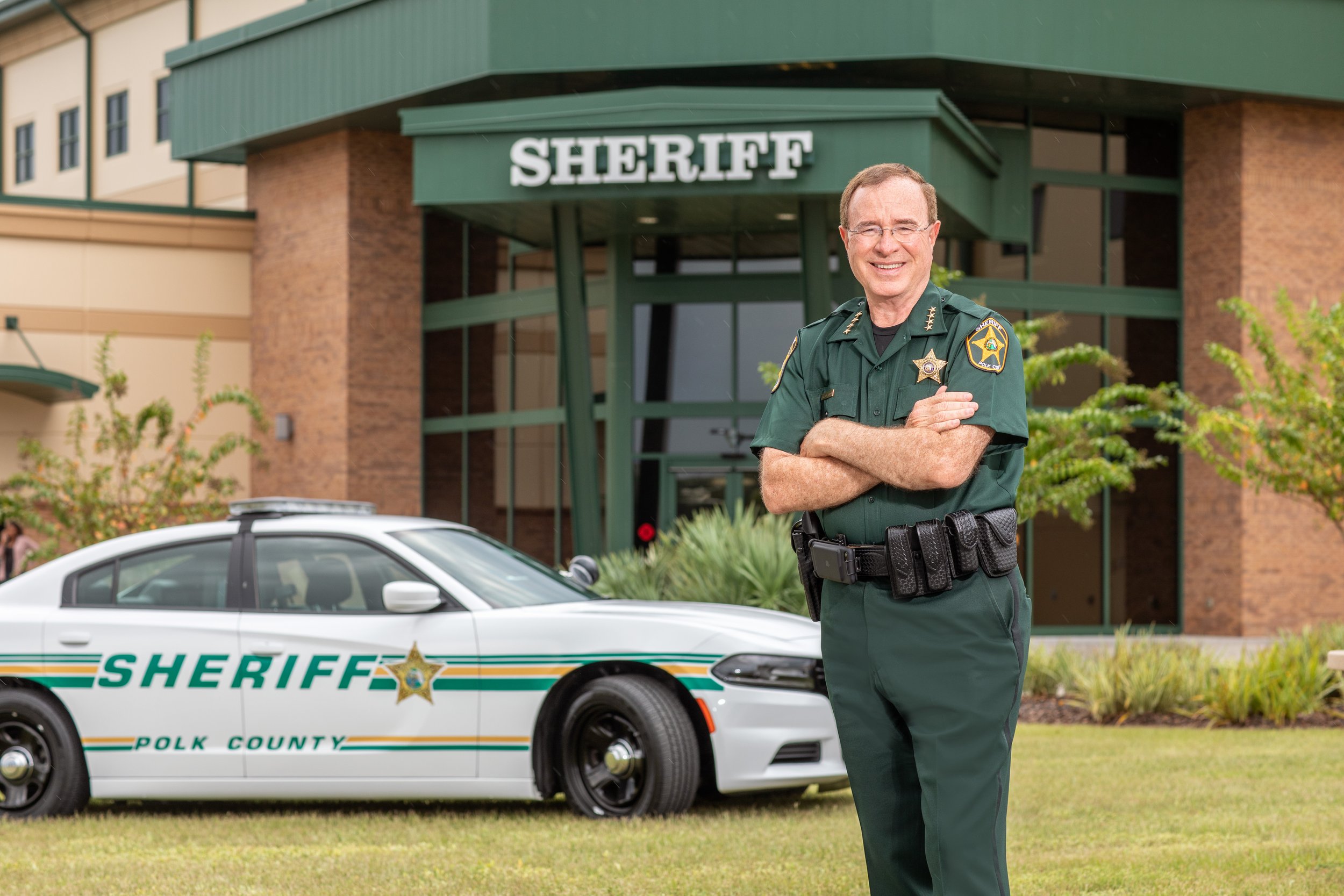
Florida Polk County Sheriff Grady Judd

Florida Polk County Sheriff Grady Judd
By The Blue Magazine Team
Catherine Angel, Shai Carr, Raytheon Martin

Blue Magazine recently traveled to Polk County, Florida to sit down with Sheriff Judd--a no-nonsense law enforcement leader whose directness and honesty is breath of fresh air during these troubling times. In this exclusive and uncensored interview, Sheriff Judd calls it as he sees it, and holds no punches as we discuss many of the controversial current topics affecting law enforcement. Blue Magazine thanks Sheriff Judd and the outstanding officers of the Polk County Sheriff's Department.

The BLUE Magazine: Can you tell us a little bit about yourself?

photo credit: polk county sheriff

Sheriff Grady Judd: Well, I can start out by saying I was born a long time ago. What you see is what you get. I'm the same on television as I am in the office, as I am at home. You see, I found out if you just tell the truth all the time, you don't have to remember lies. And I've also found out that the community loves transparency, and they love people that will stand up and just tell the truth. They may not always agree with me. Heck, I make policy and procedures that I don't even agree with. But after all, this is not about me. It's about the best interests of the community and how we can keep them safe and how we can help them. So, it's an honor to be the sheriff. It's a lifelong dream since I was a little bitty dude. All I ever wanted to do was work for the sheriff's office. I was the first deputy under the age of 21 and the youngest person to ever be sworn in as a deputy.

I married my wife when I was 18 and we raised two wonderful kids and I went to college nights and taught weekend--23 at both the University of South Florida and Florida Southern. And then my boss, Sheriff Crowe, retired and I ran for sheriff, and the people of this community were gracious enough to let me serve them.

In this current anti-police environment that we have now, have you seen any change with your recruitment with your officers?

Sure. I think it's important to point out why we've had an anti-police environment. I call it the hate on the police or the defund the police that you've seen all around the nation. None of that ever came to our community. And for those of you who aren't from here, our county's 2,000 square miles. And we have about 750,000 residents. And while we saw this being perpetrated upon us and upon all the people of this country--that wasn't this community--that wasn't most communities across this nation. So, at the end of the day, why we saw people that weren't peaceful, protesting, throwing rocks and bottles and burning and looting, the opposite occurred here.

If you were in a position up north, how would you handle the situation?

Well, here's the problem with the police chiefs. They're great men and women who have dedicated their lives to this career, but they're surrounded by a political environment. They are either appointed by a mayor who got elected, or they may be appointed by a city manager who works for an elected body. So, they are government employees hired to enforce the law or the rules, OK? They're hired. Follow what I say. So their government's answer to law enforcement in Florida, I'm elected by the people. I am the people's representative to enforce the law. I don't work for a county commission. I don't work for a mayor. I don't work for city commissioners.

But as a chief in that appointed position in those environments, I can stand up and talk until the mayor fires me. But I can't make any meaningful changes.

In some states, we are seeing a lot of officers lose their jobs due to the COVID-19 mandates, not complying. What are your thoughts? Would you fire an officer in your department if they don't comply?

I want to underscore COVID is real and it's dangerous and it's deadly. But a lot of this world's gone nuts over that. And here's what we did here at the sheriff's office and by and large, throughout Florida, while the world was all hunkered down behind masks and then double masks, and then staying home and drawing your kids out of school and all this craziness that occurred. We took a common-sense approach. I said, look, when the vaccine becomes available because I talked to my doctor and he said, take it, I've got a lot of friends that are physicians, and I ask every one of them, “What do you think?” Every one of them said unequivocally to take the vaccine. And I did and I took the next vaccine, and I took the booster. I recommend you take the COVID shot. But let me make one thing abundantly clear. That's your personal health decision, not mine. From day one, long before there was a COVID shot, I will never impose a requirement on you to take this shot. Never. We're not mandating. I encourage it. I educate. It's their decision. It's their life.

What is your message to law enforcement leaders today who are firing officers because of these mandates?

I would resign from office as the chief before I mandated people do things that were against my ethics, my morals and my values.

In the past, we have seen law enforcement leaders kneel to appease these special interest groups. Would you be one to kneel? 

No, I'm not kneeling. I kneel in front of the altar for my Jesus and my God. And that's the only person I kneel for. I am going to work for and with the communities and ensure that there's fairness and there's equality and there's opportunity and I'm going to do what's right. But you write this down in your little book. You won't see me kneeling for a social group.

photo credit: polk county sheriff

What is your biggest barrier or obstacle on fighting crime?

Well, I don't have a big barrier or obstacle for fighting crime. You know, I'll wake up every day. Well, I guess I do have one. There's only 24hours in a day, and that's the only thing that limits us. We certainly fight crime. Our crime rate here is at a 50-year low.

At the end of the day, if you have the right systems and processes in place and you're appropriately funded with the equipment, you can respond and should respond. And I'll go back to my board of county commissioners. They have never, never underscore, never refused us equipment or technology training. Resources. To find what we needed to protect this community.

So, what would you say to the defund the police people?

Well, I would first tell them, let's do some scientific study about defund the police. Then I would look at the defund the police people and say, you're nuts.

Some say your aggressiveness or proactive methods on crime may be unfair to minorities. Others say your direct no-nonsense approach is best suited to protect the citizens. What's your message to both arguments?

Yeah, I can tell you clearly and unequivocally that my African American community looks at me and says, we want more resources, sheriff. We don't want less. I can tell you I don't put up with anything other than treating people equitably and fairly. You know, we're all God's children and to allow children to kill children night after night in these big cities is shameful. But if the cops don't have the infrastructure in place to support them, what can they do?

We as active law enforcement look to our leaders for guidance and support many times throughout our career. In your words, how are you there for your officers?

I'm a street cop at heart. When you go into my office and you look behind my desk, you see a star in a shadow box. It's called First Badge. It says Deputy Sheriff Polk County. I'm a street cop. I recruit the best, I hire the best, and I trained the best. I hold them to the highest standards, and I got their back. Now if they run out here off the edge of the mountain, that's on them. But if they're following the rules and they're following the laws, it doesn't make any difference what other people think. I always have their back. I always support them. Now, if you go out here and get stupid, you know, I'm going to arrest you and put you in jail.

And I've done that. But the reality of it is if you don't support the men and women who do this job, you shouldn't be a police leader--you should get out, get out right now and let somebody if they'll appoint somebody that can defend the police officers, why they're doing their job the appropriate way. What fuels me every day is not sitting behind a desk, looking at spreadsheets. It's being out there with the people and the deputies. I love them. My mom and my dad passed. I got a sister that I loved to the ends of the earth. I got a wife who why she stays with me, I don't know. But there's nobody better in the world. I got two boys. I got 13 grandkids. And after that, after that handful, I love these deputies, like they're my own children. And I can say that at my age, I used to be the youngest guy here. I'm the oldest guy here, but I look at them through the lenses of when I was their age doing this dangerous job. How did I want to be treated? How did I want to be supported? And I wasn't all the time because some people were more concerned at different times of their politics instead of doing what's right. But it's easy for me because I love these people. They're my family. And when I go to a scene, I don't run to the supervisors. I can talk to them anytime I want to go see my deputies.

Your marriage has been pretty much parallel to your career, so how do you keep it going so long?

She gets all the credit. This, you know, I asked my oldest son, who I thought had a great personality and disposition to be in law enforcement, why he never wanted to be in law enforcement. Neither my children are in law enforcement. My son said he didn’t like that when he woke up in the morning, I was gone. And when he went to bed at night, I was gone a lot of days. And he never wanted a job like that. So, my wife is really the fiber of our family. She is a strong Christian woman. She is just wicked smart. I'm married way up and she is supportive of me. Why in the world she picked me or stayed with me? I don't know. But she's the best.

There's a serious issue with law enforcement today where some officers use prescription medication to manage pain. Because of this, many develop addiction to these drugs. How will your department handle this if one of your officers falls victim to addiction?

That depends. I'll give you two episodes. If we have a law enforcement officer that has an emotional issue or a health issue and that falls under health issue, we have infrastructure in place, everything from EAP to medicine to our medical systems, and we certainly look through all of that and work with that and help them. And it's all confidential. It doesn't even come to my attention. Let me give you another example,  about eight or 10 years ago, one of our deputies became hooked on OxyContin and we got a call here the admin office one day and a gentleman said, you know, I really don't mind your deputy coming by. And he comes back, you know, every two or three weeks to count my OxyContin, my pain management, he said. But could you ask him not to come by at 11 o'clock at night? What the heck? Well, it turns out he was stealing the guy's medicine. Well, we fired him and put him in jail, which is what we should have done. So, if someone needs help, we make sure that they get it and the infrastructure is in place if it becomes a work issue, if it becomes a criminal issue as opposed to a medical issue, then they're held accountable, and they can't work here any longer.

We lose more officers to suicide than line of duty deaths. There's an officer right now contemplating suicide. If you're talking to that officer, what would you say?

What I would say is there's always help and there's always tomorrow. And you're not in this by yourself. And we got your back and we're going to help you. And we're not going to let you commit suicide. Give us the opportunity because we know that you've been the leader in the community. We know those stressors have built up on you. We know you have personal stressors in addition to that, but there's ways for us to peel this onion back. To save your life, to save your family and save your career. But we can't help you if you don't let us. And if we hear about it, we'll do everything in our power. There are no resources we won't use to help you. Because you know what, you're worth it, you're doing God's work out here and why would you think you're alone. I'll promise you, you never are.

You've been through five elections. Do you have any intention of slowing down?

Oh no. When I die, you know, you'll know when I don't want to run for re-election anymore because the media will be gathered out watching them bring me out feet first in a pine box. And I tell folks, in all seriousness, as long as I have my health, my wife has her health, we can move the agency forward. I can look out for the men and women, and the people will re-elect me, that's a real important part.

When it's all said and done.

What do you want to be remembered for?

I want to be remembered that I was a cop. I was just a good cop, and I hope to obtain that status. And I love my family and I love my troops.

How has God helped you in your life?

photo credit: polk county sheriff

Well, we wouldn't have a life without God. I look around at nature and I wonder how can you look at the beautiful trees and the birds and the wild animals? How can you look at the grass that grows in the yards and not know there's a God? This stuff just didn't happen. And God is in the center of my life, and I can tell you this from a lifetime of experience, when you get your priorities right, when God's first in your life, your family second and your job’s third, everything will go fine. There's always going to be conflict in your personal life. There could be a lot of stress. I have people say, oh, what about the stress? To me, it's not stress, it’s opportunity. It's opportunity to help and to change and to modify and do good things. You read your Bible. We're all here because God put us in these positions. It makes it real easy for me.

Editor's Point of View

Welcome to another excellent issue of Blue Magazine. As we continue to grow on the national stage, we will continue to speak out against injustices in our profession. We will continue to advocate and promote awareness of law enforcement's great work in our troubling society.

We are experiencing perilous times in America. Our cities are rife with violence, the bloodshed is endless and the innocent lives are stacking up like cordwood, while many self-serving politicians and the greed-driven corporate media exploit these tragedies for gain. Schools, houses of worship, supermarkets and shopping centers are targeted daily for homicide. What's being done to solve this? We endlessly watch politicians and their coconspirators in the media drive purposed narratives for political expediency on the 24-hour news programs. We watch these self-proclaimed experts pontificate ceaselessly, point fingers and blame political opponents/parties; yet, no real progress is made toward solving the problem. We must demand they do something! Stop seeing every tragedy through political lenses, and work together for a solution — yeah, a real solution.

I know the solution, but many don't want to hear it. In a world where God is first, honesty and truth matter, and respect for one another, our country and law enforcement is paramount, we could work toward solving these problems. Yet, in our world, God is last, and those who love and follow Him are shamed. Disrespect for our country and our flag is fashionable to many. Trashing and disparaging law enforcement is not only celebrated but also embraced by many supposedly ethical political leaders. Therefore, we, unfortunately, live in a world similar to that of Stephen King's fictional Castle Rock, where the main character Leland Gaunt's shop, "Needful Things" gives customers the objects of their life's desires, while Gaunt uses them to commit violence against one another. Sound similar?

In my life, I have resigned myself to trust my God — Jesus Christ — to lead my family and me through these treacherous times. If that upsets you, my point is made.

Our upcoming annual valor awards dinner is being held in Davie, Florida, on Friday, Sept. 30 at the Signature Grand. It's sure to sell out, so reserve your seat today. We hope to see you there! This will be a night like no other in our profession!

As always, stay safe and demand truth, justice and intellectual honesty in everything. Blue Magazine exists for this reason. We are glad you are on this journey with us.

George Beck, Ph.D.
Editor-in-Chief

Innovative resiliency: NYPD for Health and Wellness

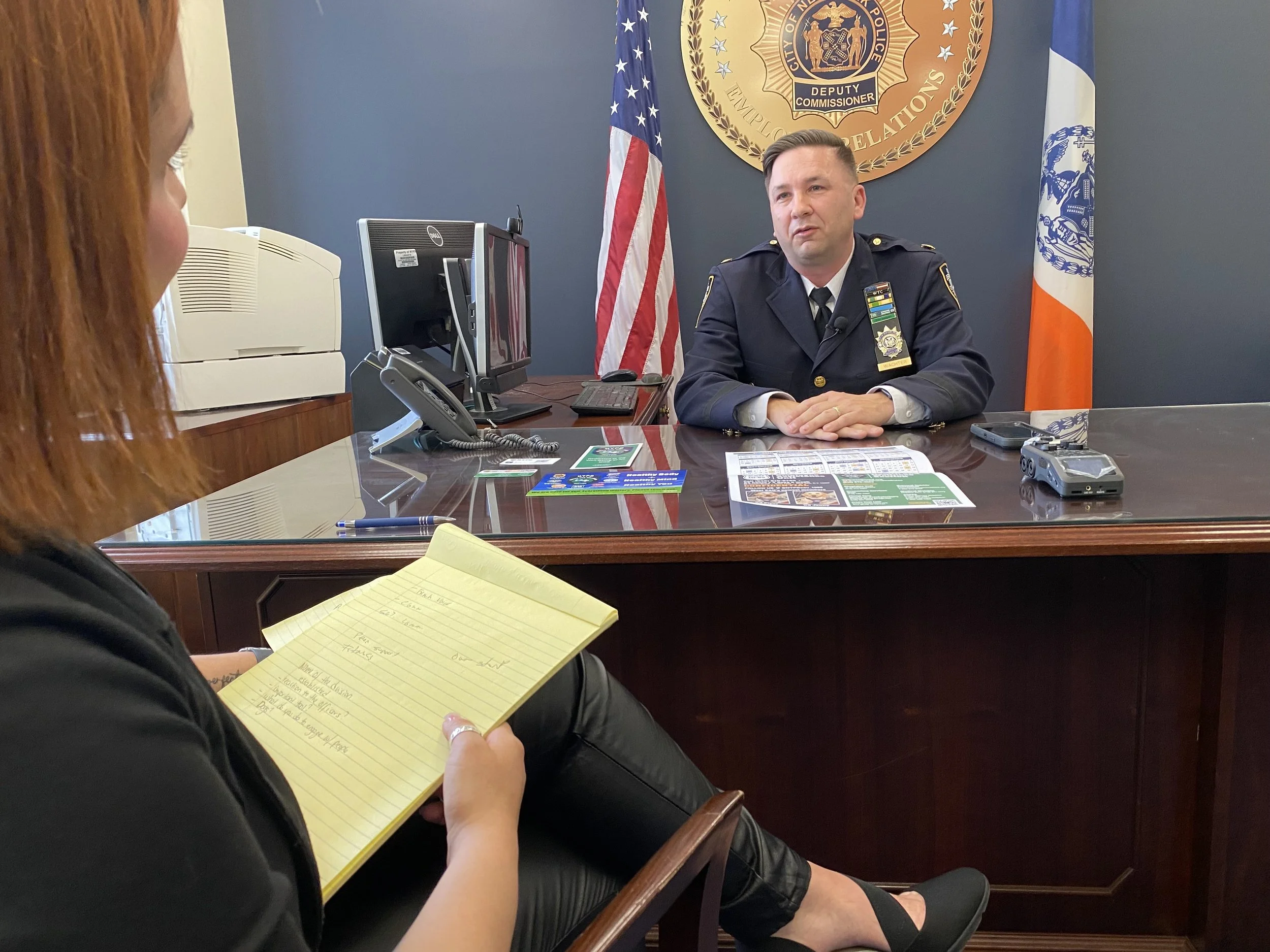
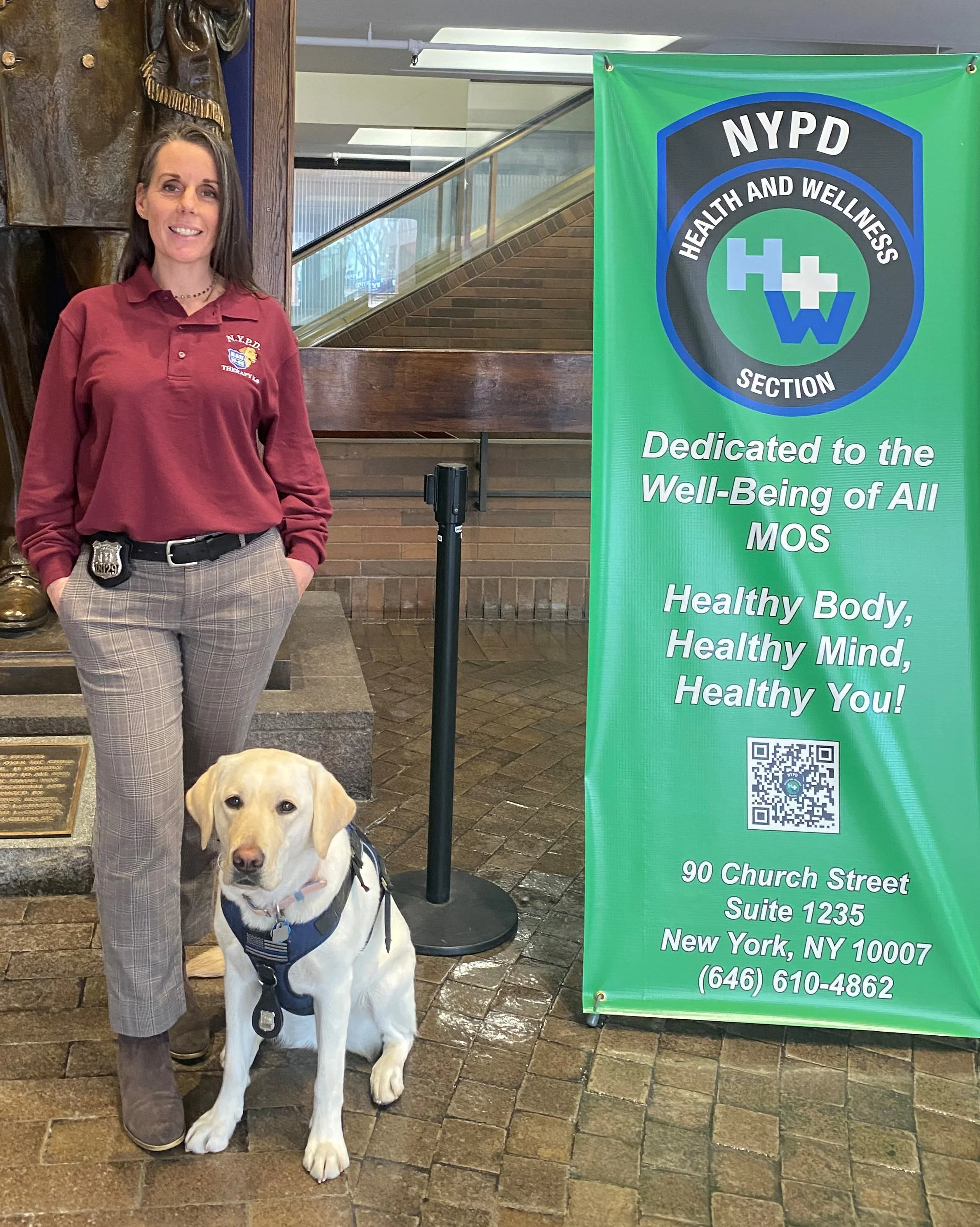
The NYPD Health and Wellness Section was created in 2019 with the intention of providing both clinical and holistic resources to our members, uniformed and civilian, that may not only improve mental and physical well-being, but provide tools to cultivate a more resilient mindset.

Mark Wachter is a deputy inspector in the NYPD and has been on the job for 25 years. He oversees the Health and Wellness Section.

Aaron Lohman is a sergeant in the NYPD Health and Wellness Section. He is a 15-year NYPD veteran and is currently the peer support coordinator, coordinating the peer support program and running the Health and Wellness Social Media page on Instagram. He also provides fitness and nutrition guidance and counseling and personal training for all 55,000 members of the department, both uniform and civilian.

Frank Voce has been a police officer since 2015 and in 2018 went through an extremely hard time in his personal life. He is the founder of the nonprofit organization Reps for Responders. Earlier this year he became a member of the staff in the Health and Wellness Section of the NYPD.

To watch the full interview scan here to go to our YouTube channel

The BLUE Magazine: How do you go about looking out for your officers’ wellbeing?

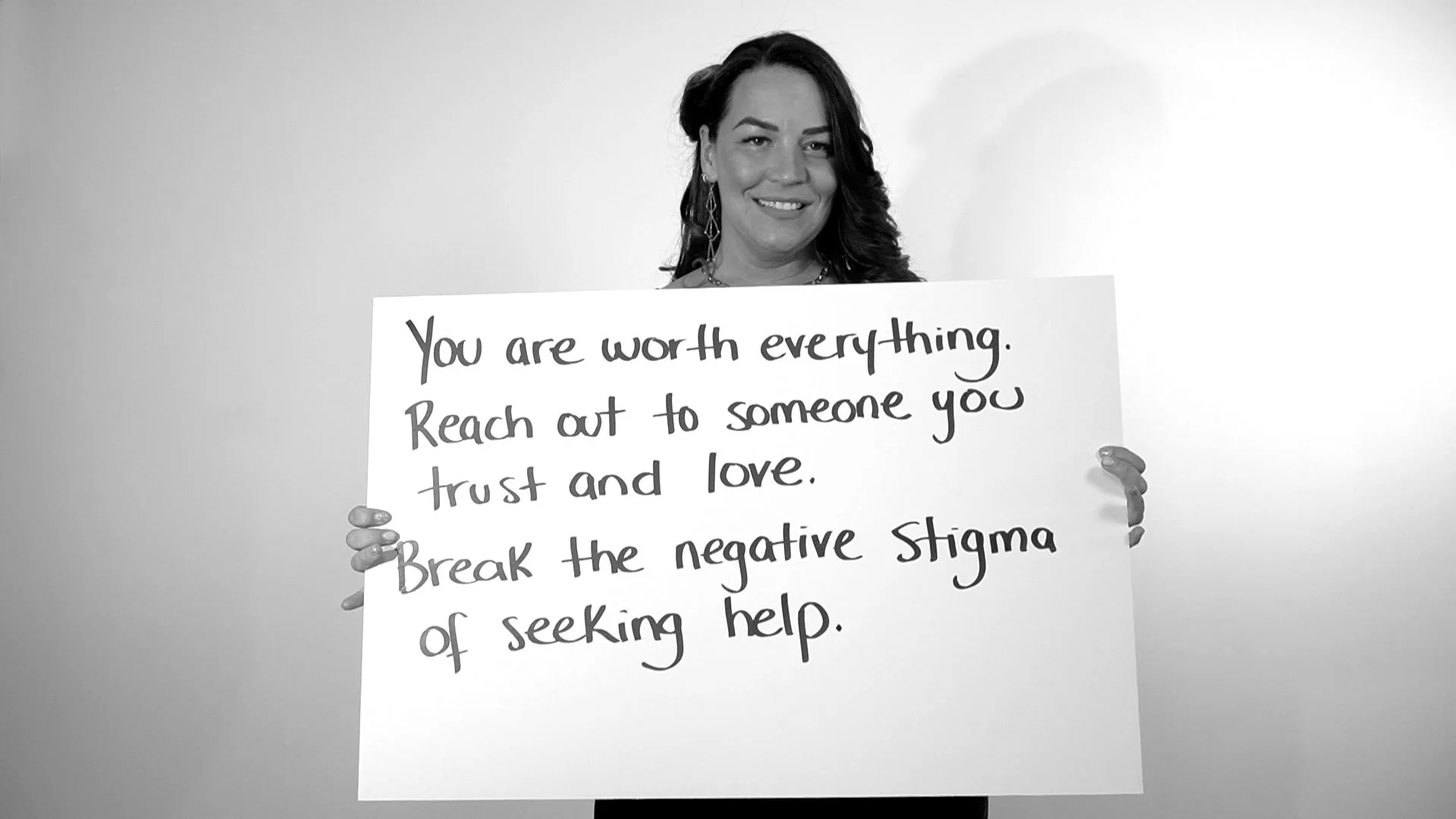
Mark Wachter: We've got to watch out for their mental well-being, their emotional, their spiritual well-being, and even really after they retire from the job. And again, this job is extremely stressful. You know, what our officers see every day, the traumatic incidents that they respond to sometimes just really not a lot of time to process it. And then they go home and how do you explain an incident that was horrific and now you've got to go home and explain that to your loved ones, your children. So what we try to do here is reduce stigma. It's OK not to be OK.

Can you tell us a little bit about why the NYPD chose to come up with this unit? What changed?

Mark: Really what changed is 2019 was just a horrific year for the police department. We experienced 10 members who died by suicide that year, which was just a tragedy for everybody, for the department, their families, for the city. I mean these offices patrolled the streets and built a lot of bridges with the community. So in 2019, you know, we really looked at the practices of what we were doing and we really changed our focus. And it was about the employee.

There are a lot of people who want to work on mental health, but at the same time, don't know enough about it. What is your opinion on this?

Mark: Yeah. No, it's true. And I think a lot of it is teaming up. And what we do in the Health and Wellness section, it's not just about coming to us for help. What we do is we advocate and we advertise every other resource that does similar work because at the end of the day my concern is that you get help. And if you come to us and I say, maybe it would be a different avenue for you to get help, we will guide and navigate you to that.

Should an NYPD officer be scared to come forward to look for help? The reason why I ask this is because at the end of the day, we're all scared to lose our job.

Mark: It's a valid concern. Again, you know, should you be concerned? Yes, it's a fear. It's real. But what I try to do in the health and wellness section is to build that trust. And it takes time. It takes time to build that trust. But by bringing testimonials of people who have gone through the same experience are, yes, you can trust me, you can trust the health and wellness section here.

Aaron, tell us a little bit more about your background.

Sgt. Aaron Lohman I spent a majority of my career as a police officer in high-crime active units, where I made one of the biggest mistakes that I think police officers make is they make the entire job their complete identity. So I was always chasing the bad guy, not looking after myself. I got to a point where in 2010 they took my gun and shield from me because of an incident that happened at work. And it was like my whole entire world collapsed. You know, my identity was taken from me. It was at that point that I looked back. I was over 425 pounds. I was completely stressed out and I wanted to end my life. So I was left with this decision either fix myself, seek help, change my life or end it. So I chose to give in, to surrender myself and change everything about my life. So from that point on, I decided I was going to make my life the best life I could possibly make it. So I started by controlling what I could. Everything in this career just seems so out of control.

I was the type of person who would just constantly fight with everybody on social media about things you couldn't control, whether it was the news or the media or things like that. So I would begin focusing on some of those things that I could control like what went into my brain, what went into my body, and how I used my body. And through doing that, slowly but surely, I improved my mental health by improving my physical health. I've lost over 178 pounds, and nothing stresses me out anymore and nothing bothers me. I've learned to manage my stress. I've learned about resilience.

That's how I changed my life. But what I try to preach to people is find something that you love doing. If you like finger painting, go do that. Find therapy through that. Find therapy through seeking treatment through mental health, whatever it is that you find something you love outside of this job. Because this job takes so much from us and we dedicate so much to it that you have to find outlets outside this job. For me, it’s exercise and working out and I try to impart that on other people because that's what worked for me. And you know, there's a statistic that says, you know, 30 minutes a day decreases severe mental health issues by 25%. You know, and to me, looking at those numbers and look at what I went through, I'm living proof that that is true.

How many hours a week do you workout? What's your routine?

Aaron: About an hour and a half a day. But what I want to impart on people is like when I say that I workout a half hour, an hour and a half a day, that's something I do because I enjoy doing it. Nobody has to start out that way. And literally all I want others to do is start out by doing something three times a week, walking 20 minutes three times a week at a reasonable time. Because as much as fitness and nutrition is about calories and calories out of all this stuff, what it really comes down to is behavior modification and behavior modification and changing your mindset. Your attitude toward exercise and physical fitness is where we all fail. This is why it's so hard. So when you fit it in, in a realistic time frame and you start making it a habit after a certain time period, it becomes second nature. And that's when you build on that.

Aaron, so before you said that when you were not in such a good place, you gave a lot of your time to being a police officer. And now that you're not giving so much time and you're in a better place mentally and physically, does that change? Does it not make you the best cop?

Aaron: I can't speak for anybody else's scenario, but for me personally, when I was giving so much time to being a cop, you think at the time that you're being a good cop because you're putting in those hours and because you're putting in that time. But if you're not taking those breaks and pausing and self reflecting, you're pouring from an empty cup and you cannot be the best police officer or best person or best family man you can be.

Frank, so tell us a little bit about yourself.

Frank Voce: Before I even say anything, I just want to shake Aaron's hand and say thank you for sharing your story and being honest, because that right there is what this whole department and unit is about. I actually left the NYPD and went to a different department. I was diagnosed with major depressive disorder and alcohol use disorder in 2018.

I came back to this job, New York City, because I love being a New York City police officer. I enjoy working in a busy command. But there's also a lot of life experience and things that weren't, I would say, addressed, you know, and police officers have to know also that there's a lot of things that happen in our life. So I said, what could I do to make sure no one ever has to go through what I went through? So I ended up starting a nonprofit. And my goal is to increase the emotional and physical survivability skills of first responders so they can make more responsible choices while they're working or at home.

What would you say to an officer right now who's contemplating suicide?

Mark: What I would say, you know what? A lot of people have been where you are. Come forward, call the health and wellness section. We will guide you where you need to go. And again, it could be our services, it could be other department services, it could be outside resources. But we are here to help you. Don't let the current moment turn into a tragedy. We can make it better. We will walk that journey with you.

Aaron and Frank, what are your hopes for the future for this wellness unit?

Aaron: My hope is just to get the word out, to encourage people, to let people know that what I went through and my story and let them know that they're not alone and they don't have to be alone, that a lot of people are going through what they're going through. And I hope that we just continue to break down those walls of stigma and get more people help through whatever means necessary.

Frank: My hope for the future in the health and wellness section is that more officers see and hear the different stories. And I hope more officers actually come forward and share their own personal story like I did and Aaron did. It goes back to saying, wow, you know, similar experience like me. Now you've got cops coming to you saying they might not even say anything to you about needing help but thank you. You know, we hear you. We understand you. And that is how one helps me stay sober. It helps me stay clean. This is the best thing that has ever happened to me. There's no greater feeling than helping another cop help themselves.

Mark, what are you most proud of in this division?

Mark: In this division, you know what? I'm blessed. I work with some of the most talented people. All the people who work for me are dedicated. They pick up the phone 24/7 and they walk the journey. And that's the great part of being the CEO of this unit. Yes, I can come here and talk about it all day, but the real work is not done by me. It's done by the people who come to work every day. And you see it. They care for people.

Catherine Angel is an active law enforcement officer in the state of New Jersey and journalist for The Blue Magazine.

A SHORT FILM TO END LAW ENFORCEMENT SUICIDE

A SHORT FILM TO END LAW ENFORCEMENT SUICIDE

This film was made after many years of watching our brothers and sisters in blue make the ultimate mistake. We as humans are not exempt from failure, bad times, depression or a mental health crisis. This is why we believe that this film needed to be made in order to remind all of you that life is worth living for. Don't ever feel alone, there are many people here for you. Enjoy this short film and pass it on to anyone you believe may enjoy this beautiful message. Never give up and always be proud of who you are.

Thank you to all the officers from different departments who were part of this beautiful project to save lives.

#BlueSuicide #MomentOfSilence #TheBlueMagazine

Presented by


Saving the Brotherhood: Make the Call

Saving the Brotherhood
By: Monica Eaton

Police work is hard. It’s not for everyone.

Statistics will show cops are at a higher rate for obesity, mental health problems, suicide and divorce.

Cops will often tell you we have a brotherhood. One that exists to protect each other. To put our lives on the line for each other and to “hold the blue line.”

Cops also know that in many departments, that isn’t completely true. Many will tell you that the inside of a department is more of a “dog eat dog” world. We bitch, we complain, we tear each other down.

But why?

Why do we allow a negative work environment to be created within a mostly negative job to begin with?

Cops see people at their absolute worst more often than seeing people at their best. Cops see death, abuse, drugs, stabbings, and shootings, all of it.

We need to do better. We need to genuinely be there for our coworkers and ask them how they are doing. We don’t have to be best friends with everyone. But we can certainly have compassion for all. Everyone is struggling with something.

This goes for all first responders. Check on your coworkers. Lift them up. Be a shoulder to lean on. Be a positive person when there is always negativity around.

I challenge you to reach out to a coworker you don’t usually talk to. Ask them how they’re doing, and genuinely listen.

Take care of each other.

Monica Eaton is the owner/CEO of Five-0 Fierce and Fit which creates online nutrition and fitness programs designed to help female first responders lose fat, gain strength, and take back their confidence in 90 days because “your family depends on you to be fit for duty.” Using her six year Oklahoma law enforcement experience along with her 15-year background in fitness and nutrition she helps female first responders reach their full potential in life and career. Look her up on Instagram @five0.fierce.and.fit

Police Chaplain's Corner: In Hot Pursuit of Truth

In Hot Pursuit
By: Chris Amos

When I look back over my 26+ year career as a police officer, I am reminded of a lot of highs and a low or two or three … Sprinkled in between were a few heart-racing, palms sweating, hair standing up on the back of my neck moments of sheer fear. Without fail the worst, most dire, “this is how I’m going to die” memories all involved vehicle pursuits, specifically the pursuits in which I was riding shotgun. There is something about being a passenger in a pursuit that is not very comforting. Throw in a partner who is experiencing a major adrenaline dump and you have the recipe for disaster. I remember one specific pursuit more than any other.

I was a rookie at the time in 1988. My field training officer, a Vietnam War vet, was going through an ugly divorce and uglier custody battle. Looking back now, I think he believed he would rather die a hero in the line of duty than live the dumpster fire his life was quickly turning into. Sadly, his reckless behavior and tombstone courage would cost him his job and eventually his very life, as he would commit suicide by cop in a neighboring state. A tragic end to a very troubled life. For the sake of this article, I’ll refer to him as simply Bob.

Bob was driving as we heard another unit on the other side of our sector in pursuit of a stolen vehicle. To those of you who may be new to law enforcement, there was actually a time when officers were allowed to pursue criminals. My, how times have changed. Bob immediately activated our lights and sirens and in his “throw caution to the wind” approach set out to cut off the stolen vehicle as it weaved its way in and out of traffic getting closer to us by the second. Bob made a sharp left turn at a high rate of speed onto West 35th Street from Colley Avenue. How he didn’t end up in my lap is a mystery to this day. An unexpected consequence of Bob's driving was my suddenly aerodynamic clipboard. It literally flew past my eyes and out my open window. Bob slammed on the brakes; I bailed out of the car to retrieve what only seconds earlier had been a brand-new clipboard. I jumped back in and off we went the engine screaming as Bob floored the accelerator. By the grace of God, the suspect got to 35th St. and Colonial Avenue about 5 seconds before we did. Had it not been for my runaway clipboard we would have been in the direct path of a stolen vehicle flipping end over end almost six times before coming to rest against a brick apartment building. The suspect, walked away from the scene, in handcuffs of course, but he did walk away. Had my clipboard not taken a massive beating, I am absolutely convinced I would have. I laugh about that story now, but at the time, not so much.

I’d like to share an epic divine pursuit that has been ongoing for 6,000 years give or take. In this pursuit, you and I are being pursued rather than doing the pursuing. Let me explain:

1)     God Walked with Man

The Bible begins with God’s Creation of the heavens and the earth. He creates Adam and Eve. I believe this to have actually happened and not to be symbolic, leaving folks room to come to their own interpretations. Anyway, as the story goes, Adam and Eve sinned or broke God’s law. And with that, the pursuit begins. We read in Genesis 3:8 that upon committing their sin, Adam and Eve hid from God as He came walking in the Garden in the cool of the day. So the first recorded account of God’s interaction with the human race is that of Him walking with Adam and Eve from time to time while not in Heaven. God popping in from time to time to check on His creation before returning to His Heavenly Throne. Kind of like the lieutenant on night shift, who makes an appearance from time to time.

2)     God Lives with but is Separated From Man

As the generations passed, mankind became even more rebellious toward God. God would have been more than just in washing His hands of the human race as a failed experiment, but He did not. Quite the contrary, He did something truly amazing as His pursuit for the hearts and souls of His rebellious creation intensified. 2 Chronicles 7:1-2 tells us that God MOVED TO earth taking up residence in a temporary tabernacle made of cloth initially, before moving into a permanent temple made of stone. It was a love for a rebellious creation that led a loving and just God to move to this earth. He was now with His creation, but separated from them as He inhabited a part of the tabernacle/temple called the Holy of Holies. God’s presence among His people did not lead to their turning over a new leaf of faithfulness. No, like their fathers before them they rebelled, turning their backs on God.

3)     God Becomes Man and Lives, Laughs, Loves, Eats, Cries, with Man

Having continued down the slippery slope of rebellion and sin, intent on self-destruction, God refused to give up on those who had given up on Him. God’s pursuit of His creation went next level when He took on flesh and blood and was birthed by the Virgin Mary. God became man, His name Jesus Christ, the long-awaited Messiah. Jesus Christ 100% God and 100% man. John 3:16 tells us God so loved the world that He would send His son Jesus Christ to give His life on an executioner’s cross to pay the price, the penalty for our sins. Don’t miss that, God became a man named Jesus and Jesus lived with mankind, not separated from them in any way. The God-man Jesus ate with His followers; He laughed, cried, and traveled with this ragtag group of disciples throughout Israel. What would you be willing to sacrifice in pursuit of people who hated you, denied your very existence, and mocked you at every turn? God was willing to sacrifice everything, to include the life of His only begotten Son. He was repaid by His creation with a sentence of death by crucifixion, at least that is what His creation thought they were doing, not realizing it was all a part of God’s pursuit for the hearts and souls of mankind.

4)     God Moves into the Temple of Man’s Heart

What more could God do in His pursuit of men and women, like you and I? 1 Corinthians 3:16-17, 6:19-20 tells us the next level God took. “Christ IN you”. God the Father has taken up residence inside the very lives of those who put their trust in Jesus as Savior and Lord. For that man or woman, their very bodies become the living temple of God in which the Holy Spirit now resides.

In Revelation 3:20, Jesus says that He stands at the door of our heart and knocks. Anyone who opens the door to his or her life and invites Jesus in as Savior and Lord, He promises to enter in, and take up residence in the form of the Holy Spirit. Promising to never leave nor forsake those who put their trust in Him.

Bottom line is simply, Revelation 3:20 tells us God is in pursuit of each and every one of us to an extent we can’t fully comprehend. We have either been caught by Him having chosen to pull over and throw our arms up in the air and surrender. Or we can continue to run. If you are still being pursued, I’d encourage you to pull over, take the keys out of the ignition, and surrender. I can promise you it will be the best decision you have ever made. Take care, be safe, and I hope to see you at the finish line.

Chris Amos is a retired officer and former spokesperson for the Norfolk Virginia Police Department. He is currently the pastor at Chr1st Fellowship Church in Norfolk. He is married for over 30 years and is the proud father of three children, two of whom are police officers. He serves as the volunteer Chaplain for Norfolk Police Dept. and Norfolk Sheriff’s Office.

Officer Strategy: Understanding Human Nature and Basic Drives

BEHIND THE BADGE  - Human Nature and Basic Drives

By Lt. Joseph Pangaro BA, CPM, CSO


In recent times, we have seen several high-profile political people who have engaged in some inappropriate personal behavior: read that a former New York governor and former congressman that were headline news for quite a while. Both men were led astray by their base instincts and inner drives in the arena of personal sexual behavior, the result being the destruction of their careers and pain for their families.

Why would two such prominent men engage in such negative behavior? Were they arrogant in believing they could get away with it? Were they just plain stupid? The surface answer is probably a little of both, but the deeper question is what would drive these men and many others we can name pretty easily to step outside their familial relationships and engage in such risky actions. The answer to this question requires a greater understanding of human nature and the things that drive us as people.

As a police officer, if you want to be successful you will need to understand what makes people tick. We see evidence of this understanding in many of the processes of law enforcement and security organizations. 

Debriefing of a criminal is important. This is an interview that seeks information beyond that which you would need for a conviction in a trial. This type of interview is focused on “why” and “how” the criminal did what they did.

My partners and I would debrief suspects on almost any type of incident, from burglaries to thefts to frauds and especially in sexual cases. The information you learn in these interviews can be the key to preventing future crimes.

Understanding why a person committed a specific crime allows you to put a given set of facts into perspective and reveal patterns in behavior. It is not an exact science, but the information you learn can give the investigator insight into how certain people act and react in different instances.

Take house burglaries, for instance; if you are the victim of a house burglary it is a very difficult thing to accept. The feeling of being violated is ever present; having a stranger come into your home, walk around your house, in your children’s rooms, and go through your personal property can be devastating to some people. In contrast to how the victim feels, in the world of police work a house burglary is rather routine, something that happens quite often. How then do the police respond?

We would like to find some fingerprints at the scene and match them up to a known criminal, but that is not always possible. Some agencies do not process burglaries and some that do are not always good at it. Without that important piece of evidence we are left with hoping a neighbor saw something, noticed a person near the house, maybe they wrote down the plate of a car parked on the street or called the police to report it. These things, too, do not always take place. What we are left with is basic police investigation work 101. That’s where the debriefing interviews come in.

In a previous column, I discussed the reality of “Signature” actions by people who engage in criminal activity. This is where a criminal will find a way of doing their business that works for them. A way of committing their crimes that is comfortable for them and has been successful for them. An example would be the shoplifter who uses a friend to create a distraction to the clerk while they take the merchandise they want. When the team figures out what distraction works best they will use it over and over again; same is true for serial criminals: rapists, killers and other criminal actors.

Burglars are no different; they will choose the same type of houses, or houses in the same place on a block, such as corner properties, or houses that back up to woods. Some burglars will always break out the glass at the basement window, others will always break out the glass in the kitchen, and others will always shoulder the front door. Whatever signature they have, you can predict, to some degree; how, when and where they are likely to strike next. It is with this knowledge, gained from good solid debriefing interviews, that you can make a great investigator out of an ordinary investigator.

This understanding and acceptance that people do have signature actions; things they do all the time because it is comfortable for them, such as always driving in the left lane, or always taking a certain route to work or getting a specific cup of coffee etc. can provide understanding into the human mind. People are creatures of habit. Understanding human nature is a very important tool investigators use to solve crime. Getting good at reading the signatures left by criminals is an individual talent that police officers can develop.

Another “understanding” a good investigator needs to be proficient in is the basic human drives, the things that motivate all of us to one extent or another. These basic drives to eat, sleep and procreate all influence our daily actions.

We all feel the need to eat. We can skip a meal or two, but after a while we get that feeling that we have to eat and we will take actions to ensure we find some food. This drive has an obvious purpose. If we don’t eat, we starve and die, so it’s not something we have a choice about, it’s a drive.

The sexual drive is responsible for continuing our own families on the small scale and continuing the human species on a larger scale. This is one of the most powerful drives we have. By looking to our own experience, we can all come up with examples of how this drive has been a blessing or a curse. We were driven to say hello to someone we liked, which led to dating and maybe marriage or family. That’s a good outcome because the drive was controlled. We also know of people who get themselves in trouble because of their sex drive.

Inappropriate comments, sexual harassment of the kind reportedly experienced in the governor’s office in Albany, is a very clear examples of this drive’s negative side.

Understanding how these drives in our nature make us tick can help us solve these crimes. When does a person go from a healthy sex drive to one that is inappropriate, then to one that is criminal?

These people have signature actions as well as the burglar. The investigator has to simply uncover enough of the facts and actions of a particular crime to begin to see a picture of the person who is committing it. With that understanding we can begin to “think like the criminal” and anticipate when and where they will attack next.Whether it’s is a particular food we can’t live without or a dark desire that invades a person’s mind day and night, those drives can be identified and revealed.

These two important investigative understandings can keep our police ahead of the criminals who prey on us. They need to be properly trained and take the techniques seriously, use them on a regular basis and look for the signatures.

In the end, only the people who engage in these behaviors can explain why they did what they did in any given incident, but the rest of us can be aware of the patterns. It is for this reason that we have to be very careful with serial sexual predators in particular. The sex drive is very powerful. A sex drive that is out of control is dangerous. The reality of Megan’s Laws tells us that the large majority of people with a criminal sexual drive do not change their behavior; they just get better at hiding it. Eventually, many of them will seek to prey on us again.

A serial burglar may be driven by the desire for “things” or money, but a criminal who acts based on a human drive rarely changes. For them we must beware.

Let me know what you think.    JPangaro@Yahoo.com

Lt. Joseph Pangaro retired after serving 27 years at a police department in Monmouth County, NJ, having served as the Lead Training Officer. Pangaro is a graduate of Fairleigh Dickenson University’s Certified Public Managers Program (CPM). He’s a newspaper columnist who writes about the rigors and joys in law enforcement. Joseph Pangaro is the CEO and President of Pangaro Training and Management, and Pangaro Global Training, an online training company. E-mail at: JPangaro@TrueSecurityDesign.com www.TrueSecurityDesign.com

Body Armor Failures: Is An Extra Three Inches Too Much To Ask For?

Is An Extra Three Inches Too Much To Ask For?
By: Kirk Lawless

Three inches extra doesn’t seem like too much to ask for; especially when it comes to your safety and well-being. I’m talking about your body armor, so listen up.

We’ve come a long way in the technology of body armor and its ability to stop a projectile from entering your body. The misnomer since we started this journey was the use of the term “bullet proof.” We now refer to it as “bullet resistant.” That’s a simple way to say “There is no guarantee that body armor will 100% stop anything fired upon us from getting inside our bodies uninvited.”

When you’re a young copper, (myself included) you feel a bit invincible, even more so when that vest goes on and you head out to your shift. You may be gullible and accept what your department spoon feeds you. Or, you’ll do your own research and pay attention, at least to this article, or something similar and enlighten yourself.

First, there are some cops who just flat out refuse to wear body armor, ever.  That’s just foolish. Now, there are special circumstances when body armor is impractical, such as working in an undercover capacity, narcotics for instance. 

If you don’t wear any body armor and some shit bird wants to put metal to your meat, it will happen with monotonous regularity! I know lots of cops who have been shot and survived, some got penetrated, some were saved from grievous injury by their body armor. Some were killed, when obviously hit somewhere that wasn’t protected by body armor. Some got shot up so bad they had to go off the job. Many ended up paralyzed.

28 May 2012, one of my police brothers got bushwhacked by an asshole who popped out of a dumpster and hit my friend three times. Over a television taken in a home invasion robbery. Hit three times and lying on the asphalt, my friend couldn’t move, but he heard enough movement near him that he believed the guy was coming back to deliver the coup de grace. That did not happen. His assailant was captured. My good friend was paralyzed and to this day is confined to a wheelchair.

Here’s the lesson. The politicians and brass (for the most part) do not give a solitary damn about us, especially when it comes to money. 

Corporate America is usually protected by the courts, and the cities and police department are often granted “sovereign immunity.” My friend found out that there was a problem, a huge problem.  The problem was with his body armor.

Quite simply, the vest failed him. Just like the police department failed him, just like the politicians failed him.

My brother filed a lawsuit against the city, the PD and primarily, the body armor company. Not shocking, the city, the PD and everybody else involved on that end were quickly off the hook. That left the body armor company holding the bag.

Here’s what my brother officer and his wife (expecting their first child when he was shot) learned.  One of the rounds that entered his body did so after passing through a panel of his vest. The vest company argued that because of the trajectory of the bullet, once fired, it could not be stopped by their product. Just like that.  The company added that the outer three inches around each panel was incapable of stopping projectiles (within their NIJ rating) 81% of the time. Eighty-one percent! Did you know that? I didn’t! Take your vest panels out right now and measure three inches all the way around that thing and see how much less coverage there is, where you stand a 19% chance of it stopping a projectile!  Now check the date on that thing. If it’s expired (or getting close) demand a new one! Right now!  Would you drink spoiled milk or chug the last of the bottle at midnight on the expiration date?

Inspect it from every angle.  Check for creases or bunched-up areas in the panels. Guess what?  Those are weak spots. And weak spots are potential entry points for metallic things, traveling at high velocities, wanting to play hide and seek in your guts with a trauma surgeon.

The vest company won the case in court. The company suggested that when it instructed all of us on how to wear a vest (nobody ever told me about how to wear a vest in 28 years on the job) after we were fitted (“fitted” as in a tape measure thrown around your chest and “Hey, Charlie this guy’s a 2x). They also suggested that the vest overlap, front panel over rear panel.  This is all bullshit. If we were lucky the panels touched or maybe came close.

My suggestion, wear a military armor plate carrier with side plates and anti-spall coating. 

Look on YouTube for the CEO of the vest company (PPSS) testing his own product, or look up Richard Davis, who has shot himself more than 200 times while wearing his product.

As far as the brass and politicians are concerned, “It’s cheaper to bury a cop, than fix one.”

Three inches would cost them a little over $50 per vest. Certainly we are worth way more than that!

Kirk Lawless is a 28 year, decorated, veteran police officer from the St Louis area. He’s a former SWAT operator, narcotics agent, homicide investigator, detective and Medal of Valor recipient. Off the job due to an up close and personal gunfight, he now concentrates on writing. He’s a patriotic warrior, artist, poet, actor, musician, and man of peace.

Stay Focused: Law Enforcement is Making an Impact

We can indeed make an impact
By: Dale Gabriel

This Pennsylvania State Police Memory is actually one from just a few years back, long after my retirement. In law enforcement, it can often be very difficult to know if you are actually making an impact or not. You are typically seeing people at their worst most of the time. Car crashes, victims of crime, delivering bad news, arresting them, issuing them traffic citations. That is one of the biggest reasons I really enjoyed doing programs, working with kids.

Today's world, including many of our political leaders and the media, display not only a total lack of respect, but also a complete hatred for police officers. They seek out the worst, a very small percentage of bad things, and make it seem like this is ALL law enforcement. I try to remember and point out to my current brothers and sisters in blue to never forget that every little thing you do matters. You can make an impact on someone's life with just the smallest gesture.

A couple years back, I was at a funeral home paying my respects to a fallen local firefighter. A familiar-looking young lady, probably early to mid- 20s kept looking at me, giving me THAT stare. My wife even noticed, as long-time police wives do, and asked if I had any "dealings" with her. It was just a reminder that being a police officer affects not only you, but also your entire family.

Finally, the girl approached me and asked that "loaded" question. Are you Trooper Gabriel. Everything rushed back. I hoped that I had not arrested her or a family member. I reluctantly told her that I was indeed Trooper Gabriel, but that was a lifetime ago, that I had retired a few years ago.

She then told me that I gave her Brownie Troop a tour of our station about 16 years ago, and that I was so cool! It made me chuckle. Cool? I am not often mistaken for someone "cool." As our station's community service officer, my absolutely FAVORITE part of the job, I had put on hundreds of programs, tours of the barracks, programs for schools, scout troops, church groups, 4-H, and so many more. It was DEFINITELY my favorite thing in my career. I loved anything with kids, really. I worked steady midnights, so often; I did these on my own time just because I loved it so much.

Anyway, she went on to tell me that the program made such an impact on her. She told me that it was informative, but fun, and scary, yet exciting all at the same time. She reminded me that I handcuffed her leader, smacked something with my expandable baton, things I knew that I always did during programs. And I chuckled a bit. She went on to tell me that she remembered so much that I told her troop about what it was like to be a police officer that she never forgot, including difficult things like relaying death messages. I thought what a weird thing for a kid to remember, but that led to her telling me that her mother was killed in an accident a few years after that, and it made her think of me. While mourning the loss of her mother, she felt bad for the trooper who had to tell them.

We chatted for a few minutes. She told me she had 3 kids and can't wait for them to be old enough to do things like learning about the police as she did. She hugged me and thanked me, and told me she was happy I was retired and "never got shot or anything."

I thanked her for the memory. I am a very emotional person. Needless to say, as she walked away, I shed some tears. It served as a great reminder of how we can indeed make an impact, even when we do not realize it.

Dale Gabriel is a retired patrol and community services officer with the Pennsylvania State Police. After 25+ years of service, in retirement, he has been working on a book of his many PSP memories. He also coaches a baseball team in a Miracle League for those with special needs. He holds a communication degree with English minor from Saint Vincent College in Western Pennsylvania.