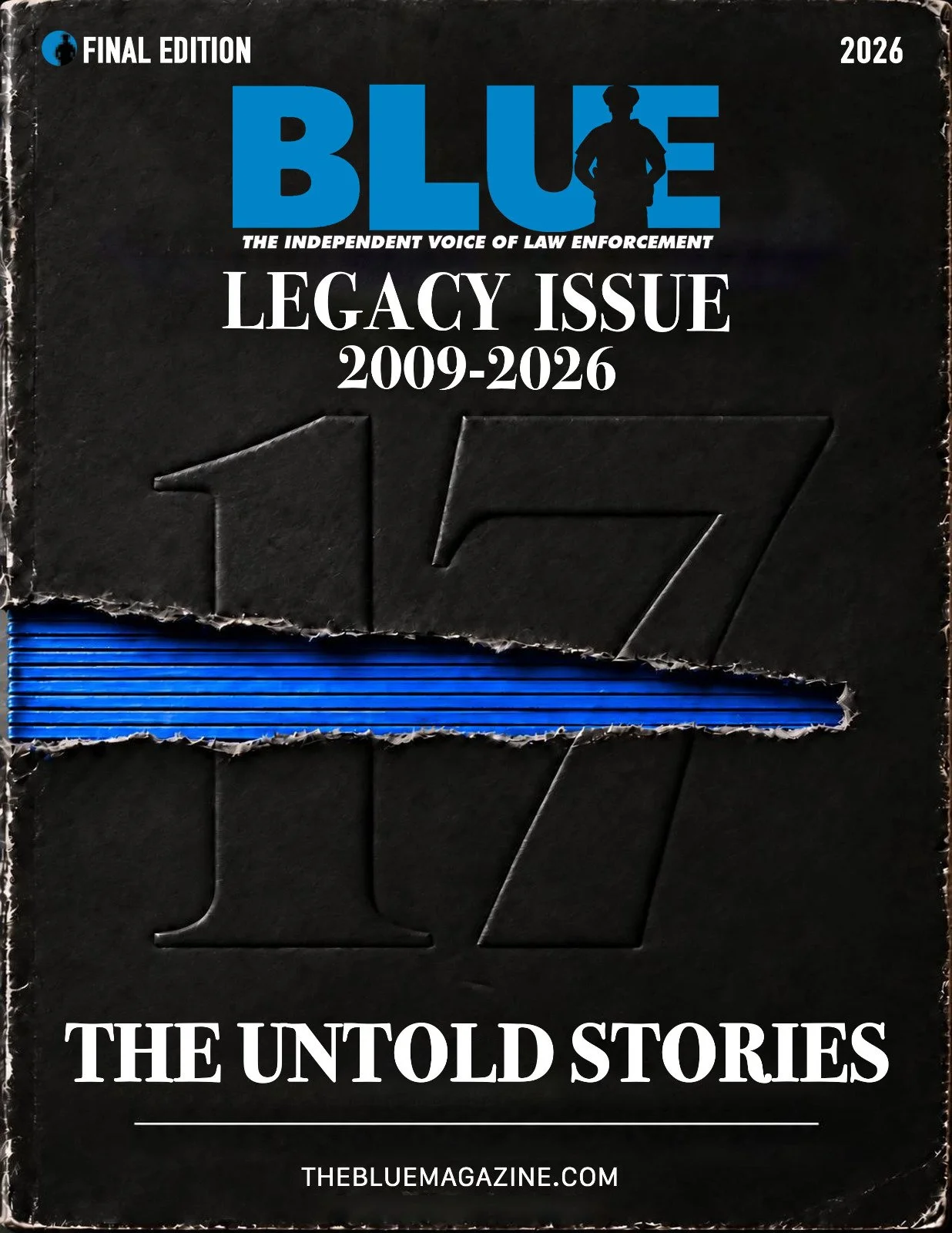
The Blue Magazine our final issue seventeen years later there is a question I have been asked many times over the years.
“Why did you start The Blue Magazine?”
The answer has changed with time. When I started what would eventually become The Blue Magazine, I wasn’t trying to build a national publication. I wasn’t trying to interview presidents. I wasn’t trying to reach the White House. I simply believed the men and women in law enforcement deserved a publication they could call their own.
At the time, there were stories that weren’t being told.
There were officers on the job whose voices were never heard. There were families making sacrifices that rarely received recognition. There were leaders trying to improve the profession while carrying responsibilities most people would never fully understand. I wanted to create a place where those stories could live.
Not through politics. Not through sensational headlines. Through conversation. Through trust. Through journalism. The magazine began as NJ Corrections Now because that was the profession I knew. Like many things in life, however, what begins with one purpose often grows into another. As the publication expanded, so did the people willing to believe in it. One of the first was Tony Williams. Tony was a Delegate with New Jersey State PBA Local 105.
At the time, NJ Corrections Now was just getting started. I remember sitting with him and explaining what I hoped the magazine could become. He believed in it. That wasn’t a small thing. In those days, some questioned why a union should help a new publication grow. Why help someone become more influential?
Tony never looked at it that way. He looked at me and said, “Danny, you’re going to build a powerful magazine.”
Then he did something that changed everything. He opened doors. Because of Tony’s support, New Jersey State PBA Local 105 embraced the magazine. They contributed articles. They supported us through advertising. Most importantly, they gave us credibility at a time when credibility had to be earned.
Looking back, Tony wasn’t simply helping a publication.
He was investing in a person he believed in. That became one of the first lessons The Blue Magazine ever taught me. Sometimes all it takes is one person willing to open a door. In law enforcement, that’s what family looks like.
Someone believes in you before you’ve proven to everyone else why they should. Tony Williams was that person for me. As the magazine continued to grow, another relationship helped shape its future. Steve Olimpio was serving as President of Paterson PBA Local 1 when we first met. People told me I needed to meet him.
So I did.
I walked into the PBA office without an appointment. We sat down and talked. Steve was direct, honest, down to earth. From that first conversation, he understood what we were trying to build. He began supporting the magazine with articles, advertising, and introductions throughout law enforcement. But what I remember most wasn’t the support.
It was the friendship. Over the years, Steve became one of my closest mentors and friends. One moment has always stayed with me. We attended the New Jersey State PBA Convention in Atlantic City together. As we walked through the convention hall, Steve introduced me to person after person. Union leaders, law enforcement leaders, friends from across the state. Every introduction expanded the magazine’s reach. More importantly, every introduction came with trust. Steve wasn’t simply introducing me. He was telling people, “You can trust this guy.”
That meant everything.
His belief in the magazine opened doors that would have taken years to open on my own. It reminded me once again that this profession is built on relationships. One introduction, one conversation, one person willing to stand behind another. Around that same time, I was introduced to Jim Durkin, then President of the New Jersey Police Honor Legion.
We met several times, usually over meals, talking about law enforcement and the magazine. As Jim got to know me and understood what we were trying to build, the relationship grew. During one of those meetings at a diner, he reached for his phone and began making calls. “Hey, I’m sitting here with Danny. He has a magazine, and I want you to help him.” Then he called someone else. And another.
In that one sitting, he connected me with law enforcement leaders throughout New York, Connecticut, and beyond. I sat across the table and watched the magazine grow with every phone call. Jim also believed the name NJ Corrections Now no longer reflected what the publication had become. The mission had grown beyond one profession. He looked at me and said we should rename it NJ Blue Now.
He was right. We made the change. Years later, we placed Jim on the cover. By then he had become more than someone we interviewed. He had become a trusted friend. Looking back, his greatest contribution wasn’t simply introducing me to people. It was helping us see that the magazine’s future was bigger than we had imagined. By then, the magazine was no longer something people were simply curious about.
It was becoming something people wanted to be part of.
Every introduction led to another conversation. Every conversation opened another door. Before long, our team found itself sitting across from leaders, officers, union representatives, and public servants from every corner of the profession. Every invitation reminded us that The Blue Magazine wasn’t covering law enforcement from the outside. We were part of the profession. Our responsibility was to document it honestly. As the years passed, those conversations carried us beyond New Jersey. We found ourselves traveling across the country.
Sometimes to cover tragedy, sometimes to celebrate, sometimes simply to listen. No matter where we went, one thing never changed. The uniform looked different, the badge looked different. But the profession was the same. That realization changed everything. It was no longer about building a New Jersey magazine. It was about serving a profession.
One assignment changed the way we looked at journalism. Until then, we thought of ourselves as a New Jersey publication. That changed the first time we traveled to Chicago. At the time, Chicago was making national headlines because of the violence. Everyone was talking about the statistics.
We wanted to understand the people behind them. So our team went. Not to report from a hotel. Not to repeat what everyone else was saying.We walked the neighborhoods. We spoke with residents. We spoke with law enforcement officers. We spoke with people living in the middle of the violence. While we were there, another shooting took place. Someone had been killed. The tension wasn’t something you could read about.
You could feel it.
As we continued talking to people, one issue kept coming up. The gangs.
No matter who we spoke with, the conversation always returned to the same problem. That assignment reminded us that statistics tell you what happened. Standing in the street helps you understand why. When we returned home, we didn’t simply publish another article. We put Chicago on the cover because we believed law enforcement deserved to understand what officers and communities there were living every day.
That trip marked a turning point. We stopped thinking like a regional publication. We started thinking nationally. Not every assignment took us into a city. Some took us into moments no family ever wants to experience. Over the years, our team traveled to line-of-duty funerals across the country. Most of the officers we honored were people we had never met.
That never mattered.
They were part of our profession. Every funeral reminded us of something. The brotherhood is real. Departments traveled from every corner of the country. Thousands of officers stood shoulder to shoulder. Families who had suffered the unimaginable found themselves surrounded by people they had never met but who understood exactly what they were going through.
Our responsibility wasn’t simply to photograph those moments. It was to preserve them. To remind people that behind every badge was a son. A daughter, a husband, a wife, a father, a mother. A family forever changed. Those assignments never became routine. They couldn’t.
The hardest stories we covered were often the ones that never appeared in the magazine. Over the years, officers on the job reached out because they were carrying burdens they believed no one else understood.
Some came to the office, some called late at night. Some simply needed someone willing to listen. Many of those conversations remained private.They were never meant to become articles. Sometimes we connected officers with people who could help. Sometimes we found resources. Sometimes we simply sat together until they knew they weren’t alone. Many of those officers found their way through difficult seasons, returned to work, completed their careers, and retired with pride.
Knowing they found their way forward remains one of the most meaningful parts of our journey. There is one conversation I will never forget. An officer came to my office during a difficult time. We talked for a long time. I knew he was struggling.
Before he left, I encouraged him to get help. After he walked out, I couldn’t shake the feeling that something wasn’t right. A short time later, I learned he had taken his own life. That news stayed with me. It reminded me that every badge represents a person. Every person has a family. And every family carries a story that continues long after the headlines disappear. That conversation changed me.
It also changed the magazine. It reminded us that sometimes the most important thing you can do isn’t ask another question. It’s simply listen.
Those experiences also shaped the way we approached interviews. We never wanted conversations to become public relations. If someone agreed to sit down with The Blue Magazine, they deserved honest questions. So did our readers. That philosophy followed us into every interview.
One of the most memorable interviews took place at Fox News headquarters in New York. Our team sat down with Judge Jeanine Pirro. The interview moved comfortably until the final question. It involved a controversial prosecution from years earlier.
She looked at me and said, “That’s a stupid question.”
Then she said it again. I respectfully explained why I believed the question mattered. A few moments later, she answered it. When the interview ended, the tension disappeared. We continued talking with mutual respect. That interview reminded me that respect isn’t avoiding difficult questions. Sometimes respect means believing someone is willing to answer them honestly. Another interview challenged people for a completely different reason.
It was Michael Dowd. Many people questioned why we would interview him. Some questioned why we would ever place him on the cover. We understood those concerns. But we weren’t asking whether people approved of his past. We were asking whether law enforcement could learn from it. During our conversation, we talked openly about corruption.
About choices. About consequences.
Michael never asked us to erase what he had done. He wanted officers to understand where those decisions lead. Over the years, something became clear. Whether people agreed with it or not, there were officers who related to him. Not because they admired what he had done.
Because they saw someone who had fallen, accepted responsibility, and was willing to speak honestly about the consequences. Sometimes an officer in crisis will open up more to someone who has made serious mistakes than to someone who appears to have lived a perfect life. Michael understood that.
If one officer read his story and decided not to cross that line…If one officer chose integrity over corruption…
If one officer asked for help before making a decision that would destroy a career…Then telling his story had value. That was our responsibility. Not to make people comfortable, to make them think. One interview led to another. Before long, we found ourselves sitting inside the office of Bernard Kerik. It wasn’t a television studio. It wasn’t a press conference. It was his office at his home in Franklin Lakes. The walls told the story before he ever spoke.
Photographs, awards, memories from a lifetime of service. We talked for hours, about policing, leadership, and national security. The future of the country. What impressed me wasn’t his résumé. It was the depth of his thinking. By then, Bernard had already endured some of the hardest years of his life. Many people believed his story was over. He didn’t.
He wasn’t looking for sympathy. He wanted to continue contributing.He wanted to continue serving. Our team believed people deserved to hear that voice. That first interview became the beginning of a friendship that lasted for years. Over time, that friendship grew into something far beyond journalism. Bernard became an advisor to The Blue Magazine and one of its strongest supporters.
Year after year, he stood before hundreds of officers from across the country as the Master of Ceremonies at our events, bringing the same authenticity, conviction, and leadership that had defined his career. He believed in what we were building because he believed the law enforcement profession deserved an independent voice. What I appreciated most wasn’t his résumé. It was his character, he invested his time. He shared his advice. He never hesitated to offer perspective when I needed it most. Like every relationship that became part of this journey, our conversations extended far beyond interviews. We talked about leadership, service, redemption, the future of law enforcement.
The future of the country. He reminded me that a person’s life should never be defined by a single chapter. He understood adversity because he had lived through it. He also understood that purpose doesn’t end because life becomes difficult. If anything, adversity reveals character.
That lesson stayed with me, I miss our conversations, I miss his friendship. I miss his advice. Most of all, I miss the perspective he brought to every discussion.
More than anything, Bernard reminded me that people are more complicated than a headline. Sometimes the most valuable lessons come from people who have experienced both extraordinary success and extraordinary adversity. That lesson stayed with me long after the interview ended. Looking back today, I realize Bernard’s greatest influence on my life wasn’t a single interview or a single conversation. It was the example he set.
He taught me that leadership isn’t about never falling. It’s about having the courage to get back up. He taught me that redemption is possible. He taught me that experience has value, even when life has been imperfect. Most of all, he reminded me that every person deserves to be understood as a complete human being not reduced to a single moment, a single headline, or a single chapter of their life.
His passing was a tremendous loss for the law enforcement profession. For me, it was also the loss of a trusted friend, advisor, and mentor. I will always be grateful that The Blue Magazine gave me the opportunity to know the man behind the public figure. That friendship remains one of the greatest gifts this journey ever gave me.
By the time the magazine had grown nationally, one thing became clear. Relationships matter. Not because they give you access. Because they reveal character. One of those relationships eventually took our team to the White House. Years earlier, I would never have imagined that The Blue Magazine would be interviewing senior White House officials.
Yet there we were.
Our team had been invited to interview Tom Homan. George Beck led the interview, Holly Finley was there. Christy was there, Jordan Beck was there. When the day arrived, I wasn’t able to enter the White House because I didn’t have a REAL ID. So while our team walked through the gates of the White House, I remained outside. Oddly enough, I wasn’t disappointed. I was proud.
Watching our team walk through those gates reminded me that The Blue Magazine had never been about one person. It had always been about the people who believed in the mission. Then Holly’s phone rang. It was Tom Homan calling from inside the White House. He asked to speak with me. When I got on the phone, he simply said,
“Danny, meet me for lunch when we’re done.”
After the interview, we met at a nearby restaurant. We spent the afternoon talking about law enforcement, the country, and the challenges ahead. The Secret Service remained nearby, but the conversation itself was simple. That afternoon has stayed with me. Not because it happened after a White House interview. Because Tom Homan didn’t have to make that call.
He knew I hadn’t been able to join the interview. He reached out anyway. That small gesture told me everything I needed to know about his character. Sometimes you learn more about a person after the interview than during it. Tom Homan was one of those people.
Another interview reminded us what keeping your word looks like. Our team had arranged a phone interview with President Donald J. Trump. The timing couldn’t have been more unusual. It took place on the morning he was leaving for New York to surrender for his arraignment. The entire country was focused on that moment. He could have canceled, no one would have been surprised.
Instead, he honored his commitment. We completed the interview. When the interview ended, he boarded his plane and flew directly to New York. Whatever someone’s political beliefs may be, that moment left an impression on our team. Keeping your word matters. It mattered to him. It mattered to us. That interview became another reminder that character often reveals itself during difficult moments, not easy ones. Our philosophy never changed. We didn’t interview only people we agreed with. We interviewed people the profession wanted to hear from.
That included Governor Phil Murphy. Many readers questioned why we would sit down with him. The answer was simple. He was the Governor of New Jersey. Law enforcement deserved to hear his perspective directly. The interview was conducted by Holly Finley a retired NYPD officer, and Catherine Angel, a Paterson police officer. They asked difficult questions.
COVID, Public safety.
The concerns officers had throughout New Jersey. Governor Murphy knew those questions were coming. He answered them. We didn’t always agree. We weren’t supposed to. Listening to someone isn’t the same as agreeing with them. Sometimes, it’s simply the responsibility of good journalism.
Later, Holly Finley and my daughter, Alyssa Del Valle, sat down with New York City Mayor Eric Adams. As a former New York City police officer, he understood the profession. The conversation centered on morale within the NYPD. Many officers believed they were no longer being supported the way they once had been.
We wanted to ask those questions directly. Not to argue, not to create headlines. To give officers a voice. When the interview ended, the respect remained. Those interviews reinforced something important. Listening to someone is not the same as agreeing with them. Our responsibility was never to represent a political party.
It was to represent the profession. That meant sitting down with conservatives. It also meant sitting down with Democrats. If the conversation mattered to law enforcement, it mattered to us. Another relationship grew over time with Sheriff Joe Arpaio. Long before we met him, he was already one of the most recognizable names in American law enforcement.
When we finally sat down together, he was exactly as people described. Direct, confident, unapologetic. Over the years, that interview became a friendship. Sheriff Arpaio attended our events. He supported our mission. One day he told me why. He said he respected us because we were “straight shooters.” We weren’t trying to please everyone, we weren’t trying to become popular. We stood behind the profession. Coming from Sheriff Arpaio, that meant something. He respected people who stood for something. Whether people agreed with them or not.
Looking back, that friendship reminded me that authenticity attracts authenticity. Not every cover featured a politician. Some honored the profession itself. One of my favorites was Detective Steven McDonald. For generations of officers, Detective McDonald represented courage, forgiveness, resilience, and faith.
When we placed him on the cover, it wasn’t because he was making headlines. It was because his life represented something every generation of law enforcement officers could learn from. Not long before he passed away, we had the opportunity to spend time with him during an event in New York. It wasn’t about publicity.
It was about honoring a man whose example had inspired countless officers throughout the country. Some stories deserve to be remembered. Detective Steven McDonald’s story was one of them. Another cover carried an even more personal meaning. It was Sheriff Edwin Englehardt.
Long before The Blue Magazine existed, Sheriff Englehardt unexpectedly changed the course of my life by giving me the opportunity to begin a career in law enforcement. Years later, I had the privilege of placing him on the cover of The Blue Magazine. By then he had been retired for many years.
Our interview wasn’t simply about looking back at his career. It was about leadership. At a time when many leaders seemed willing to bend under public pressure, I wanted today’s leaders to hear from someone who had led with strength, conviction, and unwavering confidence.
Sheriff Englehardt believed leaders should lead.
He believed respect was earned through integrity, accountability, and the courage to make difficult decisions. He never believed leadership meant surrendering your principles because public opinion had changed. Those conversations reminded me that leadership isn’t measured by popularity. It’s measured by character. When the interview ended, I realized it meant as much to him as it did to me. Years after he had given a young man an opportunity to serve, I was able to honor him by preserving his story for future generations.
Sheriff Edwin Englehardt has since passed away, but the lessons he shared continue to live on. His leadership, his values, and his example remain part of the foundation upon which I built my own career. Looking back, I realize none of these interviews were really about famous people. They were about lessons, every person we met left us with something. Some taught us leadership, some taught us redemption.
Some taught us resilience. Some taught us humility, every one of them helped shape The Blue Magazine.
And in many ways…They helped shape me.
If readers only saw the finished magazine, they saw only part of the story. What they didn’t see were the late nights. The deadlines, the phone calls, the debates over headlines. The last-minute interviews, the miles traveled. Or the people who quietly made every issue possible. No publication survives for seventeen years because of one person.
It survives because a team refuses to let it fail. George Beck became the editorial foundation of The Blue Magazine. As Editor-in-Chief, he challenged us to think deeper, ask better questions, and never settle for easy journalism. More than that, George brought something else to the magazine.
Faith.
Every event we held, George gathered everyone together before it began. He prayed. He reminded us that whatever success The Blue Magazine had achieved wasn’t ours alone. It belonged to God. Looking back now, I realize how much that influenced me. When I started the magazine, my relationship with God wasn’t what it is today. Over the years, this journey brought me closer to Him. Not because everything went well.
Because it didn’t. There were victories, there were failures. There were moments of uncertainty, there were friendships. There was loss. Every one of those experiences changed me. The magazine didn’t simply document the profession. It changed the person I became. Joe Gordon became another example of commitment.
Whether he was writing, editing, or helping shape an issue, Joe always found a way to contribute. Even after losing his leg, he never stopped serving the magazine. From his hospital room, he was still discussing articles. Still editing, still looking for ways to help. That kind of commitment can’t be measured. Holly Finley became the person who quietly kept everything moving. As Executive Director, she was involved in nearly every part of the organization. Planning events, coordinating interviews, and managing relationships.
Keeping projects together when most people never realized how much work was taking place behind the scenes. Catherine Angel grew with the magazine and eventually became Chief Operating Officer. Watching her grow from a young member of the team into a law enforcement officer and one of our leaders has been one of the most rewarding parts of this journey.
There were many others whose fingerprints can be found throughout these pages.
Dari Izhaky Bulriss.
Barry Morgenstein.
Dan Larco.
Juan Salcido.
Alberto Palacios.
Christian Bonilla.
Shay Carr.
Rick Vanderclock.
And many others who gave their time, talent, and friendship because they believed in the mission. Every issue carried their work. Every success belonged to the entire team. No one builds something that lasts seventeen years alone.
One deadline still makes me smile, it was our anniversary edition. The deadline was only hours away. The office looked like controlled chaos, old magazines, photographs, hard drives and coffee cups. Everyone trying to decide which stories deserved to be remembered. Dari Izhaky Bulriss, our Chief Design Editor, carried an enormous responsibility that day. She remained at her computer for nearly twenty-three consecutive hours, determined to finish the anniversary edition the way it deserved to be finished.
There were no complaints, no excuses.
Only a commitment to get it right. That issue wasn’t simply another magazine. It represented years of memories, relationships, and milestones. Readers would eventually see the finished product. What they never saw was the sacrifice behind it. Those are the moments that defined our team. Another project grew almost by accident. Dan Larco and Barry Morgenstein worked together to create a law enforcement calendar. What started as an idea became a project embraced by departments across the country.
Thousands of calendars eventually found their way into police departments, sheriff’s offices, and law enforcement agencies nationwide. It wasn’t simply another publication. It became something officers displayed in their offices every day. Another reminder that this profession belonged to all of us.
Looking back, I realize those projects succeeded for the same reason the magazine did. Talented people came together, they believed in the mission. And they always cared more about getting it right than getting the credit. As the magazine continued to grow, so did our vision. From the beginning, we believed bringing the profession together was just as important as reporting on it.
Beginning in 2011, The Blue Magazine started hosting annual law enforcement events throughout New Jersey. Year after year, officers, their families, and supporters came together to recognize service, strengthen relationships, and celebrate a profession built on sacrifice. These evenings were never about promoting a magazine. They were about honoring the people behind the badge. For many years, former New York City Police Commissioner Bernard Kerik served as our Master of Ceremonies. His leadership, experience, and unwavering support helped shape those events into something officers looked forward to every year.
Throughout those years, we recognized officers who had survived line-of-duty shootings, military heroes, and men and women whose stories reflected extraordinary courage and resilience. Among them were Chris “Tonto” Paronto for his actions during the attack in Benghazi, Brian Mast for his remarkable perseverance after being severely wounded in Afghanistan, and countless law enforcement officers whose commitment to service inspired everyone fortunate enough to hear their stories.
By 2019, we believed it was time to raise the bar. For years, organizations throughout the law enforcement community had hosted outstanding events independently. Rather than continue separately, Michael Burke, founder of Brothers Before Others, Steve Olimpio of Moment of Silence, and I asked a simple question.
What if we brought the profession together under one roof? That conversation became Night to Unite. It wasn’t created to become another awards banquet. It was created to demonstrate what could happen when organizations chose unity over individual recognition. The response exceeded every expectation. More than 900 officers, families, supporters, and community leaders filled the ballroom. Representatives from federal, state, county, local, and tribal law enforcement agencies from across the country attended.
For one evening, jurisdictions and titles became secondary. What mattered was that everyone stood together as one profession. Commissioner Bernard Kerik once again served as Master of Ceremonies, leading an evening dedicated to recognizing extraordinary service, sacrifice, and leadership. Sheriff David Clarke joined us. Sheriff Joe Arpaio joined us. Jon Stewart attended in support of America’s first responders and the 9/11 community. Pat Lynch and many other respected leaders stood alongside officers from departments throughout the nation. Tom Homan was recognized as our Man of the Year.
After the event, Tom shared with us how meaningful that recognition was because it came directly from the law enforcement community. The following day, he spoke publicly about what the evening meant to him. Hearing that reinforced exactly why we created Night to Unite in the first place. As preparations for the event continued, another unexpected moment reminded me how far this journey had come. President Donald J. Trump’s team contacted us directly from the White House regarding the event and requested an invitation for the President while he was scheduled to be in New Jersey. Although scheduling ultimately prevented him from attending, that conversation reminded me that what had started as a small publication in New Jersey had grown into an event drawing attention at the highest levels of government and law enforcement.
The evening featured Honor Guards, the Bergen County Police Pipes and Drums, live entertainment, and the presentation of Valor Awards recognizing extraordinary courage, sacrifice, and service. Yet what I remember most wasn’t the stage. It wasn’t the applause, it wasn’t the attendance. It was the conversations. Old friends reconnecting, new relationships beginning. Officers introducing one another. Families sharing stories.
For one evening, the profession stood together without division. That was always the purpose of Night to Unite. Not simply to recognize heroes. But to remind them they were part of something much larger than themselves.
Night to Unite was never intended to be remembered because of its size. It was intended to be remembered because of its purpose. For years, I had watched organizations across the country work tirelessly to support the law enforcement profession. Every organization was making a difference in its own way, but I believed something even more powerful could happen if we came together instead of working independently.
That vision became a reality in 2019. Together, Michael Burke, founder of Brothers Before Others, Steve Olimpio of Moment of Silence, and I committed ourselves to building something that reflected the very best of the profession. The result was Night to Unite. More than 900 officers, family members, supporters, and community leaders came together for an evening unlike anything we had experienced before. Representatives from federal, state, county, local, and tribal law enforcement agencies from across the country attended.
The evening was built around one simple idea.
The profession deserved a night that reflected the dignity, sacrifice, and commitment of the men and women who serve it every day. Commissioner Bernard Kerik once again served as Master of Ceremonies, bringing his experience, leadership, and passion for the profession to an evening dedicated to recognizing extraordinary service.
The program honored officers whose courage had inspired others. Valor Awards recognized acts of heroism. Military service was acknowledged alongside law enforcement service, reminding everyone that courage wears many uniforms. Throughout the evening, Honor Guards, the Bergen County Police Pipes and Drums, and live performances added to an atmosphere of pride, respect, and gratitude. National leaders joined us in recognizing that service transcends geography.
Sheriff David Clarke, Sheriff Joe Arpaio. Jon Stewart, whose unwavering support for America’s first responders and 9/11 community had earned the respect of so many. Tom Homan, who was recognized as our Man of the Year. After the event, Tom shared with me how meaningful the recognition had been because it came directly from the law enforcement community. Hearing those words reinforced everything we had hoped to accomplish. Recognition means something different when it comes from the people who understand the sacrifices behind the badge.
Another moment remains equally memorable.
As preparations continued, President Donald J. Trump’s team contacted us directly from the White House regarding the event and requested an invitation for the President while he was scheduled to be in New Jersey. Although scheduling ultimately prevented him from attending, that conversation was a reminder of how far this journey had come. What began as a small publication serving New Jersey had grown into an event drawing attention from the highest levels of government and law enforcement.
Yet when I think back on Night to Unite, those are not the moments that stay with me the most. I remember officers embracing former partners they had not seen in years. Families meeting one another for the first time. Young officers sharing a table with men and women whose careers had inspired them to enter the profession.
Conversations that would continue long after the lights were turned off and the ballroom had emptied. For one evening, differences in agency, assignment, rank, and geography disappeared. Everyone was simply part of one profession. That was always the purpose. Not to host another banquet. Not to create another awards ceremony. But to demonstrate what is possible when good people choose unity over division.
Night to Unite didn’t end when the evening was over.
It became proof that relationships remain one of the greatest strengths in law enforcement. Looking back today, I believe that evening represented one of the defining moments in the history of The Blue Magazine. It demonstrated that our mission had grown beyond publishing stories. We had become a trusted place where people could come together, strengthen relationships, and remind one another why they chose this profession in the first place. That realization would shape everything that came next.
When I first launched The Blue Magazine, I believed our mission was to tell the stories of the law enforcement profession. Seventeen years later, I realized the stories were only part of the journey. The people behind those stories became the greater lesson. Over the years, I had the privilege of sitting across from presidents, governors, commissioners, sheriffs, chiefs, military leaders, and officers from every corner of this country. Some were nationally recognized.
Others had never appeared on television or in the headlines. Yet the lessons they shared were often the same. Leadership begins with service. Trust is earned over time. Character is revealed during adversity and every title eventually gives way to the person behind it. Those lessons extended far beyond interviews. They came through conversations after the cameras were turned off. Phone calls that were never recorded. Long drives home from funerals.
Quiet moments with families whose lives had been forever changed. The more people I met, the more I understood that journalism carried a responsibility beyond reporting facts. It carried a responsibility to listen. That lesson changed the direction of my life. What began as a magazine slowly became something much larger. Officers reached out looking for guidance. Families called asking where they could find help. Departments asked us to connect them with resources.
Sometimes all someone needed was another person willing to answer the phone. Those moments were never planned. They simply became part of who we were. Looking back now, I don’t believe the greatest accomplishment of The Blue Magazine was the number of interviews we conducted or the covers we published. It was earning the trust of a profession. That trust became the greatest responsibility we ever carried. And it became the foundation for everything that followed.
As the years passed, I began to understand something I never expected when I published the first issue. The greatest lessons I learned were not found in interviews. They were found in people. Some were nationally known. Others spent their entire careers serving quietly, known only by the communities and the brothers and sisters in blue who stood beside them. Every conversation added another piece to a lesson that took years to understand. Bernard Kerik taught me that a person’s life should never be defined by a single chapter. I watched him continue moving forward with determination, rebuilding relationships and finding new ways to serve despite the adversity he faced.
Steve Olimpio reminded me that leadership is built through consistency. Day after day, year after year, he invested in people, strengthened relationships, and demonstrated that real leadership rarely seeks recognition. George Beck showed me that faith belongs at the center of leadership. Before every event, before the first guest arrived, he gathered our team in prayer. Those moments quietly shaped the culture of The Blue Magazine and influenced my own journey in ways I did not fully appreciate until years later.
Tom Homan reinforced another lesson.
No matter how significant someone’s position may become, character is revealed by how they treat people when no cameras are present. Through every interaction we shared, he honored his commitments, valued relationships, and treated people with respect. Those lessons were never limited to the people whose names appeared on our covers. I learned just as much from the men and women in blue who reached out over the years. Some called to share good news. Some called during the most difficult moments of their careers.
Others simply needed someone willing to listen. Those conversations reminded me that behind every badge is a human being. Behind every uniform is a family. Behind every career is a story that deserves to be treated with dignity. Over time, I realized that trust is never built through one interview, one article, or one event. It is earned one conversation at a time. One promise kept. One relationship strengthened. Looking back, I believe that trust became the greatest accomplishment of The Blue Magazine. Not because it belonged to us. But because thousands of members of the law enforcement community chose to place it in us. That is a responsibility I will carry with me long after the final issue has been printed. And it is a responsibility that will continue to guide whatever comes next.
When people ask what The Blue Magazine accomplished over seventeen years, my answer has become simpler with time. It was never about the number of issues we published. It was never about the interviews we conducted. It was never about the events we hosted. Those were all part of the journey. They were never the destination. The true legacy of The Blue Magazine cannot be measured by magazine covers or headlines. It lives in the relationships that were built over nearly two decades. It lives in the officers who reached out because they trusted us. It lives in the families who shared their stories during the most difficult moments of their lives. It lives in the friendships that began with a single interview and continued long after the cameras were turned off.
Some of those friendships changed my life. Some challenged me. Some inspired me. Some reminded me that leadership is not about being the loudest voice in the room. It is about earning the confidence of others through honesty, consistency, and service. Looking back, I realize The Blue Magazine was never simply documenting the law enforcement profession. It became part of it. We stood beside departments after line-of-duty deaths. We traveled to communities following tragedies. We covered moments of celebration and moments of unimaginable grief. We witnessed promotions, retirements, funerals, memorial services. Acts of extraordinary courage. Acts of quiet compassion that never became headlines.
Those experiences changed the way I understood journalism. The responsibility was never simply to report the story. It was to respect the people living it. If there is one legacy I hope The Blue Magazine leaves behind, it is not that we published another magazine. It is that we earned the trust of a profession by treating its people with dignity, fairness, and respect. That trust will always mean more to me than any award, recognition, or accomplishment we could have received. Because when the final issue is placed on a shelf, relationships are what remain. And those relationships will always be the greatest story The Blue Magazine ever had the privilege to tell.
Seventeen years ago, I could never have imagined where this journey would lead. What began as a small publication with a simple purpose became part of a profession that welcomed us into its most meaningful moments. We were invited into squad rooms. Courtrooms, roll calls, academies, command offices, memorial services, family celebrations and some of the hardest days imaginable. That trust was never taken for granted.
Every interview every article, every event, every mile traveled. Every conversation. Every friendship. Together, they became the story of The Blue Magazine. There were moments that made national headlines. There were others that only a handful of people will ever remember. Looking back today, I realize both mattered equally. History is not written only through extraordinary events. It is also written through ordinary people who quietly choose to serve others every single day. If these pages have accomplished anything, I hope they have honored those men and women with the dignity they deserve.
I also hope they remind future generations that behind every badge is a human being. A husband or wife, a son or daughter, a mother or father. A friend, a brother or sister in blue. Someone whose story deserves to be heard long after the uniform is put away. Although this is the final issue of The Blue Magazine, it is not the end of the mission. The publication may be coming to a close. The responsibility to serve others does not. That responsibility continues through Moment of Silence, through every relationship that has been built over the years, and through every opportunity to remind someone that they are never alone.
As I close this final issue, my thoughts return to the people who made it possible. Our readers, our contributors. Our team. The men and women in blue who welcomed us into their lives and trusted us to tell their stories with honesty and respect. To all of you… Thank you.
Not simply for reading The Blue Magazine. But for allowing us to become a small part of your journey. For seventeen years, we had the privilege of telling your stories. That has been the greatest honor of my professional life. And it always will be.