
The badge came off the mission didn't
/By Holly Finley and The BLUE Magazine Editorial Team
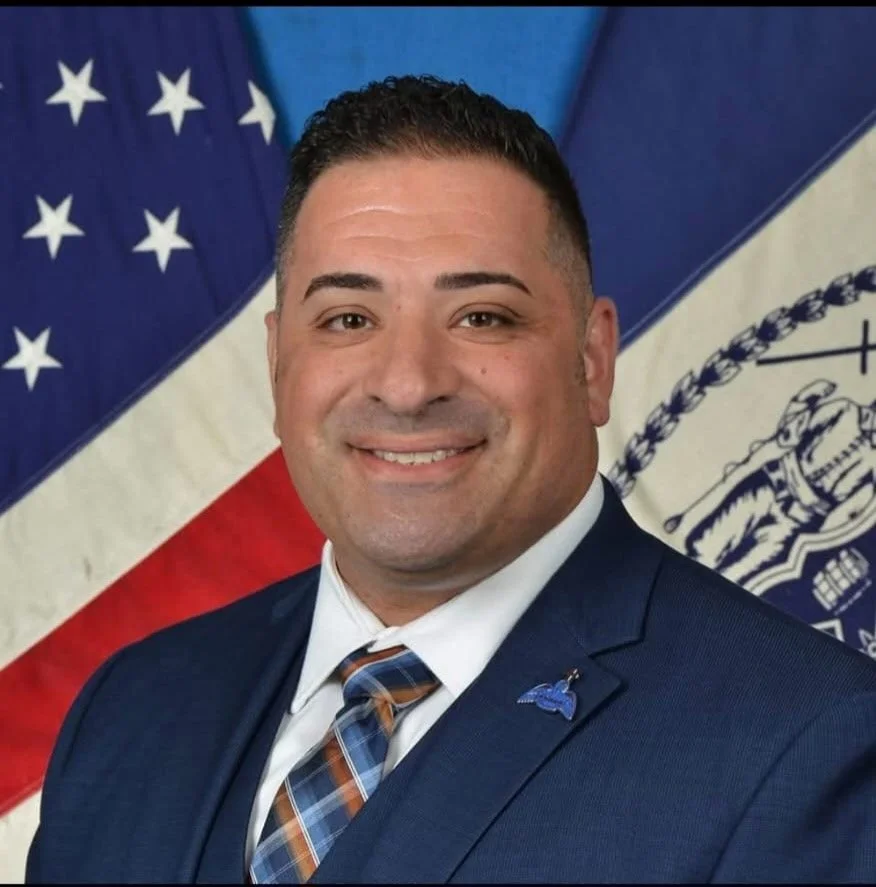
The number was 24955, and Joseph Imperatrice’s father wore it first. Anthony Imperatrice was an NYPD officer assigned to Manhattan’s 17th Precinct. Years later, when his son entered the Police Academy, a few phone calls were made and Joseph was given the same shield his father had carried.
Imperatrice still remembers what his father told him. “That shield sees everything,” he said. “You always have to do the right thing. You don’t raise the bar unless someone else raises the bar. You always stay respectful.”
Imperatrice carried that lesson through 20 years, two months and 22 days with the New York City Police Department. He worked in Brooklyn and Manhattan, served in specialized and supervisory assignments, spent part of his career at the Real Time Crime Center and eventually finished on Staten Island, the borough where he was born and raised. He retired from the Detective Bureau.
His connection to service began long before the academy. His mother, Joan, was a hairdresser. His father was a cop both of his grandfathers served during World War II, and other members of his family served in the NYPD and FDNY. As a boy, Imperatrice watched them closely. “My family didn’t know it, but from watching them as a little boy, I always wanted to grow up and be just like them,” he said. “Especially with my dad, and I got to live out that dream.”
Early in that dream came an understanding of what the profession could take from the people who entered it. Imperatrice knew NYPD Officer Russel Timoshenko from Brooklyn. In July 2007, Timoshenko and his partner encountered a stolen vehicle. Timoshenko was shot and critically wounded and died five days later. Imperatrice had roughly a year and a half on the job.
He remembers the funeral and what seemed like an endless sea of blue. What stayed with him, however, was what happened when the ceremony ended. The officers returned to work. The uniforms disappeared. A family was still missing someone.
“I knew I wanted to do something,” Imperatrice said. At the time, he didn’t know what.
Seven years later, policing had become one of the most contentious subjects in America. Demonstrations filled streets, use-of-force cases dominated national news and anger toward law enforcement became increasingly visible. Then, on December 20, 2014, NYPD Detectives Rafael Ramos and Wenjian Liu were murdered while sitting in their patrol car in Brooklyn.
Imperatrice attended the services and again saw officers arrive from across the country and beyond. Different uniforms and different patches filled the streets as thousands stood together for two men many of them had never met. Eventually, the funerals ended and everyone went home. Imperatrice kept thinking about the families and about what happened after the attention disappeared.
“How do we keep this going?” he remembered asking.
Together with Christopher Brinkley and Carlos Delgado, he began working on an answer. Their first idea was simple: black-and-blue wristbands modeled after the thin blue line and carrying three words that would eventually become known far beyond New York Blue Lives Matter.
The plan was to sell the bands and use the money to help the families of Ramos and Liu. Within roughly two weeks, Imperatrice said, they had raised thousands of dollars. He and Delgado drove to Brooklyn and met with an attorney who worked with nonprofit organizations. They admitted they knew almost nothing about running one.
Imperatrice remembers the attorney looking at the name and telling him it could someday become known around the world. Imperatrice wasn’t thinking about that “I’m not worried about that,” he recalled saying. “I’m worried about doing the right thing, and I’m worried about learning the right way.”
That was the beginning of Blue Lives Matter NYC.
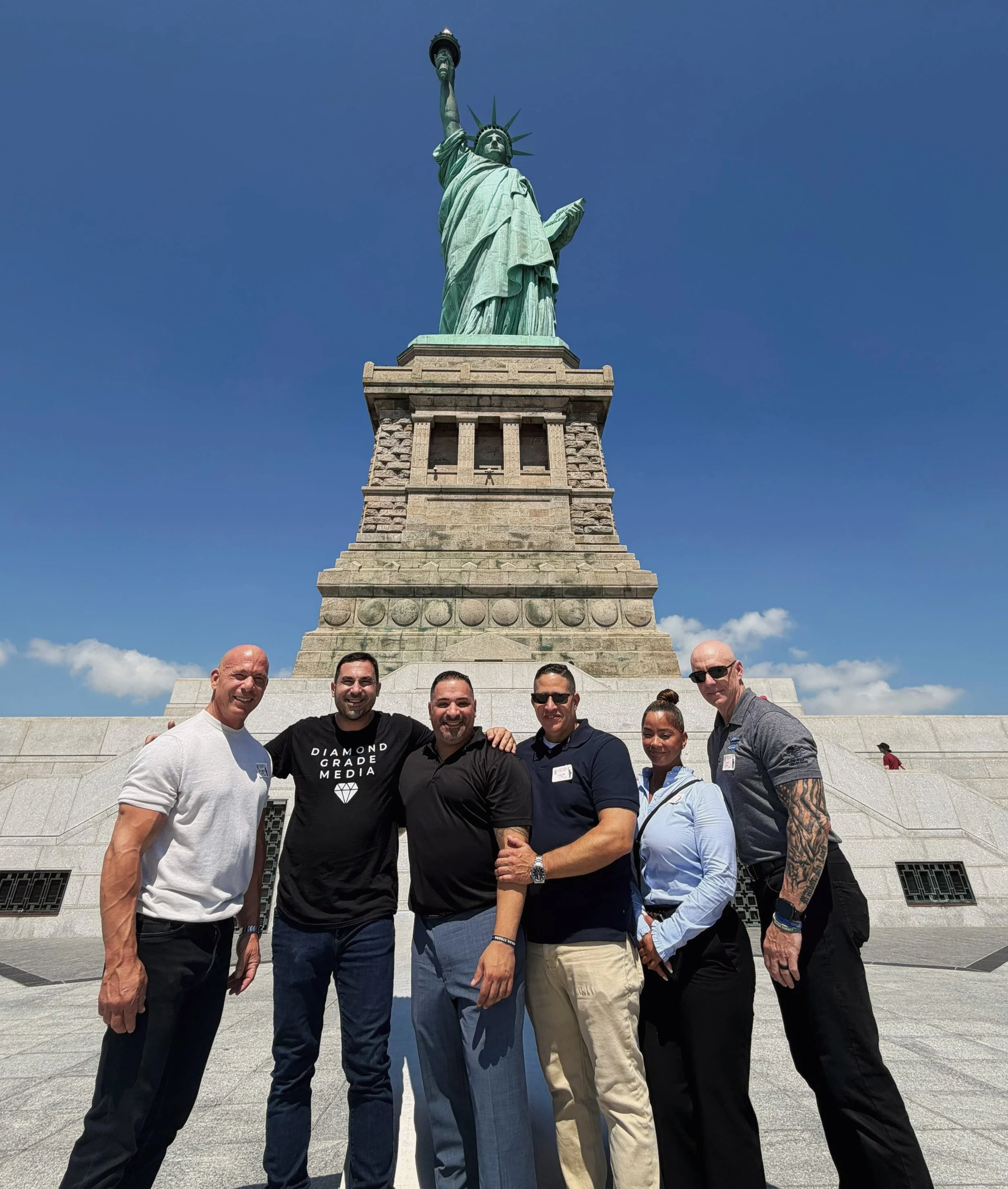
More than a decade later, Imperatrice says the organization has raised millions of dollars and helped law-enforcement families and others facing extraordinary circumstances. The Blue Lives Matter name became part of a much larger national debate over policing, but some of the work that affected Imperatrice most had little to do with politics.
One of those stories involved Abigail Arias, a young Texas girl battling cancer whose dream was to become a police officer. Law enforcement in Texas embraced her and helped make that dream real. Imperatrice saw her story and eventually helped bring Abigail and her family to New York, where Blue Lives Matter NYC paid for the trip and surrounded her with members of the profession she admired.
Other children facing serious illnesses followed. Imperatrice knows a weekend cannot change a diagnosis. What it can do, he says, is give a family a few days when the disease isn’t the only thing in the room. For a little while, the child is not simply a patient, and the parents are not thinking every minute about hospitals, needles, test results, long drives and whatever news comes next.
“For one weekend, all these kids get to come to the city,” he said. “They’re excited. But more importantly, they’re cured for a weekend.”
He was not talking about medicine, He was talking about giving a child a chance to feel like a child again. “That’s been probably the biggest blessing of my life,” Imperatrice said, “It’s changed me. It’s changed me for the better.”
The NYPD changed during those years too. Imperatrice entered the department at a time when he says officers were expected to police proactively and many of the supervisors directing them had significant street experience themselves. “When I first came on, we were still able to be cops,” he said.
By the time he retired, Imperatrice believed the culture had shifted. He argues that political pressure, changing policies and inconsistent leadership have made some officers hesitant about legitimate enforcement because they are uncertain whether decisions made on the street will be supported afterward.
His criticism is not reserved for politicians or police executives. Imperatrice also believes officers themselves have an obligation to meet a standard worthy of the NYPD name. He talks about the uniform, physical readiness, situational awareness and whether an officer appears engaged when dealing with the public. To him, those things matter because authority begins before an officer says a word.
The NYPD has spent generations being called New York’s Finest. Imperatrice believes every person who puts on the uniform inherits some responsibility for that reputation. “We can bring back the pride,” he said. “We can bring back the tradition.”
His argument is not that police officers should be beyond accountability. It is that accountability has to travel in both directions. Officers should be expected to perform professionally, and the people leading them should provide clear standards and stand behind lawful police work.
That belief becomes especially clear when Imperatrice discusses videos of officers being taunted, assaulted or publicly humiliated. He acknowledges the tactical reality that two officers surrounded by a large crowd cannot recklessly escalate a situation simply to prove a point. Sometimes officers have to disengage, call for additional resources and return. What he rejects is allowing the incident to end there.
“You can’t just smile and push it off and allow it to happen,” he said.
Imperatrice believes small acts of disorder can become larger ones when people conclude there will be no consequences. His concern is not simply a water bucket or an object thrown at an officer. It is what comes next. That is why so many of his answers return to leadership.
Imperatrice believes the relationship between New York City’s mayor and police commissioner can influence the culture of the entire department. When expectations are clear at the top, he argues, commanders can command and officers know where they stand. When that relationship fractures, uncertainty moves down the chain until it reaches the street.
His years at the Real Time Crime Center also shaped his view of what a modern police department requires. He rejects the idea that strengthening the NYPD is simply a matter of hiring more officers. He wants greater investment in technology, intelligence, training, protective equipment and police facilities.
“We have to reinvest into our police department,” he said.
For Imperatrice, the point is not merely to put more uniforms on the street. It is to give the people already wearing them better information, better equipment and better preparation before they walk into danger.
The upheaval of 2020 tested many of those beliefs. COVID placed police departments in circumstances few had prepared for, while nationwide demonstrations following the death of George Floyd transformed the debate surrounding American policing.
Imperatrice opposed COVID vaccine mandates that forced some public employees to choose between vaccination and continued employment. He also disagreed with law-enforcement leaders who knelt with demonstrators, believing the gesture sent the wrong message to officers at a moment when many were already uncertain about what was expected of them.
His assessment of the pandemic itself is more measured. Departments were dealing with circumstances they had never encountered and relying on information that continued to change. “We were in a place that the world never saw before,” he said. “You’re walking into the unknown.”
Imperatrice’s public voice had begun developing years earlier. His first Fox News appearance came in 2015 while Blue Lives Matter NYC was helping a Staten Island girl named Chloe who had quadriplegic cerebral palsy. Her father worked for the MTA, and Imperatrice remembered the transportation support the agency had provided around the services for Ramos and Liu. He wanted to return that support.
After the television appearance, Imperatrice said a viewer stepped forward and covered a full year of Chloe’s medical expenses. The experience showed him what a microphone could accomplish.
More appearances followed on Fox News, Newsmax and other national platforms, along with appearances in programming produced by Netflix and VICE. Since retiring, Imperatrice says requests for his perspective have increased. For someone with strong opinions, however, he says he has little interest in becoming another person shouting into a television camera.
“You don’t need to go out there and be nasty and curse and call people names to get your point across,” he said. He would rather make an argument people can understand, including people who do not begin on his side. “The goal is just to bring down the temperature, speak the facts and try to fix the problem.”
Imperatrice’s ideas about leadership began with his father and grandfathers, but he also points to people he watched from a distance before eventually meeting them. Two names come up repeatedly: former New York City Mayor Rudy Giuliani and the late Bernard Kerik.
At a Blue Lives Matter NYC gala, Giuliani was honored and sat near Imperatrice’s eight-year-old son, Landon. Imperatrice remembers Giuliani looking at the boy and saying that Landon reminded him of his own son, Andrew. The comment stayed with Imperatrice because he recognized something familiar in the moment. As a boy, Joseph had watched his father. Now his son was watching him.
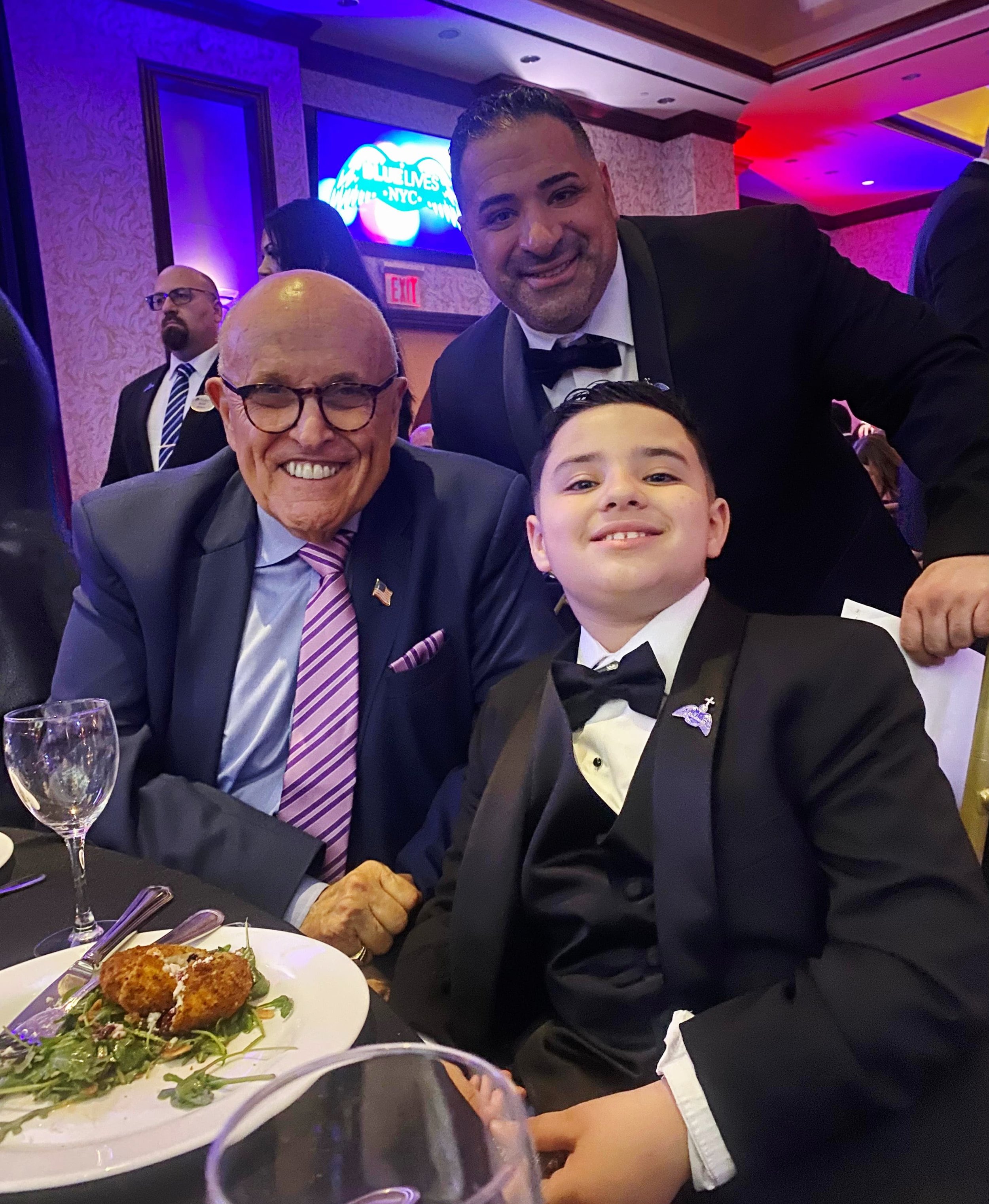
Imperatrice takes Landon to fundraisers, sporting events and trips whenever possible. He wants his son to see service up close, not because he expects him to become a police officer, but because Imperatrice remembers how much he learned simply by watching the adults around him.
One of his favorite images depicts a lion and its cub looking out from a mountain. Its message is about remembering who is watching when you consider giving up. Imperatrice once saw himself as the child watching the adults around him. Today, the perspective has changed. He is the father being watched.
Faith has become more important to Imperatrice as he has gotten older. He remembers nights when he was awake at 3 a.m., exhausted from preparing Blue Lives Matter orders or putting together another fundraiser, wondering why he continued pushing himself. He says his faith kept telling him to continue.
“This whole road I’ve been on, this is greater than a human being,” he said. “I truly believe that the Lord above put me on this path.”
September 11 is also central to the way Imperatrice understands the city he served. He was a Staten Island high school student on September 11, 2001, and remembers sitting in a classroom while the World Trade Center burned. Students cried because parents worked in or near the towers. Cellphone service failed. Families could not reach one another. Smoke remained over New York.
As the 25th anniversary approaches, Imperatrice believes the most important obligation is to remember the people who were lost: the nearly 3,000 killed that day, including 23 NYPD officers, 37 Port Authority police officers and 343 FDNY firefighters, as well as the thousands of responders and survivors who later became sick or died from illnesses associated with their exposure.
“We have to honor and remember those we lost and the family members that are still grieving today,” he said.
After 20 years, two months and 22 days, Imperatrice decided it was time to leave the NYPD. He had worked in Brooklyn and Manhattan, served in specialized assignments and eventually finished his career back on Staten Island. Retirement, however, has not made him less interested in New York.
When Imperatrice talks about the city today, he uses a metaphor that came from his mother. Imagine a once-beautiful house that has fallen into disrepair. Its windows are broken, the roof leaks and the foundation is cracked. People walk past remembering what it once looked like. Her point was not to abandon the house. It was to restore it.
“You can still keep the foundation,” Imperatrice said. “You can still keep the structure, but you’ve got to bring it up to today’s times and make it more beautiful than ever.”
That is how he sees New York: not finished, not beyond repair and not something he is prepared to walk away from. He wants a city where people want to invest, families want to visit, residents feel secure and police officers understand both the standards expected of them and the support they can expect when they meet those standards.
Imperatrice has not defined exactly what his next chapter will look like. What is clear is that he has no intention of disappearing into retirement. He continues to speak publicly, lead Blue Lives Matter NYC and think about what service means without an NYPD shield on his chest.
Near the end of the interview, BLUE asked Imperatrice what he wants people to remember when his story is eventually finished.
“I want to be remembered for doing the right thing,” he said. “I don’t want to be remembered as someone that followed. I want to be someone that led.”
More than two decades earlier, Anthony Imperatrice watched his son put on shield 24955 and gave him a standard to live by. Joseph Imperatrice carried that shield for more than 20 years. He no longer wears his father’s shield, but the lesson that came with it remains.