TELL A LIE LONG ENOUGH, AND...

Tell a lie long enough, and…
(By: Pat Ciser)

“It becomes the truth.” One such lie is that our kids today have it harder than we did. Think about it; does anyone believe that, except for the kids?  I’m a Baby Boomer. Anyone born after WWII from 1945-1965 are “Boomers.” Millions who served in the military, and those who worked extremely hard here at home in support of the war effort, felt incredible relief and exhilaration that peace had finally been achieved in Europe, and later in the Pacific over Japan in 1945. The celebrations and optimism for a wonderful life were at an all-time high! Try, just for a moment, to envision their lives throughout the Great Depression and World War II.  Many remained taciturn over the years while keeping some of the horrors that they witnessed and experienced deep inside. Today, we have movies like “Saving Private Ryan” and the series, “Band of Brothers” to get a glimpse into events that were sometimes hard to understand and fully appreciate by those who never lived it. So as a result of America’s economy doing so much better after the war, with The New Deal, and the housing boom, Americans finally had hope for a better future, got married and started a family. The suburbs were born and quickly expanded. But think about what they all had to endure to get here.

When I was young, and many from my generation can relate to this, I started working at anything I could at age 13. I would walk the neighborhood raking neighbors leaves for a couple of bucks in the fall and shoveling out driveways in the winter. At 14 I got a paper route and delivered newspapers for the Herald News in addition to my seasonal work. NOBODY I knew had a landscaper, or even a snow plow; only rich people did.  Most parents back then didn’t have two incomes, as our mothers were usually housewives who took care of the home and children. With six kids in my family, my father worked seven days a week and also a couple of evenings. We were poor by today’s standards, but we didn’t really know it. I never in my life had a new bicycle, for instance. At age 16, I got a job at the local Foodtown. This was great for me as I wanted to start saving money for a car one day. We all worked hard, went to school, put up with all the bullshit peer pressure like today, and had an occasional fist fight behind the school building. Many of us were also accustomed to getting a beating from our fathers when we did something wrong. Millennials by contrast got “time outs” when they screwed up. Teenagers today get cyber bullied, which is certainly a problem, but don’t have to worry as much as my generation did about “actual” bullying, and getting jumped after school.

Think of all of the inventions developed over the years since 1945 that made our lives so much easier. I remember my mother hanging our clothes on the backyard line to dry and then of course, she’d then have to iron most of them later. A dishwasher? What’s that? We had homework AND chores to do all week long. More and more women entered the work force in the ‘60s and ‘70s, giving many families two incomes. Baby Boomers would say, generally, my kids are not going to do without, like I had to. The demand for toys was so high that stores like “Toys R Us” started to pop up. Our kids would get brand new bicycles and anything else we could afford. People began taking their kids on wonderful vacations, including Disneyworld. I never flew on a plane until I had enough money to do so. Today in the suburbs it’s fairly common that parents buy, whether new or used, their kids’ first car for them.  I could go on and on about how much we spoiled entire generations … and yes, we even lied to them in an effort to show empathy for their, according to them, extremely tough lives. But at what cost? Don’t coddle your kids; you’re not doing them any favors. Push them to try, fail, and then try harder rather than feel sorry for themselves.

Note: This article reflects my observations of mostly middle-class America today of all races. Poor people don’t have it as good as our middle class, but still have more today than poor people had in the 1960s. TEACH STRENGTH and personal responsibility, you’ll be glad you did!


I AM MY BROTHERS KEEPER! ARE YOU?

I Am My Brothers Keeper! Are You?
By Michael Boll

A few years ago, I was approached by a friend and co-worker of mine who expressed how extremely depressed he was and that he wanted to take his own life.  Initially, I was completely shocked because this guy seemed to be upbeat and happy all the time.   Immediately, I asked him to come with me to a private office so we could talk about his awful situation.   This was the first time in my life that I had a friend talk to me about suicide, and I knew I had to really do my best to help him get through this horrible ordeal.  We spoke for a few hours and I listened closely to everything he said.  I was able to convince him to immediately get some help and we went to the hospital.  I stayed with him at the hospital and met with him when he was released.  I did everything to show my friend that I had his back, and because of this he is alive today.  This awful situation inspired me to do whatever I possibly can to help others in need, and shortly after we created our mobile outreach program. 

In today’s day and age, most of you have known a veteran or first responder who has taken their own life.  We lose nearly 22 veterans and approximately 300 first responders every year to suicide.  Even with all the awareness and new anti-suicide programs available, this number has not changed, and in some cases has increased.  The VA hospitals with PTSD and mental health programs are packed with patients and unfortunately, they continue to grow. More of our first responders are also seeking help and utilizing some of the state programs being offered.  So many people want to help and put an end to this crisis, but sadly there isn’t a foolproof program available that will stop this ever-growing crisis from destroying our uniformed heroes and their family’s lives.

For the last two years, our team has been working tirelessly with other charities to come up with a better solution to help prevent this epidemic from continuing.  Personally, we believe our “Mobile Outreach Team” is really making a difference and everyday it helps our uniformed heroes live a better way of life.

The first thing we learned is to lose your ego and seek out other groups and organizations that are looking to save lives.  Then we find the right volunteers who are committed and dedicated to being a mentor to a person in crisis.  Volunteers are extremely valuable because they want to be there, and they usually care more than the people who get paid for their services.  

To date, we have been able to change and save countless lives because of the incredible commitment from the volunteers and other supporting groups.

Our approach is to aggressively seek out and contact a veteran or first responder in crisis.  Our goal is to immediately work on building trust by being completely honest with the person in crisis.  Using our network is wonderful, but it’s more important to show the person in need that we are there for them and won’t give up.  Usually, we go out and meet with those in crisis and spend whatever time is needed to help them get in a better frame of mind.  Bottom line “Human Contact” and “Friendship” is the key to saving a life. 

Our Mobile Outreach Team is unique because it consists of  mentors from all over the state who  are willing to do whatever it takes to save and change a life.  

If you are interested in joining our team please feel free to contact me at (973)-332-1556 or email mdbollio@optonline.net

A Man on a Mission: Special Police Captain Garth Brown (Ret.) 

A Man on a Mission: Special Police Captain Garth Brown (Ret.) 
By George Beck, Ph.D.

Blue Magazine recently spoke with Special Police Capt. Garth Brown (Ret.), whose career spanned over three decades at the Ridgefield Police Department. In this interview, Brown offers his perspective on the special police program—he highlights the valuable services they provide, including their involvement in community outreach efforts, such as the New Jersey Special Olympics. The most visible forms of policing in the United States are the local police departments, which provide the majority of policing services for the country’s 327 million people. Local police departments employ approximately 600,000 full-time sworn officers and about 55,000 people on a part-time basis. These part-time supplemental forces greatly help overburdened police departments deliver quality services to the residents, and they help increase the overall safety of the community. Special police officers are an invaluable addition to the police force.

Many special police officers are passionate law enforcement professionals who work tirelessly for the betterment of the profession and the community. Since Brown was hired as a special police officer, he immediately demonstrated a love of service to others. It fitted that he later became involved with the New Jersey Special Olympics. Brown’s work with the Special Olympics is commendable. He is a significant part of the program and currently serves as the Bergen County (Area 12) director. In 2017, they collectively raised nearly $9.5 million—%3.9 million directly from the Law Enforcement Torch Run. Brown has been active with the Torch Run since the early days of his career and continues today with the same level of passion and dedication.

Why are special police officers necessary?

Special Police Officers give a level of community policing that might not be available, depending on the size of the regular force. In Ridgefield, we provide security at municipal recreation areas, borough buildings, and events throughout the borough. This is accomplished by foot, bicycle, Segway and motor patrol. These officers are helping the patrol officers keep the community safe and secure for the residents and the many visitors who travel through the community every day. Many aspiring police officers begin as special police officers; tell us how valuable this experience is. Extremely valuable. Positive interaction with the public is one of the keys to successful policing. Getting to know the residents makes the job so much easier when dealing with stressful situations.  Being a special also provides learning for aspiring officers—learning like how to react to certain stressful situations early on, like a graphic car accident or another tragedy they are called to assist at. This exposure makes it easier for them when they later add responsibilities that come with being a regular police officer. They also learn things that they will take with them during their career—tasks like directing traffic, report writing, observing the entire scene to avoid tunnel vision. I was always a stickler for ‘no hands in your pockets’ when you’re at a scene. It looks sloppy and lazy and is not a tactical way to perform your duties. 

What is the most memorable part of your work on the job?

After 30 years, it's hard to pick the most memorable moments, but I think as a whole, as we say all the time, I had the best seats to the greatest show on Earth. I got to see people at their worst and their best. There were so many memorable experiences throughout my career. I really enjoyed the interaction with the residents and doing what I could to help. Hopefully, I made a difference in their lives and the community I served.

What are your goals this year with the Special Olympics?

I’d like to see younger officers getting involved. We need officers to carry on over 35 years of raising awareness and funds for people with intellectual disabilities. We have such a worthy cause. Yeah, I’d love to see more of the younger officers get involved and see how powerful the brotherhood can be when we are united around a common cause—to help those who need us and make an impact on the world around us. 

The Torch Run is very successful. What is the secret to success?

I have always said that once you touch it, you’re hooked. I am blessed to have three healthy children and two healthy grandsons. I was raised to give back to the community, and that’s the way I raised my kids—all three volunteers with the Special Olympics. My son is presently a Marine assigned to Washington, D.C., but when he finds the time to come back and visit, he volunteers at events. The key to a successful Torch run is really because of the people who are involved. So many great officers and supporters give so much of their time and effort to make it a success each year. I am proud to be a part of this endeavor, and I know they are two. It’s all about working together, and rally behind the right cause.

What are your plans for the future now that you are retired? 

I retired from my full-time job with Bergen County Communications back in September of 2016. Since then, I have been teaching and consulting for 9-1-1 Centers and Communications Centers. I am also starting to get involved in Suicide Awareness and Prevention for emergency service workers. It’s an important issue that needs to be dealt with. Every day I go on social media and see how we lose a brother or sister to suicide. I always think in some way I can help. Even it’s just one life, I know I can help. So I’ve been putting my energies there. Suicide is a significant problem in our Country. We all need to do our part to help. Also, retirement has afforded me more time to devote to the Special Olympics. I am genuinely enjoying myself and the initiatives I get involved in. Isn’t this what retirement is supposed to be about?

When all is said and done, what do you want to be remembered for?

 As I said before, I hope I made a positive difference in the lives of the people I had worked with and the public that I served. I hope they would know that I always cared about them, the law enforcement profession, and the residents we served. I’d like to think that they’d say, ‘Garth, yea, he’s OK’!

Blue Magazine thanks Special Police Capt. Garth Brown (Ret.) and wishes him the best in retirement and with all his future endeavors. For more information on how to get involved with the New Jersey Special Olympics, check out https://www.sonj.org.

THE EMOTIONAL COST OF SOCIAL MEDIA NONSENSE

The Emotional Cost of Social Media Nonsense
By: Meredith Atwood

Why are we even doing social media? For me, I love seeing the kittens and babies and sports antics. But that’s about it. Social media, as we all know by now, has an exceptionally dark side. It ranges from hate to sheer cowardice and vitriol. Invisible people will spew words from their phones and computers but not from their mouths. They’d never say this stuff to your face.  I have a series of questions (that I ask myself) when it comes to deciding whether to engage, comment or post on social media. This is not for my audience. This is for me.

My current engagement on social media is 100 percent purposeful. I try to put out content or updates, but I rarely post comments or “status updates.” I will say positive things (“Happy birthday” and, “Your baby is the cutest thing ever”), but you will not find me fighting people on social media anymore, or posting things for mere reactions. I simply won’t do it. Of course, there are always a few exceptions. Sometimes the fights are not nonsense. Sometimes you should fight. But learning to find the line is important. I no longer post anything when the goal is to try to make someone else look stupid. I have learned my lessons several times over the recent years. I hold my posts, my typing fingers, and my comments to a new standard, and the greatest gift? It has made me so much happier. If you don’t do it for anyone else, do it for your own sanity. That is the takeaway.

I ask these questions now before posting or commenting on social media:

• Is this post helpful to someone?

• Am I making someone else feel better with it (or just myself)?

• Is it, at a minimum, entertaining in some way?

• Even if entertaining, who might this hurt?

• Am I being respectful, even if I disagree?

• What are the repercussions of this post, comment or statement?

• Is this “share” actually true or from a credible source?

• If I post this, will I waste an ungodly amount of time responding to comments about it?

The last one is my guiding light. Even if I feel something with everything I have, if dealing with my opinion being out there will waste my time, I don’t post. Time is valuable, and I am not in the business of wasting mine. Even if something is true, maybe (just maybe) we don’t need to speak it on social media. If we will lose true friends or loyal followers (who mean something to us), then we should think twice. 

Now, I don’t believe every post should be some massive value-added proposition. Nothing is more annoying than people trying to post something “huge” and “valuable” and “vulnerable” each time. Vulnerable and honest is awesome—but we can go crazy with that, also. It’s important to remember that social media can be funny, silly, and whimsical as well as valuable. Finding that line, however, is tough—and sometimes we just don’t know where we fall. We do, however, learn as we go.

Under some circumstances, we can’t ask these questions because the stakes are too high. Maybe someone caused a ruckus about one of our children. Maybe it’s about a cause that matters. That’s when we find the need to stand up for ourselves—because our reputation, the truth, or something bigger might be on the line. Many people (especially on the topic of politics) use this “pen is mightier than the sword” tactic in everything they touch online. In reality, your presence on social media should aim to reflect some sort of mental stability and sanity—and heck, maybe even some manners. If we are one of those people constantly flying off the handle, we’re only making our own lives especially difficult, and everyone around us likely thinks we are in need of a psych evaluation. Unless the fire is blazing out of control and your entire life is being destroyed, take a few minutes and consider the response before you post it. I often write a response in the “notes” app on my phone. I think about it. I ask the questions above. And if I feel good about it, then I post. Finally, I learned to turn off my notifications—unless they pertain to a program I am running, my clients, or something of a more urgent nature. You will be beaten with notifications if you don’t turn a filter on these. Choose carefully what hits you. Make sure you are the ruler of your social media time—that you choose when and how you see things.

By asking a few simple questions before our fingers start flying, we can save ourselves a lot of trouble. So what is nonsense on social media? That’s up to you. But I am certain that spending hours in a given day defending, responding, and reading responses to something you wrote—that perhaps should have been left off social media to begin with—is a giant waste of time. Wasting time is nonsense. This is the #YearOfNoNonsense. Translation: We’ve got better things to do.


WHEN ART TWISTS LIFE

When Art Twists Life
By: Chris Amos

The other day my wife and I went to a movie. As expected, there were the typical 30 minutes of movie trailers. I usually can’t remember most of the trailers I saw by the time the movie is over. However, on this particular occasion that would not be the case. Two of the movie trailers had law enforcement themes. Both were eerily similar. Does anyone want to guess the lens through which the police officers were viewed? Let me give you a quick rundown as portrayed in the two-minute trailers.

The first, Black and Blue, is set in Detroit. Apparently the star, a black female rookie cop, witnesses a group of crooked cops, white and black, murder an informant. One of the cops then turns his gun on the rookie cop and shoots her. She falls about 20 feet before finding a soft landing. The remainder of the movie will be a race to see who gets her first, the gangs or the cops. You see, thanks to her body cam, the initial murder was caught on tape as was her own shooting. In their desperation to catch her and conceal their crime the crooked cops join forces with Detroit’s finest gang bangers, drug dealers and all-around thugs to insure she is captured, preferably killed, before she can expose the corruption. 

The second, 21 Bridges, is a much more subtle approach that comes to the same conclusion. In 21 Bridges, the trailer begins by vividly portraying the murder of eight uniformed cops who respond to a robbery call at a business. The police department, shaken by the deaths, sets out to catch the suspects. At some point during the trailer, it becomes obvious that high-ranking police officials are behind the initial robbery that left eight of their fellow officers dead, all in their pursuit of the almighty dollar.

Now, both are just Hollywood movies and Hollywood movies depicting crooked cops are as old as Hollywood. But, what is different about these offerings seems to be the portrayal of not simply a cop or two or three, but of entire departments or many if not most of the officers therein. Are these movies intended to entertain or fan the flames of the existing false narrative that cops are crooked, corrupt, racist, thugs deserving of any violence that comes their way? 

Might I share an observation I have made in recent years? Before sharing I offer this warning: It’s political. Looking back at Vietnam, and having worked with several Vietnam veterans who went on to become police officers, it is undeniable that many felt a tremendous backlash on their return to America. I know men who were spit on and men who were called murderers, rapists, baby killers, etc. Did these men do anything wrong? No, their only “crime” was in answering their nation’s call and not fleeing to Canada. Why the backlash? I suspect it had much more to do with a hatred of President Nixon than it did Private Jones. Unfortunately for Private Jones, he was a little more accessible to an enraged public than was President Nixon. What does that have to do with anything?

Friends, we are living in a country that is as polarized now as it was during the Vietnam War, if not more so. I believe there is a hatred for President Trump that exceeds that of Nixon. Some have gone so far as to label it Trump Derangement Syndrome. Now I’m no doctor, but there is something in the water that has literally made Thanksgiving and Christmas nearly untenable for many families. Trump, like Nixon, is well insulated from the average citizen. But guess who isn’t? Exactly, it’s the men and women of law enforcement. Trump prides himself on being a law and order president and has repeatedly thrown his support behind police officers and deputy sheriffs, never passing on a good photo op. The Trump haters need someone to attack and Trump is well beyond their reach. Unfortunately, like Private Jones, Corporal Smith in his marked police car sporting that shiny badge and gun is within reach, except at a number of businesses where Corporal Smith and his fellow officers are not welcome. Think about it, who is the most visible, accessible reminder of a despised law and order president? It’s law enforcement officers … enter Hollywood.

Apart from academia, there is not a demographic that despises Trump more than Hollywood, with the rare exception of a Jon Voight or Chuck Norris.  Apparently, as we head into the 2020 election year, Hollywood has decided that cops, PLURAL, are fair game. Why attack a corrupt officer or two, such low-hanging fruit, when you can take out a whole platoon, precinct, division, or department and all it will cost is the price of a few more extras on set?

Now I confess I could be overly sensitive. After all I’ve only seen the trailers and admit I have no intention of rewarding these hit pieces with my hard-earned cash. From what I’ve seen and read, I am offended! Are cops allowed to be offended?  I’m offended when entire police agencies are portrayed in such a disparaging light, especially when life seems to be very much interested in imitating art.

As for Black and Blue and its depiction of a police department out of control, too bad they did not end the movie with the names and pictures of Officers Glenn Anthony Doss Jr. EOW 1/28/18, Darren Maurice Williams EOW 2/13/18, and Fadi Mukhlis Shukur EOW 8/14/18. These are just the most recent three officers of 237 who have given their lives in the service of Detroit, Michigan…And we wonder why nationally, law enforcement applications are down over 50% compared to years past.

A LOT OF WHATS WRONG IN SOCIETY FROM FIVE MINUTES IN SKID ROW

A LOT OF WHATS WRONG IN SOCIETY FROM FIVE MINUTES IN SKID ROW 
By: Officer Deon Joseph 

So I was in Skid Row walking a foot beat. I was anxious to get out there due to working special events and meetings. I missed being around the people. I grabbed some fliers with a list of programs for the homeless and headed out. I had just exited the station onto Sixth Street. I didn’t even get to the corner when I saw an officer in foot pursuit of a suspect. Instinctively I ran flank to the suspect and called to him to stop. He looked and recognized me. He stopped immediately and lay on the ground. He was taken into custody without incident (community policing works, folks). I gathered my fliers and started to head east toward San Julian. As I walked past a blue tent I heard a woman yelling for help. I threw down my fliers and responded to the tent. I removed the tarp that was blocking the screen and saw a naked woman crouched upright in fetal position inside with a man who covered himself with a blanket.

I had the woman come out. I then ordered the man out and detained him without incident. Once he was secured I tried to talk to the woman, who was so severely mentally ill that she could not even tell me what happened. As she babbled incoherently, I tried everything I could, even getting a female officer to try to calm her down so I could help her. As the female officer was trying to help, an idiot who probably spends too much time on Shaun King’s page kept taunting me because he felt I was racist for handcuffing a black man because the woman who was in the tent with him was white (she wasn’t, and it didn’t matter), he even accused me of setting him up because he was black. I confronted him about his bullshit. He continued to rant that the woman was crazy and is always naked. Based on that, he thought it was all her fault and that she could not be a victim. I have grown so tired of people who believe that because a woman is mentally ill or on drugs, that somehow she is less of a victim. It infuriates me when I hear that because I know that they make the perfect victim. I caught myself and went back to the woman who refused to put her clothes on and was now throwing herself into a roll up door. Sadly, because she was so out of her mind, we were not able to determine what happened to her. I had to release the man. As I walk over to unhandcuff him, he said “Why y’all got a black man like me handcuffed and humiliated. How you just gonna harass me for no reason?” Before he could say another stupid thing I interrupted him. “ Bro. Ain’t nobody harassing you.

Put yourself in my shoes for a sec. You are a cop; you walked past a tent and hear a woman screaming for help. What would you do?” He looked at me humbled and said “Ummm. I guess I would have done the same thing.” I had no choice but to release him. My focus now was getting the woman some help. We took her to the station to have her evaluated. It wasn’t her first time. She is known by officers and residents alike to walk around nude in one of the most dangerous places in the nation. But as it was initially explained to me, she did not meet the requirements for help. If it wasn’t for her throwing herself against the door and trying to bang her head, I would have had to release her. I took her to the hospital. There I was told (for the millionth time over 20 years) that she would be given a shot and released back into the street in a few hours. So much failure in such a short amount of time. What the system and ignorant people showed me once again, is the following:

-The system won’t protect the most vulnerable no matter how hard we try.

-Chauvinistic mindsets are evil.

-Social justice rhetoric is poisoning the minds of black people.

-People believe that mentally ill people and drug addicts are not worthy of justice.

-Skid Row in its current state is a health and safety issue for women, men and the mentally ill.

Because if I can’t see them getting hurt in a tent, I cannot save them in most cases. I’m sick of it all. But I’m not going to stop caring. I’m not going to stop fighting. I’m not going to stop speaking out. One day, someone will hear me.

BRING BACK THE FEAR

BRING BACK THE FEAR
By Lt. Randy Sutton (Ret) 

When did the police become America’s punching bags. I mean that literally as well as figuratively. Was there a defining moment? Or did our country gradually morph into a society where the authority of law enforcement officers has eroded to the point where even grade school children no longer fear consequences from confrontations with the police.

Now I know that simply using the word “fear” in a conversation about law enforcement is in and of itself politically incorrect. I mean after all, if one was to listen to all of the political rhetoric coming from senators, congressmen, governors, mayors and all assorted others who consider themselves experts in law enforcement and community relationships, the police should work tirelessly and relentlessly to reform themselves into a kinder and gentler culture. Every discussion concerning violence and law enforcement always and inevitably will center around fault. Whose fault? I will give you just one guess: the police. 

Let’s take a short walk down memory lane. Remember just a few years ago when everyone from the media to the President of the United States Barack Obama were crying out for body-worn cameras to be issued to every police officer in the United States? Why? To protect the public from those mean old bullies, the police. The word “reform” was the rallying cry for politicians, the media and social justice warriors. So, quite literally millions and millions of dollars have been spent on equipping law enforcement officers across the United States with body-worn cameras. But I wonder if you have noticed this, when was the last time that you heard these demands for body-worn cameras? The answer is you probably haven’t. Why? The answer is also simple. The reality is that the use of body-worn cameras has revealed that law enforcement officers are acting appropriately, not using force unnecessarily and have shown that it is actually the police who need to be protected from the public. And once again I mean this both physically in terms of assaults against them and in the thousands of frivolous and concocted complaints filed against them for everything from excessive force to sexual assault. Yes, the evidence is quite clear. The vast majority of law enforcement officers in this country do their jobs as they are expected to.

Yet the war against cops continues not only unabated, but is accelerating. Every single day a law enforcement officer puts on his uniform and goes out on patrol they are quite literally putting their lives on the line. The murder rate against officers continues, shootings of officers take place almost daily in this country and physical assaults have become commonplace. The important question here is why? I am going to relate my theory and I am going to relate my solution. I am pretty sure that the International Association of Chiefs of Police won’t be adopting it. As to my theory of why? Because all of the “reforms” the law enforcement has been called upon to make have been all too successful. All of the mandatory training in de-escalation techniques, Sensitivity Training, Implicit Bias, and Community Relations combined with law enforcement administration’s heavy-handed disciplinary processes relating to use of force incidents have sufficiently intimidated working cops into becoming minimally aggressive in order to survive the political environment. Some refer to this as de-policing, and that is an accurate characterization. It is simply a matter of survival. Not necessarily physical survival but political survival.

 What does this look like? It means less proactive police work. It means fewer car stops looking for criminals. It means fewer pedestrian stops looking for guns, drugs and fugitives. It means fewer physical encounters, it means getting out of the patrol car less, it means taking fewer risks as in, “You’ll never get in trouble for the car stop you don’t make.” In other words, it means the bad guys are winning. When the police are afraid to do their job, not because of the physical dangers but because of the political dangers, society as a whole becomes a much more hazardous place to be.

I told you before that I also had a solution. Everything that I just talked about concerning the factors of de-policing empowers criminality, civil unrest, violence and injustice. Why? Because when people figure out that there are no consequences for their actions, the reality is that the ugliness of human nature is unleashed. Robbers find it easier to rob, thieves find it easier to steal, drug dealers deal their poison with impunity and our very society becomes threatened. I believe it is time to “bring back the fear.” Fear of consequences first and foremost, and that includes the fear of the police. Does that sound harsh? Well I believe that a little fear is healthy. I think the fear is a deterrent to criminality. I think that someone should be fearful of putting their hands on a law enforcement officer. I think that someone should be fearful of pulling a gun on a cop. I think that someone should be fearful of becoming argumentative and disrespectful to a police officer and resisting arrest.

I served as a police officer for 34 years, and I will tell you this as sure as I’m sitting here, I lived this rule: If you try to hurt me I’m going to hurt you back. If you try to kill me, I’m going to kill you first. Simple. Those are the rules of the road. It is time for police leadership to stop surrendering to political whims and fantasies. Law enforcement is often messy, law enforcement is often ugly, and law enforcement is always dangerous. It is the responsibility of political leaders and it is the responsibility of law enforcement leaders to make the playing field as safe as possible for the men and women who serve in our nation’s law enforcement agencies. That means understanding that law enforcement officers will need to use force, including deadly force, to accomplish their mission and safeguard their own lives. And no amount of political correctness should stand in the way of allowing our country’s cops to do with they are paid to do: Serve and protect … and that includes protecting themselves.


EDITOR'S POINT VIEW

By George Beck, Ph.D.

Welcome to another excellent issue of Blue Magazine. We are proud that our last cover was featured on Fox News to seven million viewers. Yes, over seven million viewers saw our previous cover! While we are honored and pleased with this mention, we must continue to keep raising the bar of success by staying focused and staying true to our core values. We exist to be the independent national voice of active and retired officers. We exist to stand up for injustices against our profession when many others will not. We take on these risks knowing there will be pushback, haters and lunatics out there who want to silence us. But we must always speak the truth, regardless of how inconvenient the truth is. 

Our cover story, written by our managing editor, Dr. Joseph Uliano, exposes a grave reality that friendly fire is, unfortunately, something we must discuss. We can no longer pretend it doesn’t exist.  After recent friendly fire deaths, the NYPD announced they would increase training for plain-clothes officers by subjecting them to live-fire exercises and training simulators. Although this is excellent news, we must ask why now and not before these tragedies occurred? I believe many administrations are to blame. Administrators must always make sure their men and women, who are risking their lives to protect and serve the community, are not disadvantaged. They must insist they are equipped with every training and tool needed to safely perform their duties, reduce the risks, and survive this dangerous profession. Think about it. Why hasn’t every officer received firearms simunition and simulator training? We are quick to show the media these technologies as a way to demonstrate the difficultness of the nature of our work, yet there are many officers who have never had these trainings.  Also, it is no secret that many agencies are operating patrols at bare minimum staffing—some with only one officer.

Additionally, many agencies are not equipped with life-saving devices such as long guns, tourniquets or QuickClot. We can all agree making this training and equipment a requirement is paramount, so why wait until after a tragedy to implement? The common reasons admins use to explain these “acceptable” risks are budgetary constraints. This is unacceptable. Officers are placing their lives on the line; they should at least take these risks knowing their departments are giving them every chance for survival. Officers do not need to die for change to occur. 

On Nov. 21, 2019, at the Venetian in Garfield, NJ, we will hold our annual law enforcement dinner. We are partnering with Brothers Before Others and Moment of Silence. Both of these organizations are run by respected law enforcement leaders, Michael Burke and Steven Olimpio, respectively. These organizations are doing an excellent job for our profession, and we are honored to be partnering with them for this event!  So many officers are flying in from all over the United States to attend. We are looking forward to a night to unite law enforcement like no other night. We are blessed to be working together with so many passionate people, and we thank everyone for all their efforts.

Until next time!

REMEMBRANCE - DEPUTY SANDEEP DHALIWALCHEZ

Deputy Sandeep Dhaliwalchez
Article and Artwork By Jonny Castro 

Deputy Dhaliwal.jpeg

It began as a simple traffic violation on Friday afternoon. The patrol car’s dashboard camera captured the entire encounter from start to finish. Deputy Sandeep Dhaliwal approached the vehicle and began speaking with the driver. As he walked back to his patrol car to check the male’s information, the driver (who was wanted on a parole violation) immediately got out and gunned down the deputy. Sandeep had his back turned and was never given the opportunity to defend himself. He suffered numerous gunshot wounds to the head. Deputy Dhaliwal was airlifted to the hospital, where he was unable to be revived. His killer was apprehended at a nearby store after he was spotted by an alert citizen. 

Deputy Dhaliwal was a 10-year veteran of the Harris County Sheriff’s Office. After completing his training, he was deputized and officially became the agency’s first Sikh deputy. Deputy Dhaliwal was a walking lesson in tolerance and understanding; a beacon for his community. He was a quiet but confident leader. 

Deputy Dhaliwal leaves behind a wife and three young children. He was 42 years old.

COVER STORY: SECURING THE BORDER SAVE LIVES: FORMER ICE DIRECTOR TOM HOMAN

Securing the Border Save Lives: Former Ice Director Tom Homan
By: Daniel Del Valle, George Beck, Ph.D. & Joseph R. Uliano, Ed.D.

Blue Magazine recently sat down with former Ice Director Thomas Homan and current Fox News Contributor to ascertain his perspective on the recent violence against ICE facilities, and disdain for border patrol agents, while these law enforcement officers risk their lives to lock up criminals and keep us safe. Former Director Homan spent 34 years in law enforcement, starting out in patrol in upstate New York, before transferring to the Border Patrol, and rising through the ranks to lead the organization. Mr. Homan is the first director to rise from the ranks. In this candid and uncensored interview, Mr. Homan holds no punches.

Blue Magazine thanks former Director Mr. Homan for sitting down with us to discuss many issues effecting law enforcement and the agency he formerly lead. 

The Blue Magazine: Please tell our readers about your career in law enforcement. 

Tom Homan: Well, I was a police officer in upstate New York. My father was a police officer and also my grandfather. I knew since I was kid I always wanted to be a cop. I started out in New York for about a year and a half and then I joined the Border Patrol. For 34 years, I've worn a badge and gun, enforcing the law. I am very proud to say that I was a law enforcement officer. Anybody that ever asks what I did for a living; I tell them I was a law enforcement officer. There is no bigger honor than to serve to protect and help others.

Can you tell us about your position before you retired? 

I left the Border Patrol to advance and become a Special Agent, probably for about eight or nine years, and then I started climbing the ranks. I became the Assistant District Director, working as head of criminal investigations in San Antonio. Then I transferred to Dallas to run the investigations office there. Then DHS was created, and the legacy US Customs Service Special Agents and the INS Special Agents became folded into one agency called Immigration and Customs Enforcement (ICE). I continued to promote and worked my way up to headquarters to be the Executive Associate Director for Enforcement. That position was third in command for the Agency and it had the responsibility of all interior enforcement operations within the US. 

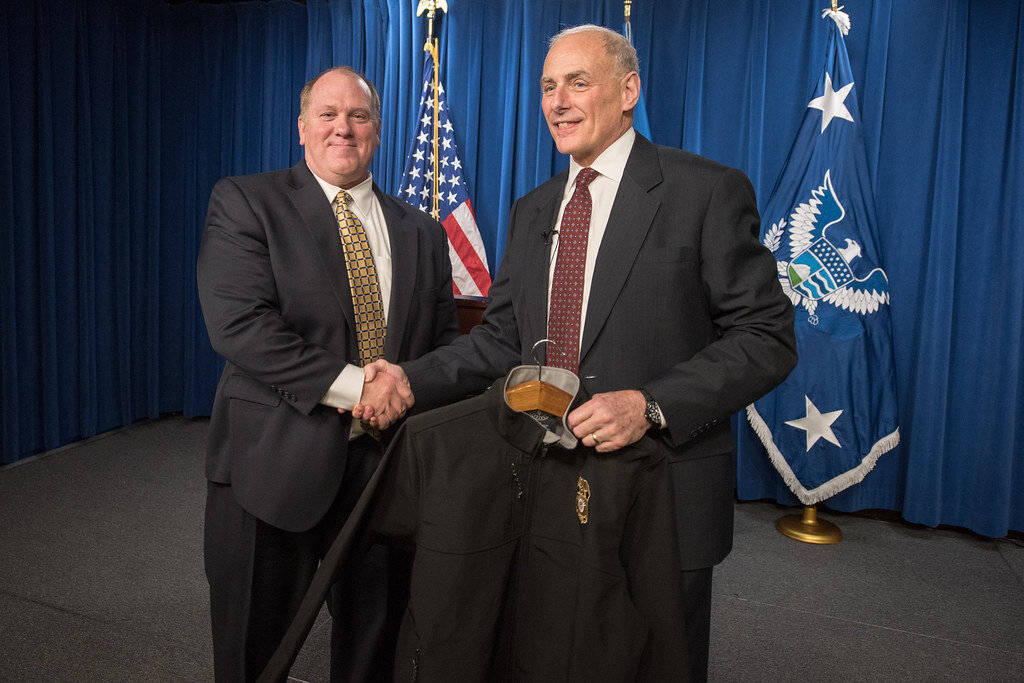
And in January 2017, I retired. At my retirement ceremony, my family and about 400 people were in attendance. All my stuff that I collected over 34 years was already packed in my home garage. My office was empty. At the end of the retirement ceremony, I was in the hallway shaking hands. I received a phone call from John Kelly who at the time was the Secretary of Homeland Security—an American hero—and he said the he and President Trump wanted me to be the Director of ICE and delay retirement. I told him that I would need to discuss this with my family first as we were prepared after a long career to change pace. I had also signed a contract with a consulting firm which paid much more than the government. I would also have to see about the contract options. He gave me the weekend to think about it but before hanging up left me with these few words. The President of the United States is asking you, a career law enforcement officer, to serve your country a little bit longer. Think about that. Well, Monday morning I agreed and came back to serve this president and my country for a while more. So the next morning I came back. I was honored to be the first Director of ICE who came up through the ranks. Anything I would ask of my 20,000 employees; I have done myself as throughout my own career.

Was it stimulating to get that call?

No, it was shocking. Exciting but shocking. I mean John Kelly's words that the President of the United States is calling me back to duty stuck in my mind the entire weekend while I was considering the choice. My wife was initially against it because in 34 years we moved a lot. We moved six times for God and country across this nation.

When I accepted on that Monday and the White House announced it I received hundreds of calls from ICE employees, current friends and family, college buddies and many people from my hometown. It was overwhelming. The following morning I showed up to the office to be met by numerous employees that were shocked and gave me a heroes welcome. Later on that day, I met with a lot of Ethics attorneys in my office who were waiting on me to make sure I gave every gift back that my wife and I received a few days earlier. Rules are rules. 

Since my first day back I have met and talked to the President many times. I actually think this President… I've worked for six presidents and respect everyone because I don't care what party they are from, I respect the office of the Presidency, but I'm going to say it: President Trump has done more for border security and law enforcement than any other president I’d worked for. No contest. No comparison. He talked the talk during the campaign like they all do but President Trump walked the walk when he became President. He is doing everything he can to secure our border and protect America.

Assess the border for us right now. 

The border right now is extremely vulnerable. The numbers have gotten better the last two months, but part of that is because of the season. During the hottest summer months the numbers will go down. But they're also down a lot because the President has made a deal with Mexico like no other president was able to. I'm glad he did it, because now Mexico is actually enforcing their own immigration laws. The threat of tariffs worked thus far. We just have to hope that Mexico’s work is sustained. 

There is an unprecedented crisis at our border because illegal aliens are taking advantage of loopholes in the legal system that the Democratic leadership in Congress is refusing to address. This is not just a humanitarian crisis—it's a national security crisis. You can read many intelligence reports. The criminal cartels in Mexico control the northern border of Mexico. Nothing crosses that border without a thumbs-up from the cartels and paying their plaza fees. They are managing where these large groups of families go and when they send a large group of 200 families this way. They know that moving large groups in one Sector will tie up the Border Patrol for hours, so they can send bad guys and drugs through the unprotected areas of the Sector because of the chaos of these large family groups. This border is very vulnerable right now to criminals and drugs because the cartels are running the show.

If somebody in this world wants to do harm to this country, they’re not coming by plane because of all the intelligence checks done before you get an airline ticket. That's why we have no-fly-lists and all the different intelligence databases. 

If they want to harm this country, they’re coming the way 12 to 20 million others did—especially right now knowing half the border patrol is not on the line. That's what makes us vulnerable. And this president recognizes that and that's why he’s doing everything he can to secure the border without the help of Congress and without the help of the courts. 

So certain members of Congress are calling for the abolition of ICE. What are they missing? 

tom homan - https://www.flickr.com/photos/cbpphotos/38823432802/sizes/l

tom homan - https://www.flickr.com/photos/cbpphotos/38823432802/sizes/l

It's a political play to their base. It’s the red meat to their base of people who have open borders agendas. It's easier for Congress to abolish a federal law enforcement agency than do their job? Ridiculous. If they don't like what ICE does, then change the law. They’re the legislators.

You see, if they looked at the facts that 90% of everybody arrested by ICE is a criminal—but they don't even talk about that—they’d be getting rid of an agency that 90% of people they arrest are criminals in the country illegally. They're doing the law enforcement work to look for the bad guy that are putting our communities at risk. 

Do they realize that ICE last year seized enough opioids to kill every man woman and child in this country twice? Do they not realize they’ve arrested 37,000 criminals, most with significant violent criminal histories. ICE also rescued over a thousand children from predators. They’ve rescued several hundred women from sex traffickers. They’ve arrested thousands of child predators. They're the second largest federal agency that makes up the Joint Terrorism Task Force. ICE conducts many terrorism investigations. That's who they want to remove—that's what they want to abolish?

Look… It's a sound bite for their base. That's all it is. They do not know what ICE does, because if they did, they’d be thanking them rather than vilifying them. 

What would you like to see state and local law enforcement do to assist in reducing the criminality associated with illegal immigration? 

I’d like them to do what they've been doing for decades working with us. We're the good guys. We’re enforcing the law. If someone is in the country illegally and ICE has probable cause, that another law enforcement agency has them in custody, don't conceal them; don't harbor them in your jail. You know, when I was director, I took a lot of heat during one interview. I said the Department of Justice needs to look at this issue with the sanctuary jails. I arrested people for harboring illegal aliens in their home or their place of business, but what are the jails doing? When we notify that we have probable cause based on fingerprints that this guy is in your jail, in the country illegally, and you don't allow us access to them, is that not harboring—is that not concealing? 

I want law enforcement to work with law enforcement like what the 9/11 commission decided… that law enforcers communicate with each other. We worked with law enforcement for decades. It's only the last few years that this has become such an issue because of the ACLU and the open border agenda people.

So, I would like law enforcement to uphold the oath they took to protect their communities. People need to educate themselves and talk to your county or state attorney about the Immigration Nationality Act. They will learn that there is no criminal warrant process for the administrative arrest of an illegal alien. It doesn't exist. A U.S. magistrate is not going to give any ICE agent a criminal arrest warrant to arrest somebody for an administrative violation—it's not going to happen. The only time you'll get a criminal arrest warrant is if you're going to prosecute them criminally, and we're not going to prosecute one million people for entering the country illegally. That is the system that Congress set up and it is lawful. 

The Fifth Circuit has ruled less than a year ago that the immigration detainer is constitutional and legal. Now, it's going to be fought out, I'm sure, in the Supreme Court, but until then I tell everyone to be sure when you read that detainer, read the whole detainer. If you don't want to hold for the 48 hours because you feel uncomfortable about that and maybe feel like you're taking on liability, I get it. However, the detainer also says just call us before you release them. Sheriffs say well, we want the immigrant community to trust us-that we want them to report crimes and have victims and witnesses to come forward—that's fine because unless you're arresting a victim or witness and putting them in your county jail, we don't know they exist. All we want is access to your jail. We don't care about your criminal case. We don’t want the victim or the witnesses. We want the criminal that you locked up in your jail.

You bring up sheriffs and you recently expressed your displeasure with Sheriff Gary McFadden of Mecklenburg County, North Carolina for releasing a convicted child rapist who had an ICE detainer. What violation of law did he commit and what repercussions can happen to him?

(L-R) Director Tom homan with dhs secretary john f. kelly. https://www.flickr.com/photos/dhsgov/32780157284/sizes/l

(L-R) Director Tom homan with dhs secretary john f. kelly. https://www.flickr.com/photos/dhsgov/32780157284/sizes/l

He knows releasing a public safety threat back into the public when you don't have to is ignorance of his responsibility in office—it’s ignorance of the oath he took as a law enforcement officer. Cops that don’t want to work with cops stopped being a cop when they made that decision. When you choose to make a solely political decision over one of public safety, you stopped being a cop. Cops believe in the enforcement of the law. They don’t prevent other cops from doing their sworn duty to enforce the law. It’s that simple. 

Look I've seen a lot of terrible things in my 34 years. I've talked to hundreds of Angel moms and Angel dads out there whose children have been killed by people that were released from sanctuary city jails. The vast majority of sheriffs in this country work with us, and the ones that don't made a conscious choice not to for political reasons. Sheriff McFadden stopped being a law enforcement officer when he became a politician and turned his back on the community at the expense of U.S. citizens and taxpayers who shouldn't have to be put in that position.

There's this perception from the media that women and children, mostly children are being detained in cages or not detained properly or with adult men, can you tell us about this? 

Politicians refuse to listen to the experts until it's too late. Now when you have a border patrol station built for 400 detainees and now you have 800 families, what do they expect is going to happen? Border Patrol stations are nor designed to house vulnerable populations like families. They are jails. So this whole detention conditions and facility issues are the fault of Congress’ inaction after numerous warnings by the President, the Secretary, and the Chief Patrol Agent. I have also been warning Congress about this growing crisis and our inability to provide the care for children in a jail setting. We begged them to close the loopholes causing this. We begged them for more money so HHS could contract more beds in appropriate designed facilities. When they were finally forced to fund the needs; the families were quickly moved within 48 hours to an HHS facility. 

Remove your position, your life experience, and your career and as a dad tell us are the children being treated fairly, are they being taken care of? 

OK, everybody wants to talk about how children are treated. They talk about the children in HHS custody, right? And they say that they don't think they are treated well. I've been to those facilities and they are very good. They were designed for children. They are run by licensed daycare specialist. 

They talked about how terrible it is to separate children. But U.S. citizens get separated every day from their children. If you're driving home tonight and get a DUI with your child in the backseat, you're going to get separated. It's unfortunate and it's sad but that doesn't mean we don't do the job. The parents are being criminally prosecuted. That's what happens. They can't go to lock up with them but all that kind of talk is about 2,500 children. No one talked about the 14,000 children in HHS custody that came to the country in the hands of a criminal organization because their parents residing here in the United States chose to hire a criminal organization to smuggle their child in the trunk of a car or the back of tractor-trailer. That's inhumane, right? But no one talks about that? I've seen many dead children in my career, and as a father it affects me to this day. The blame belongs on the parent that put their family in that position to violate our laws rather than standing in line like millions do every year. We welcome millions of immigrants to this country every year, the legal way. These parents cheated the system and in doing so put their children at great risk. The rest of the blame belongs to Congress who has refused closing the loopholes that cause these people to come. Other Democrats keep talking about abolishing ICE, giving free medical care to illegal aliens, getting rid of private detention, giving illegal aliens drivers licenses and in-state college tuition and they wonder why they keep coming?

A lot of illegal immigrants state shop  for driver's licenses. What would you say to the people who say let them have a driver’s license, let them come out of the shadows because when somebody crosses the border if they're not detained, or if they're not caught, they're pretty much a ghost. 

First of all, it’s slippery slope when you normalize the illegal behavior because this brings more illegal behavior. You now have people running for the president of the United States—I never thought my career I’d see everybody on the stage running for president raise their hand to give illegals free medical. Yeah, free medical. Yeah. Holy shit. I got that they can't afford medical insurance. But if you offer free medical insurance, you're going to have every illegal alien in the world that has a medical condition rushing into California or New York, because you normalize illegal behavior, which is going to bring more and when you bring more of that, more women will be raped and more children will die at the hands of the criminal cartels… You have to stop enticing them. Look at the governor of California. He's got veterans of the Iraq and Afghanistan war on the streets. They need help and the governor is ignoring them—the homeless population—while wanting to bring more illegals in and give them free medical insurance. How about taking care of our homeless veterans first?

Look, I'm all for helping the world best we can but let's not forget these congresspersons like Nancy Pelosi and Chuck Schumer and all the rest of them that leave the Capitol every day and they see the same stuff I see every day—all these people on the street, many veterans of armed services living on the streets and they take a blind eye to that. They should spend more time taking care of that than attacking the men and women of law enforcement—the men and women of ICE. Instead they are enticing more illegal aliens to come here while not addressing the crisis on the border. How about taking care of the veterans? How about taking care of our veterans before you take care of people that enter this country illegally in violation of our laws. Like I said, you can't be a part of greatest country on earth and not respect our laws. What angers me is that these politicians talk a good talk, but they don't walk the walk. They certainly don't show me that and you know Chuck Schumer he voted for more border barriers numerous times, but a reversal now? You can’t tell me that's not a political move.

Instead they go after the president with their hatred toward our president. Why him? Because he's not in the club. He's a guy that came from outside of the swamp— outside the politics, and he doesn't do things the way they want to do it. I’ve spent many meetings with the President. He's not a racist. He's a guy who wants to fix this country. He's a guy who really wants to secure the border because he understands that there's no downside of a secured border. Yet, the president is attacked every day. His family is attacked every day. It's disgusting when it's elected representatives doing this.

I respect this President and what he's trying to do for this country, you know, he's trying to get people to stand up and not kneel for the national anthem. He respects law enforcement and he's trying to uphold his promises like most presidents make but they don't keep. He’s the right guy for the right job and at the right time.

The president is pushing to name ANTIFA domestic terrorists. With that being said, you recently made reference to an incident in Tacoma, Washington where the Federal Detention Center was fired on. Do you see a possible civil war in this country 5 to 20 years from now?

I don't think it's going to get that bad. As long as we keep doing what we’re doing … but you have people like AOC saying the kids are in concentration camps with no basis of truth to it. If people would take the time to educate themselves, they’d say holy cow, my tax money is going to that? That is because they would see we have the highest detention standards in the industry.

It’s a domestic terrorist act when you try to burn down a federal facility with 1400 people inside. It’s a domestic terrorist attack when you riddle an ICE office with bullets missing an officer by inches. There's no other word for it and I haven't seen one Democratic leader of the House or the Senate come out against the attacks. There's a lot of hate rhetoric over on the left. Why is nobody, especially all those running for president—those that want to abolish the agency and vilify ICE come out and say we can't do this—we have to stop attacking. Have you heard anybody say it? No, of course not. They won't and that's why I get upset because it's a political game. They know it's wrong. They know trying to burn down ICE facilities is wrong. They know that shooting up an ICE office is wrong and they know they're wrong deep in their heart. They know we have to have a system of legal and illegal immigration. We have to have a secure border, but they're putting that all aside for their political ambitions. It's all politics. That's what disgusts me and if they’d ever stood in the back of that tractor-trailer—that one day when I had 19 dead people at my feet, and smell what I smelled and saw what I saw, you know, you taste it and a 5-year-old dead little boy was held by his father. I have nightmares about it. I knelt beside that child. I just looked at him and I thought about what his last 30 minutes of life was like. How scared was he? How much did he suffer, and his father suffer? Can you imagine what his father was thinking those final minutes, that he put his child and himself in that position. The child died before the father according witnesses, so can you imagine what that father went through holding his dead son until he ultimately died, too?

No one wants to talk about that stuff. They don't want to talk about the truth. So we have to educate. I don't mean that as insulting anybody, but they don't know the backstory and that's why I’ve chosen to get out there and tell the backstory. It's just not about enforcing the laws, it’s about saving lives. I've done this for 34 years. I've seen some terrible things in my career—things I'll never forget.

And it's because we refuse to address illegal immigration. Illegal immigration is not a victimless crime—never has been and never will be. I always tell a few stories of people I saw in my 34 years so they'd understand why I'm so emotional about this. I know you guys are police officers so you will understand. I found dead bodies all the time that were abandoned on the trail by the smuggler who once they got sick and they couldn’t make the trip, the smuggler didn't call 911. He did not look for help. He left them there to die because they weren't worth any money anymore. He wasn't getting paid for them. 

On that note tell us a little bit about the positive things border patrol officers are doing?

Border Patrol saved over 4,000 lives last year. 4,000 of these are people that when they found them were in dire straits, they saved them. Many of those people would have died without the Border Patrol rescue efforts. So they saved many, many, lives. No one talks about that. They want to talk about the three or four children that died in custody, which is terrible. Let me make that clear. It's terrible. No one wants to see that, right? But I know the men and women, the paramedics and the staff we're trained for rescues, and they did everything they could have to try and save these kids. 

But no one talks about the lives they save. Here are men and women—they're coming to work every day. They strap a gun to their hip, put the Kevlar vest on to do a job that no one else wants to do. We send them out there in harm’s way and we never say thank you. And we seem to ignore the fact that they put themselves in harm’s way for a little bit of money. None of them are getting rich while they're taking sicknesses home to their families—their kids, because we've had cases of TB, we’ve had cases of chicken pox and measles. That's not what they signed up for. They signed up to protect that border but so many are not on the border right now. So they're disillusioned, their morale is down, but they're still doing the job because they’re patriots. 

But few are defending them, right? AOC is disgusting! She's a disgusting person for doing what she's doing. But she's not the only one and I still see men and women come to work this tough job every day. I did it for many years. It's a tough job. These are mothers and fathers and sons and daughters; they have their own kids they go home to. I know officers are bringing toys into the facilities to these children so they have something to play with. The facilities weren't built for families. So, they see them sitting in a cell—500 in a space for a hundred, so they're bringing in their own kids toys—they’re bringing snacks and stuff in, also because they are parents too. They’ve all seen terrible things. And they have to live with that and no one thinks about the mental toll on these men and women and it just irritates me. 

Law enforcement officers in this country, whether you a city cop, county cop, state cop, tribal cop, or federal cop; are the finest one percent this nation has. Treat them like that. They are not asking or demanding any respect but they deserve it. That was the way it used to be when I was growing up. That’s the way it should be and we have a President that agrees. 


Photo source page 26: By U.S. Customs and Border Protection - Acting Commissioner McAleen and POTUS Tour Southwest Border, Public Domain, https://commons.wikimedia.org/w/index.php?curid=62042626

Photo source page 30: Thomas Homan hosts a press briefing to update the media on progress of "Operation Raging Bull" at ICE headquarters in Washington, D.C., Nov. 15, 2017. U.S. Customs and Border Protection. photo by Glenn Fawcett. https://www.flickr.com/photos/cbpphotos/38412580036

EXCLUSIVE INTERVIEW: BERGEN COUNTY SHERIFF ANTHONY CURETON

69592906_2118706665099499_7478937461465284608_n.jpg

BERGEN COUNTY SHERIFF ANTHONY CURETON
By Daniel Del Valle and John Welsh

Bergen County Sheriff Anthony Cureton is a law enforcement professional and community leader with 30 years of experience. Sheriff Cureton leads the largest law enforcement agency (600 officers and civilians) in the state’s most populous county—nearly one million residents living in 70 municipalities. Sheriff Cureton also teaches criminal justice at Ramapo College of New Jersey and Fairleigh Dickinson University, and as a guest lecturer at John Jay College of Criminal Justice. He was the longtime president of the Bergen County Branch of the NAACP.

In this feature interview, Editors Daniel Del Valle and John Welsh sat down with Sheriff Cureton to discuss many issues affecting law enforcement. Blue Magazine thanks Sheriff Cureton for his openness, directness, and professionalism. 

Daniel Del Valle: Sheriff, tell us a little bit about you.

Sheriff Anthony Cureton:  I am from Englewood, born and raised. I went to the school system there and served in the Englewood police department for 25 years—elevated to the rank of Sergeant. During that period of time, a lot of the assignments consisted of working in the administration for more than half of my career. I still live in Englewood with my wife and two kids… I was much of a social activist, taught at Ramapo College as well as Fairleigh Dickinson University. And then my life took this direction, and as I sit before you with the blessings of God, I have the opportunity to serve as the sheriff of Bergen County.

You said you’re a social activist. What do you mean by that?

I was the president of the NAACP for seven years, and prior to that active in college. Working for the city of Englewood I was already active not only in politics but other programs, between my fraternity doing more social things—a little more outreach to the community as well as my church involvement. I serve as a deacon at the church. 

What is your life at home like? 

I’m the typical husband that gets bossed around by his wife. I’m the family foundation that I credit my mother and father for, and I credit God for. I know what it takes to keep my family structure together. 

John Welsh: What do you think is the most essential skill about being a good sheriff? 

People skills. Both internally and externally. 

Do you have an open-door policy? Do you follow it? 

For the most part, yes, I do. I’m the type of sheriff that doesn’t have a problem going to my jail; I don’t have a problem walking through the courts. One of the biggest challenges right now is that with 600 plus employees, learning everyone’s name is my priority. 

Right now, blue suicide is a big crisis within law enforcement. When an officer is in a dark place, they have nowhere to turn. Obviously, turn to the PBA or Cop to Cop, but I’ve been noticing sick time has gone up because of the stress in our careers. Do you have a strict discipline when it comes to calling out sick? 

I keep my finger on the pulse. I make sure the command staff keeps their fingers on the pulse. If it’s a pattern, we look at the pattern. Obviously, if you are taking two or three days a week or four or five days in a month, there is a problem that exists. So to have that conversation, “hey is everything okay? Would you like to sit down and talk?” We’ve seen that helps with many individuals. Of course, we share a responsibility, and by having that discussion to find what the problem is, we can help officers deal with stress. We have built a relationship with clergy staff. Right now, we have a little diversity within clergy between the Jewish community, the Christian community, and the Muslim community, where we inform the officers if they are willing to talk to these individuals, we encourage it. So we offer that opportunity here. 

If you had an officer right now dealing with this crisis, how would you handle that? 

First, having a support base here is important. We want to deal with their problem. I want officers to do their job and make sure they maintain their job, and I will get whatever resources I can to help them.

AZ2I7952 (1).jpg

What are your most significant barriers currently facing you as a leader in your department?

I guess everything changes. We are only in the 8th month-our predecessor was in for eight years. So we have a culture we want to redefine. So it’s a challenge…Of course, being in law enforcement in my 30 years, trust is always a necessary factor. I think we are getting to a point where we are establishing a healthy level of trust, and because of this, barriers are coming down.

With that being said the fact that it was a special election, have you seen any personal or proffesional barriers being a minority. Has that affected any angle behind the scenes? Have you felt any heat or discomfort?

We are in an occupation where, especially in Bergen County, this is a unique situation. This is the first time a person of color, specifically an African American, was elected and serving in this capacity. There are some challenges where perceptions are had before you sit at the table as we are now at this discussion and learning about the individual. It’s all about learning. We have our social issues outside these doors… On a national level, we’re dealing with things in terms of racial issues. Can it trickle down to this level? Of course, it can. We are dealing with various personalities. 

Some people believe that the reason you were chosen for Sheriff is because of the color of your skin. If someone says that what would your rebuttal be? 

Well, look at the things we are facing in America now. There is always a challenge as far as relationships among each community. If you want to talk about Charlottesville, Virginia, for example, it is a racially motivated issue there. We got to have diversity, and we all have to learn how to deal with each other.

Do you believe it’s an advantage to have a sheriff that represents or is a minority at this time? 

I believe it’s a representation of a county as a whole that the community can accept the individual for who they are. We all have cultural differences. There is no requirement in law enforcement that specifically says that you have to be Caucasian. The profession is open to any and everyone. So in this particular situation, my skin color has nothing to do with it. 

Are you happy where minorities are heading? Are you content with the progress that minorities are having in this country? 

I’m content… As long as the door is open and opportunity is extended to everybody. Look at here in Bergenfield, the first Muslim chief, Chief Mustafa, was sworn in. This shows where we are going in our county. It shows that diversity is the key to make an environment here that is represented in other counties.

Do you think it is a slippery slope when we are praising someone’s faith in a position rather than their merits?

I don’t believe so. We are about community policing—we are about opening ourselves and embracing all. 

You were one of the leaders of the NAACP, and that’s socially accepted today. If White America had this type of organized leadership activism based on race, would they be considered like the KKK? Do you agree that there is some type of bias or double standard?

I guess you have to look at the foundation and what it’s built on. The NAACP is about equality. If you go back to the founding of the NAACP—and a lot of people don’t know—they started with seven founders—five were Jewish, and two were black. These founders were representative of obviously not the majority of what the organization is perceived to be African American, but the issues of the African Americans had to be dealt with, so they took that position. 

The Attorney General has a directive that many say conflicts with federal law, what are your thoughts on that?

I live with what the attorney general set forward, he’s the lead law enforcement officer. He put out a directive, and we have to follow it. So as far as any conflict with the federal policy, I’m sticking to what I been charged to do per his directive. 

President Trump, a good or bad president?

Certain things he’s doing we can say it’s okay. Some things he’s not doing the nation has spoken about as far as what they agree or disagree with. I know where I stand, some things I don’t agree with. I am not thrilled about his immigration policy; however, I have to follow the law, and I guess that’s all I can do. He is pro-law enforcement, but we have to do that within a respectful parameter, respecting everyone. 

Image-1 (1).png

Do you feel it’s essential to have a strong relationship with the Union? And how much of an asset is it to have them on your side, especially for your upcoming election?

What are your most significant barriers currently facing you as a leader in your department? 

I guess everything changes. We are only in the 8th month—our predecessor was in for eight years. So we have a culture we want to redefine. So it’s a challenge. …Of course, being in law enforcement in my 30 years, trust is always a necessary factor. I think we are getting to a point where we are establishing a healthy level of trust, and because of this, barriers are coming down. 

With that being said the fact that it was a special election, an asset is it to have them on your side, especially for your upcoming election?

Again, you have to have that relationship and be part of that relationship with the  union. We all have to work collectively to give the community what they need; to me, that’s the ultimate goal.

We have a significant opioid problem in Bergen County. Tell us about that?

It’s a unique problem that affects everyone. I had a meeting yesterday with someone from the Jewish community and not long ago from the Muslim community. We can see on the surface what it’s doing. But the devastation the families suffer, I don’t think it’s really showing until after the person has expired, unfortunately. The Jewish community they’ve explained to me that their children out there are doing drugs, but the children are not talking to them. Then there are some folks in their families that are in denial. The Muslim community is just the same, but I guess when we look at the grand scheme of it, we all face that. We all want to hide behind the elephant in the room. So is it a serious problem? It’s beyond serious as with anything else opioid addiction doesn’t discriminate when it comes to the end result. 

Commissioner O’Neill fired Officer Pantaleo, agree or disagree?

I need to know all the pieces of the puzzle. I gather he has some rational. I’m sure the next question will be did he make this decision under community pressure. I think some part he probably did, but did he make the right decision for the organization is the question at this point.

When it’s all said and done, and you no longer have this position, and you’re just an average person whose phone doesn’t ring constantly, what do you want to be remembered for? 

What I did for the community, or that one person I may have touched or that one law enforcement officer who said they can do this job and enjoyed doing this job. …When I retired I walked around, and I said you know what I had enough, I reached a level of my life where I was content moving on, so for me the job’s been great so if I had to walk away tomorrow in my conscious, in my heart, I know I did the best I could do and I did my best not to hurt anyone on the way there.

SOMETIMES THERE JUST AREN'T ENOUGH ROCKS...

AC50F521-34EE-4590-BD10-865AF5F18257-720x380.jpeg

Sometimes There Just Aren’t Enough Rocks…
By BBO Staff Writer

There’s a scene from the Tom Hanks movie, “Forrest Gump”, where Forrest watches Jenny throw rocks at an abandoned house that represents a painful memory from her past. In a moment of seemingly simple minded analysis, Forrest realizes that no amount of thrown rocks will ever undo the hurt that has been done.

Recently, Brothers Before Others hosted a memorial dedication in honor of 5 year old Delaney Gaddis and her grandmother, Deborah Limmer, who were both killed in July of 2018 by a 22 year old intoxicated driver as they took a morning walk on the sidewalk. At the request of Delaney’s mother, Jennifer, those who attended the dedication hand painted rocks to be placed at the memorial. As I stood and looked at the hundreds of heart-felt beautifully painted rocks, in that moment, I couldn’t help but feel exactly like Forrest. Sometimes there just aren’t enough rocks.

As any police officer can testify to, crimes or calls for service that involve children are among the most stressful calls we are asked to answer. Similarly, the losses of Delaney and Deborah have impacted our charity, from the top down.

When Brothers Before Others traveled to Baltimore late last year and met with Brian and Jennifer Gaddis in order to deliver the portrait of Delaney done by Philadelphia Police Officer/Forensic Sketch Artist/BBO Partner Jonny Castro, the plan for a memorial was set in motion.For Brian and Jen, there was only one obvious location for the memorial: Spring Lake Park in Timonium, Maryland. The park holds a special place i

n their hearts, as well as the hearts of members from both of their families, resulting from the countless memories that have been tied to that location.

  With the help of Baltimore County Executive John Olszewski Jr., the Dulaney Valley Memorial Gardens , and funded by countless sponsor and member donations, BBO was able to have a one-of-a-kind plaque and bench placed in the park, mere feet from rocks that Delaney herself often climbed on.

The quote on the plaque reads, “In an ocean full of fish…be a mermaid”, and was specifically chosen by Brian and Jen. The plaque also contains a few photos taken from those supplied from Brian and Jen as well.

Attended by Brian, Jen, members of both of their families, County Executive Olszewski, Baltimore County Police Chief Melissa Hyatt, the Baltimore County Police Color Guard, the Bergen County Pipes and Drums, over 20 members of BBO including Daniel Del Valle of The Blue Magazine and approximately 200 members of the local community and Delaney’s classmates, the memorial was full of emotion and remembrance.

During the ceremony, there was a special presentation on behalf of BBO Partner, Blue Line Bears. Megan O’Grady, the teenage daughter of Cape Coral (FL) Police Sergeant Patrick O’Grady, has been hand-making teddy bears using the uniform shirts of fallen police officers since she was 14 years old. To date, she has made approximately 560 bears which have been distributed to 220 families.

When she heard about the tragic loss, Megan created bears using articles of clothing belonging to Delaney and Deborah. Megan made a bear for both Brian and Jen in honor of Delaney and then a larger bear for Jennifer in honor of her mother, Deborah.Following the dedication, all of those who attended each placed individual rocks and/or flowers around the plaque.

Led by a marked Baltimore County Police unit, the Color Guard and the Bergen County Pipes and Drums, the attendees then set off on a short memorial walk from the park to the crash site, where a second wreath and painted rocks were also placed.

0E4B90ED-796F-45CC-B430-DCD892779E85-225x300.jpeg

The nature of the work we do as a charity has exposed us to countless families in the midst of a storm. The people we have connected with have been some of the most amazingly humble and strong individuals you could ever meet. Brian and Jennifer Gaddis, along with their families, are no exception to this. What they have been asked to endure, as parents, is among the most unnatural things you could face. There is no road map when it comes to healing. However, Brian and Jen are walking proof that it can be done; and done with grace and determination.

This memorial was a tangible example of what Michael Burke had hoped to create when he founded Brothers Before Others in 2014. In regards to the dedication, Mike stated, “Our Baltimore County family has suffered an unimaginable loss. We try not to think about it because we don’t want it to be true. The Gaddis family does not have that luxury. However, what they have collectively shown us is that, in darkness, you CAN find light. That light was never more present than this past weekend. Our members and our charity will never be more than a phone call away for anything that either Brian or Jen could need.”

6121C541-9564-4F4F-8C64-82AFD7237504-225x300.jpeg

There are many people who believe that, when you see a dragonfly, an angel has come to visit you. The belief is that the extra set of wings allows the angels to ride on their backs. Spiritual or not, it’s hard to turn a blind eye to some of the signs that are right in front of you most days. As we set up for the memorial this past weekend, and during the service itself, we were visited by the same dragonfly that seemed to never really leave the area. In fact, it made its’ way into numerous photographs, at one point landing on the wreath placed next to the plaque. What does that mean? I’ll leave that for you to decide for yourself. For me? Well, let’s just say that I firmly believe that Delaney and Deborah see their loved ones…still…and are more proud of them now as they were a year ago.

Forever rest in paradise, angels.

EDITOR'S POINT OF VIEW

EDITOR’S POINT OF VIEW
George Beck, Ph.D.

Welcome to another excellent issue of Blue Magazine. It seems like only yesterday 2019 began, and in a flash, we are already moving toward 2020.  Law enforcement has made a lot of progress in the past year. Unfortunately, the tired and outright lies against our profession are still peddled for ratings, votes, and personal gain. This war on cops has taught us that officers, citizens and communities suffer as a result. When will it end?

This past summer, we watched miscreants incited by the irresponsible rhetoric douse cops with water and milk, and stomp on their patrol cars—proof that words matter and those scapegoating law enforcement for personal gain must stop—or perhaps they do not care. What a shame to see people who claim to champion human rights and humanity disinterested when officers are violated. Are officers not human? Are they not mothers and fathers, sons and daughters? Are their lives expendable?  The anti-police animus in some areas of our country is stunning. Every day we see more unsafe policies to fix the police and none to fix the criminal, who has dangerously morphed into a sort of victim. History will prove pandering to criminals was the wrong approach. But at what cost?

The mainstream corporate media has been insatiably triggered on President Donald Trump since 2015. Any news that is not involving Trump, or cannot be twisted to include him somehow, is seldom part of the news cycles. This reality creates a void where many stories worthy of news coverage like the many recent laws and policies attacking law enforcement are silenced. Thankfully, publications like ours harness the power of social media to fill in this void. 

Our cover story features former ICE Director Tom Homan. We sat down with Mr. Homan to ascertain his perspective on the recent violence against ICE facilities, the disdain for border patrol agents and much more. The hate toward a law enforcement agency whose officers risk their lives to lock up criminals and keep us safe is perplexing. We should be thanking them for doing a dangerous job. Our interview with Mr. Homan was over an hour and is being produced as a video. We will have that to you shortly. Thank you, Mr. Homan! Your honesty, directness and love for our country and the officers who serve is inspiring. 

Congratulations to our Managing Editor Joe Uliano, who recently completed his doctorate at Seton Hall University. Less than 2% of the population reaches this academic achievement. Dr. Uliano, a 20-year law enforcement veteran, earned his doctorate while working full-time on patrol and serving as managing editor of this publication! Dr. Uliano’s passion for our profession is unmatched. His dissertation “Arming America’s K-12 Teachers, the Second Amendment, and the Gun-Free School Zones Act” is nominated for “Dissertation of the Year” with the Educational Law Association—a national organization covering legal issues affecting education and the rights of those involved in K-12 schools, universities, and colleges. We at Blue Magazine are proud of Dr. Uliano’s accomplishments! Keep up the great work. Your intellect, drive and passion for our profession are unmatched.

Blue Magazine has an exciting fall prepared. On November 21, 2019, we are teaming up with Brother Before Others (BBO) for a law enforcement event like no other. Tickets will sell out quickly, so the time to purchase tickets is now. We hope to see all of you there. For more information see the flyer here on this page.

EMPLOYMENT DANGER: STERIODS

EMPLOYMENT DANGER: STEROIDS
By: Timothy Smith, Esq.

We are all aware of the dangers of steroids.  Police officers who abuse steroids are subject to disciplinary measures, including termination.  The Attorney General’s Office has publicly declared its concern over this issue.

As that office has stated, the misuse of anabolic steroids, human growth hormone (HGH) and human chorionic gonadotropin (HCG) by law enforcement officers can lead to serious on-the-job consequences.  For example, lawsuits have been filed asserting that officers abused the civil rights of individuals through excessive force or police brutality. Those violations were potentially attributable to so-called “steroid rage,” that is, an inability to control one’s temper and an impairment of one’s judgment as side effects of steroid usage. 

In addition, while anabolic steroids can be legally prescribed, they are listed by New Jersey statutes as Schedule III Controlled Dangerous Substances.  Anabolic steroids are defined as any drug or hormonal substance chemically and pharmacologically related to testosterone, other than estrogens, progestins, corticosteroids and dehydroepiandrosterone.

Given that broad definition of anabolic steroids, it is obvious that officers should be extremely wary of purchasing any advertised substance that claims to boost one’s testosterone levels.

Of course, violations of New Jersey regulations regarding the proper prescription, administration and dispensing of a Schedule III Controlled Dangerous Substance can result in prosecution.  

You should be aware that New Jersey regulations specifically preclude the use of steroids or HGH for the purpose of increasing muscle mass, strength or weight.  Those same regulations also preclude the use of those substances for body building, muscle enhancement, or increasing muscle bulk or strength by a person in good health for the intended purpose of improving performance in any form of exercise, sport or game.  With regard to HCG, it is primarily legally prescribed as a treatment for female infertility.  Its presence in men, therefore, is ordinarily indicative of steroid abuse.  

In general, it can be said that testosterone treatments are medically limited to patients (1) with a testosterone level of less than 300 nanograms/deciliter (“300 ng/dl”) as confirmed by a blood test (2) treatment for the delayed onset of puberty: and (3) for females suffering from metastatic inoperable breast cancer.  Of importance, any officer considering any such treatments must be guided by the opinion of his or her doctor, not this article.  

Any officer undergoing any such doctor-prescribed treatment would be wise to consult his department’s rules and regulations, as well as his union representative.  It is highly likely that the officer has a duty to inform the department of that treatment.  This is particularly true as the Attorney General’s Office has made the recommendation to all police departments that they institute such a self-reporting requirement.  

It would be expected that following any such report, the department would direct the officer to produce a legally obtained prescription, along with a letter from the prescribing physician stating that:  (1) the CDS/steroid is being administered for a medically recognized ailment/condition that was diagnosed following appropriate diagnostic procedures; and (2) the officer is not rendered unfit for duty due to the administration of the CDS/steroid.  It is also expected that should the officer’s treating physician fail or refuse to provide such documentation, the department would then order that the officer undergo an examination by an independent physician or expert.

All of the above drives home the point that the use of any such substances must only be done through a valid medical prescription obtained from a licensed physician.  That prescription must be issued as a result of a truthful medical consultation with that doctor.  The treatment that is prescribed must be done in accordance with New Jersey regulations that narrowly limit the acceptable medical uses of such substances and must not interfere with the officer’s fitness for duty.

In addition, a court case involving Jersey City police officers has determined that police departments may engage in reasonable-suspicion testing of police officers for steroids even though steroids are not specifically listed in the Attorney General’s Drug Testing Policy.  The court reasonably concluded that the state’s compelling interest in assuring that police officers are medically fit for duty justified testing officers for steroids based upon a reasonable individualized suspicion of abuse. 

Under the Attorney General’s Drug Testing Policy, any officer who refuses to submit to a reasonable-suspicion or random-selection drug test will be immediately suspended from the force and disciplinary proceedings aimed at terminating the officer will be instituted.  Upon a finding that the officer did in fact refuse to submit a sample, he or she will be terminated, the officer’s name will be placed in the Central Drug Registry, and he or she will be permanently barred from future law enforcement employment in New Jersey.  The same results will follow for any officer when that officer does submit to testing and the test results are positive for illegal drug use.  Lastly, an officer who tests positive or refuses to submit to a test, who retires or resigns in lieu of disciplinary action, shall also be permanently barred from future law enforcement employment in New Jersey and his or her name will appear on the Central Drug Registry.

All police officers should be aware of the dangers involved in the abuse of anabolic steroids, human growth hormone (HGH) and HCG.  Such substances, unless legally prescribed for particular, narrowly defined, medical purposes, are harmful to one’s health, can endanger the safety of the user and others, and can lead to dismissal from the force.  

ON THE TEN YEAR ANNIVERSARY OF MY FATAL OIS

On the ten year anniversary of my fatal OIS
By: Kirk Lawless

The following is an excerpt from the upcoming book: PTSD/Putting The Serpent Down: One cop’s battle with PTSD, his fight against a corrupt system, and his mission to save police lives

This story has been a work in progress, 10 years in fact. That’s a long time to reflect on a life-changing event. Today is July 19, 2019, and at approximately 23:15 hours it will be exactly 10 years since I shot and killed a gunman, up close and personal, before he could kill me and another officer.

Having PTSD is not what I would consider a “glorious wound,” like getting shot or stabbed. You can’t pull up your shirt and show the scars, but your scars are there down deep in your soul. Nobody wants to see it, and those who bear that type of scar tend to keep it hidden, just because. To me it has become my “secret wound.”

The catalyst that would ultimately end my 28-year police career happened on the driveway of 2821 Cranberry Court with a 19-year-old gunman from the “Murderville” neighborhood of North St. Louis. We fought in the dark, and that is where he died.

The best way to describe my PTSD is to have you imagine waking up supine, in a deep hole, staring up at the sky. Sometimes it’s night with stars overhead, and others it’s daylight with trees rustling, sounds peaceful?

Then it begins, the nightmare, the crunching of shovels, splaying the dirt above me and out of sight. I realize I’m in my grave, six feet down, and I don’t want to be there. I smell the loam I lie upon. I feel the coolness of the earth. I can see the creeping grass hanging over the edges of my grave; I see it all in Technicolor, I hear everything in stereo.

When I say the nightly fight begins, I mean it is every night, and it lasts all night. It’s a life-of-death fight, and I’m all too familiar with it. I am literally trying to climb out of my own grave. I didn’t dig it, somebody else did, and they want me stay in it. The dirt clings to me mixing with my sweat. I am suffocating. I spit out great mouthfuls, I pull it out as fast as it rushes in, all the while clawing at the earthen walls that keep giving way. The harder I dig and claw, the faster it pours in. My fingernails are bloody and torn because I want so badly to get out and I’m thinking, praying that God will send someone to help me. I cry out, but there’s no sound. I am on my own. Still, the ground gives way as my hands are reduced to bloody shreds, as I hear voices above and out of my sight. Mostly they are laughing or taunting, I know the voices. I am all too familiar with them.

I hear the spades as they start raining dirt onto me and still I keep fighting to get out. I never quit. I’m not just terrified. I am anxious and mad. Let the monsters come! I will get out!

Flashes of my family appear in a rapid slideshow and I continue to claw harder with a ferocity that leaves the bones of my fingers exposed, and I grab hold of fleeting clumps of grass and roots until I am halfway out of my grave, lying on my stomach, screaming, cursing and spitting out dirt, crying out for help while something unseen, from inside the grave tries to pull me back in. I scream “No! I refuse! I’m not dead!”

This is usually when I am waking up, slick with sweat, my heart racing. Sometimes I vomit. I have seen things so horrific in my nightly visitations I sometimes wake up in my own piss. The pillows on the bed touted as “twist free” are clearly not living up to their expectations.

Every night a new nightmare, equally horrific, bloody and violent comes calling. I’ve never shared this with anyone until now, not my wife, my family or my friends. I’m sure some will be heartbroken because I haven’t shared it. For 10 years I have chosen not to, because really, what can anybody do to help me? Nothing. Will it ever go away, will it ever stop? It hasn’t even eased up.

I don’t want anybody to be sad for me, nor do I want pity. It physically hurts to write this. If you don’t understand this, good for you! If you do understand it, then you and I, we are living proof of the reality of PTSD.

If you are haunted by shit like this, you are not crazy. I am not crazy. You and I are merely a by-product of a broken system. 

After 10 years, I’ve just accepted it as part of the package. It has kept me motivated to help other cops in a similar situation. I’m turning the hate into positivity. I can’t change the past, but for the most part I’m in control of my future. I’ve been through the fire. I’ve been crawling out of my own grave for 10 years, and you can do it too! Don’t “opt out.” Stay alive! 

If you find yourself in your own grave with folks shoveling dirt onto you, look for that one hand, and that my brothers and sisters will be my hand. I’ll pull you out. It’s what I do. Please reach out!

Kirklawless@yahoo.com. (314) 302-0511 (you can call me as well, leave a message if I don’t answer). Feel free to friend me on Facebook, or Twitter.

MEDIA CENSORSHIP AND LAW ENFORCEMENT SUPPRESION

Media Censorship and Law Enforcement Suppression
By Joseph R. Uliano, Ed.D. with Chief Thomas Russo (Ret.) 

As managing editor of Blue Magazine, I am constantly vigilant of law enforcement censorship among media outlets that refuse to afford active and retired law enforcement professionals their First Amendment right to go public with their expertise. I attribute this deliberate act to the old saying, “The Truth Hurts,” because in many cases hearing our side of the story; the truth, from the boots on the ground would discredit and devalue the fabrication that appeals to the unenlightened spectators who watch from afar, passing unqualified judgment on the qualified.

While in my vigilant state, I was fortunate to come across a post on Facebook from Chief Thomas Russo (Ret.) from the Montclair Police Department, located in New Jersey. I paid particular attention to this post because Chief Russo has been a law enforcement professional who I have admired since the early 1990s when I was exploring a career in law enforcement. While reading the chief’s post, I first felt disheartened thinking how could a media outlet not want to hear from a seasoned, respected and proven law enforcement professional? But then I quickly reminded myself that our factually based opinions hurt their ill-intended agenda to only placate a one-sided debate. 

Here is what Chief Russo had to say:

“A local newspaper has rejected five letters I submitted to their editor, all pro law enforcement. Earlier this year, I submitted a series of letters voicing my opposition to legalizing recreational marijuana. All my letters provided facts, professional opinions, and cases that I had investigated during my tenure involving marijuana, which lead to fatalities. The local paper printed the first three but rejected the last two not giving me an explanation leading me to the conclusion I was striking a nerve and they did not want to be associated with my opposition on legalizing recreational marijuana. In New Jersey, our politicians are having a hard time passing this bill and making it law. I'd like to think my voice helped in the recent failed vote. 

However, at the end of July, I submitted a letter to the editor entitled "PURE POLITICAL INSANITY," which dealt with Eric Garner and N.Y.P.D. Officer Pantaleo’s infamous “choke hold” case that has lingered through the judicial process for the past several years. I gave my professional opinion citing the autopsy report and the fact that Officer Pantaleo was not charged with any federal civil rights violations nor was he indicted by a grand jury. I received a phone call from the local newspaper indicating they would not print my letter as my facts were wrong and that I had accused New York City Mayor DeBlasio as sending a strong message to the members of the N.Y.P.D. that "COPS WERE EXPENDABLE!" 

In describing the medical examiner’s report, I indicated the autopsy attributed the cause of death as compression to the neck and chest with contributing factors as bronchial asthma, hypertensive cardiovascular disease, and obesity. Let’s not forget that Eric Garner was a large man at 6'2" and weighing 400 pounds. I was told if I eliminate these two paragraphs, they would print my letter. I refused and rescinded my letter. I then followed up with a second letter entitled "Local Newspaper Refuses to Print the Truth.” In this letter, I briefly described my vita, including my credentials: Graduate F.B.I Academy, Quantico Virginia, Graduate U.S. Secret Service Academy, Washington D.C., selected as one of three chiefs from New Jersey by then-President Clinton to assist him and the U.S. Justice Department in establishing his crime bill and as a result was invited to the Rose Garden of the White House to witness the signing of this bill. I also indicted that I served two terms as President of the Essex County Chiefs Association, and that upon retiring, I was a partner in Russo DeLitta Law Enforcement Consultants, where we prepared what is known as “expert opinion reports” working with the New Jersey Joint Insurance Fund (JIF), who represented municipalities, police departments, and police officers who were being sued for alleged wrong doings while performing their duties . As a result, I was declared an “EXPERT WITNESS” to testify in court proceedings.

The local newspaper once again refused to print my pro law enforcement background and expert opinion. I realize that any media outlet reserves the right to not publish letters for any reason. However, one must wonder if one's letter is not within the beliefs of their agenda they will be rejected, so as not to alienate some of their subscribers . This time in rejecting my letter they did not even give me the courtesy of a phone call. Being in law enforcement for years that I have been, I know firsthand what one reads in the newspaper does not always cover the totality of circumstance. I have no ill malice toward this local newspaper, but wish they were more respectful of the men and women who have chosen law enforcement as a career, as they are willing to sacrifice more than most. By not printing my letters, I have become more motivated to get my voice out there more often, because I refuse to be silenced on matters that affect my beloved profession.”

In closing, I respectfully thank Chief Russo for sharing his post with our readers and hope that his heartfelt honesty will elicit a greater voice from our active and retired law enforcement officers who are hesitant in voicing their opinion. Make no mistake about it, our voices need to be heard. 


AMERICAN CITY IN CRISIS... WEST BALTIMORE: GROUND ZERO

American City in Crisis … West Baltimore: Ground Zero 
By: Joel E. Gordon

When I asked to be assigned to a high-crime area upon my graduation from the Baltimore City police academy in 1981 and was assigned to West Baltimore, I never could have imagined that nearly 40 years later the deplorable conditions on the city’s west side would be a topic garnering national attention.

The decline of living conditions in Baltimore far predates my arrival there and even predates my birth in 1959. A recent commentary by a fellow law enforcement officer speaks to the area:

“One of my last cases as a detective from a neighboring jurisdiction brought me to Baltimore City regularly for a few weeks. Was an eye opener when the Baltimore police told us not to stop at certain intersections due to gunfire and had to clear out areas around the doors we needed to knock on as it was not safe for armed detectives to just walk up. How they worked there in those conditions I’ll never know. The city rivals sub-Saharan third world cities in terms of crime, violence and poverty.”

So when President Donald Trump said that the area is a "disgusting, rat and rodent-infested mess" was he simply restating observations that many others have made? 

Late one night early in my career, I personally recall a time when I received a call for the alarm sounding at what had been one of my favorite go-to carryout sandwich shops on my beat. After encountering huge rats scurrying to the building’s rear and observing their activity, I thought better of my choice of eateries from that point forward. (No wonder my primary dispatcher would quip “It’s your stomach” when revealing my location while picking up my “lunch”!)

Democratic presidential candidate Sen. Bernie Sanders (Vt.) condemned Trump for criticizing the well-documented crime, poverty, drug abuse and political corruption that plagues Baltimore. However, while touring a West Baltimore neighborhood in December 2015, "Anyone who took the walk that we took around this neighborhood would not think you're in a wealthy nation. You would think that you were in a Third World country," Sanders said, according to the Baltimore Sun newspaper. "What we're talking about is a community in which half of the people don't have jobs," he later told reporters during his trip. "We're talking about a community in which there are hundreds of buildings that are uninhabitable."

Also in 2015, President Barack Obama was quoted as saying “It’s too easy to ignore those problems or to treat them just as a law-and-order issue as opposed to a broader social issue.” Then, Obama lashed out at those who had been torching buildings and looting businesses in Baltimore calling them “criminals and thugs” who were destroying their own communities.

Former Baltimore Mayor Catherine Pugh, who stepped down amid FBI raids and ongoing investigations into her own business dealings, upon touring these neighborhoods as mayor was caught on an open-mic saying: "What the hell? We should just take all this shit down. ... Whoa, you can smell the rats. ... Whew, Jesus. ... Oh, my God, you can smell the dead animals."

The first prerequisite to fixing a problem is recognizing you have one. Baltimore is again on pace for 300+ homicides this year with hundreds of shootings, stabbings, thousands of robberies, burglaries, etc... It IS rat-infested. The former mayor is in trouble as were two mayors before. The police department is a mess, with the current mayor and city council rubber-stamping old rehashed crime-fighting plans put forth as being new by Baltimore’s latest police commissioner. The civilian Deputy Commissioner brought in to implement the Federal Consent Decree was himself, along with his wife, robbed at gunpoint in a city park. Another police department civilian employee was assaulted and robbed not far from police headquarters. Is there any end in sight? 

GramercyLargeBanner.jpg

One West Baltimore resident known as Michelle completely agrees with what Trump said. "What he [Trump] said was definitely true," she outspokenly said. Michelle then gave credit to Kimberly Klacik for previously posting videos of what Baltimore really looks like with trash and rodents.

My own personal observations and interactions during my time serving the citizens of West Baltimore lead me to believe that a majority of the many good law-abiding people living in these largely neglected areas are in agreement with Michelle about our president. Local residents welcome any truly constructive dialogue that could have any chance for being an impetus for positive change. Race is not an issue here.

Once all of the tweets and comments are over and the politicians and pundits have moved on to other issues, in the end will anything change? If history is our guide, the residents of the downtrodden areas of West Baltimore and America will sadly be disappointed once again.

YOUR GOOD WORKS ARE NOT IN VAIN, AND YOU MAY NEVER EVEN KNOW IT

YOUR GOOD WORKS ARE NOT IN VAIN, AND YOU MAY NEVER EVEN KNOW IT
By: Officer Deon Joseph

Two weeks in from vacation and my work was definitely cut out for me. I came back with a lot of energy. It only took two weeks for it to weigh on me a bit. 

Today was my day off. I had to drop my “boo” off at work because her car was down. I realized I left an important document I needed to study at work, so I drove a few short blocks to the station. 

I took in the sight of all the blight being allowed just east of the bustling towers. I saw a gang member I kicked out of the area slinging cocaine behind a drug program, because per a very uniformed judge, banning drug dealers away from drug programs is “not constitutional.” 

I watched him go from tent to tent making deals and laughing. I shook my head and drove off. I hit 5th Street, and see more of his associates loitering in the area. Further east I could see more tents than when I left for vacation. 

In my head, I was ready for another vacation. I parked in front of the station and exited my car. A skid row bud of mine saw me in the lobby and stopped to hug me. She wanted to talk to me, but I needed to rush to the restroom. I got my document, and then walked back into the lobby en route to my car. 

My friend was still in the lobby waiting for me. She hugged me again and said “I turned 40 today.” I hugged her again and told her happy birthday. 

She then said, “I have some good news... I’m finally off the streets. I live with a friend in her apartment until I can get clean and go back home to my parents.” 

I congratulated her and pressed on to my car. She followed me. As I started down the steps, she called to me. “Uncle Joseph. There is something I want to tell you.” I was dreading what she was going to say. Most of the time she ends up telling me of being sexually violated or physically abused or that she suffered another miscarriage from being kicked in the stomach. As down as I was, my heart just couldn’t take it at that moment. Because I knew I’d want to suit up and try to fix it.

She then said to me “Uncle. You have known me since I was 19. You have been the only good I have known all of these years. I just remembered that I never took the time to thank you for keeping me safe and looking out for me. I know I’m a trip. I know you want me to get my stuff together. But we feel safe when you are around. We all can’t say it out loud... You know why. But you are my family Uncle. If my parents never take me back, I know I still have you.”

I gave her another hug and drove home fighting back tears. I won. Again, I hate crying. I feel weird afterward.

The fruits of my labor may not be impressive to some. But they are important to those who matter. 

My work is nowhere near done and may never be done. But it is never in vain.

ASSESSING RISK AND CREATING A SAFETY PLAN FOR OUTDOOR EVENTS

Assessing Risk and creating a safety plan for outdoor events: Sports, concerts, graduations, rallies, summer camps and other public events. 
By: Lt. Joseph Pangaro, CPM 

The need for security at any large-scale public event such as a high school football game, a musical concert, a graduation or political rally must be a first consideration for any organizer. We live in a time when violence and chaos can and do strike without warning, placing people in danger of injury or death.

The organizer of any event must ensure they have done everything they can to create a safe and secure environment by conducting a thorough risk analysis and creating an emergency operations plan that considers as many potential threats as possible and prepares an appropriate response for each.

One of the obvious concerns for large scale gatherings of any kind is the “soft target” nature of the people attending these activities. In the event of a violence-based emergency such as an active shooter, a terror incident, a bomb or IED attack or other potentially deadly event, the organizer must consider how to facilitate emergency responder activities and secure or move the crowd to safety; with protecting life as the priority.

A major security concern for any large event is communication, especially when there may not be sufficient infrastructure to support it. This concern must be addressed as a priority, because in an emergency proper communication between those on the ground at the event and the first responders will be crucial in saving lives.  

This type of assessment is applicable to schools, colleges, summer camps, sports camps or anywhere people gather in large groups. 

Before the response to violence is considered, an organizer must first prepare their team to create the vision of security they want to have in place on the day of the event. This includes but is not limited to:

1. Defining the event and the stakeholders: What type of event is it, a high school football game, a musical concert, a political rally, a graduation or other type of gathering? Who will be involved from guests, to vendors, dignitaries, law enforcement, medical teams, other facility employees and the media?  

2. Define several perimeters of activity at the event location: 

A. The larger area surrounding the event location.

B. Guest arrival portals such as vehicular and pedestrian traffic onto the event property, parking, ingress pathways, barricades and transportation to the security screening area.

C. The inner perimeter where the event will actually take place.

3. Determine resources needed to manage logistics, security, maintenance, food service, crowd control, entry screening, bag searches (if any) and medical resource staging areas. 

4. Create the event team to include: the event organizer’s staff, law enforcement, private security providers, event management, fire and medical responders, food service and any event technicians.

5. Identify potential threats or safety/security concerns including but not limited to: active shooters, acts of terror, protesters, weather, rival visitors, intoxicated persons, power outages or any potential danger to the gathering.

6. Create response protocols and match resources to each potential threat/concern. Conduct a team-based tabletop drill of each potential threat and response by each group of resources. 

7. Create an Emergency Action Plan (EAP) detailing all of the information gathered, include established response protocols, list all resource contact information and map the locations of key resource staging areas.

8. Establish communication and notification protocols to include radios, landline phones and any interoperability equipment that will be used. 

9. Establish the leadership chain of command and ensure that all involved parties understand that chain of command.  

10. Designate crowd escape locations based on threat location and ensure they are well-marked and cleared of all debris and vegetation. Identify any and all secure spaces and maximum capacity of each. Identify any and all cover and concealment locations at the facility. Establish how announcements to the crowd will be made and include potential PA failure, power outage or other disruption of amplification or communication systems. Designate power generator locations. 

11. Designate on-site and off-site Medical Triage locations with enough staffing at each. These should include personnel, supplies and vehicles at each location.

12. Establish Emergency Responder staging area(s) to include helicopter landing site(s).

13. Establish field security posts and ensure coordination and communications capability between various agencies to include sworn and private security entities. Ensure there are adequate briefings to all security staff before and during the day of the event.

14. Coordinate with all other location employees to ensure they understand the security plans and protocols.

15. Establish an on-site and remote command center to coordinate activities throughout the event, planning for continuing operations in an emergency.

16. Utilize a checklist to ensure all concerns and plans are covered.

17. Establish a debriefing date to understand any lessons learned. 

Conclusion:By planning ahead, including all stakeholders in the process, anticipating the threats and developing realistic responses to these threats, then conducting either a real-life drill or a tabletop exercise, the organizers of any large scale event can be confident they have taken every precaution to protect the life and property of everyone involved in the event. 

MODERN SOCIETY AND TOXIC MASCULINITY

Modern Society and Toxic Masculinity
By: Lt. Patrick J. Ciser (Ret.)

I imagine you’d have to be over 40 to see it, so younger readers might not be able to conceptualize my decades-old observations. I’ve witnessed the John Waynes, Marlon Brandos and Clint Eastwoods growing up. I’ve also witnessed the mental and physical toughness of the greatest generation, including my father, a WWII veteran who as a carpenter often broke his back 7 days a week to provide for his wife and 6 kids. I’m sure you’ve heard the saying, “when men were men.” During WWII, the worst thing that could happen to a young man was being rejected to serve in the armed forces. A heart murmur or even “flat feet” could get you rejected and cause personal shame while you watched your friends go off to war. 

Fast forward one generation, when young men were being drafted for Vietnam. Thousands of aristocrats and those politically connected were able to avoid the draft with waivers, while thousands more coming from both the proletariat class of our society, and those attending Universities that could not get waivers, fled to Canada. Most felt no shame as they burned their draft cards. We never belonged in Vietnam, but that’s another story. 

Today, studies show that 7 out of 10 military-aged males are not fit to serve, citing obesity as the main cause. What would happen today if we had to fight a war on the scale of WWII? Who would fight to defend our liberty and freedom? Not only does a certain segment of America no longer laud these brave warriors who serve abroad, and here on the home front (police officers), they in many cases look down upon us. 

“Toxic Masculinity” is the new catch phrase being floated about to demean our heroes of yesteryear. The phrase has been used for years by psychologists, but has taken on new meaning, a very negative meaning, as of late. “Toxic” used to simply point out the history of misogyny, and homophobia, that came with the territory of being overly masculine. But where would we be as a nation today if most of our brave men since our inception were total “wimps” and unable to perform, testosterone and all, when called upon? How does a man properly protect his family without “masculinity” and some ingrained toughness? How would we have built skyscrapers and magnificent bridges across the country if men didn’t have the balls to do it? Who would be the fighter pilots, the Navy SEALs, the Rangers, the Marines and our SWAT members across the country? There can be no crying in these areas of service. I submit to you that emotional men cannot break down in combat as it would be devastating! 

As George Orwell said, “People sleep peacefully in their beds at night only because rough men stand ready to do violence on their behalf.”

So why are men, generally speaking of course, getting weaker? Why do we keep reducing the qualifications to enter the military and our police academies? Less pull-ups, push-ups etc. No more boxing or striking of any type? Some states are banning dodgeball in high schools! Why in a country where teaching your son, and even our daughters, how to hunt is now taboo in many areas of the country and frowned upon. My brother lives in North Dakota and his son brings his shotgun to high school for outdoor competitions. Progressives and vegetarians are now pushing an agenda to outlaw eating beef. Beef, along with its high zinc content, assists many strength athletes and others to excel. If YOU don’t want to eat beef, then DON’T! But don’t push your views on me.

Metrosexuals today get manicures, pedicures and even get their eyebrows waxed. Others apply make-up, a growing business I understand, to go out on the town. And trust me, I don’t give a rat’s ass that they do, I’m only concerned about declining masculinity and who’s going to protect America if these trends continue. Understand that I’m not talking about homosexuality, as there are many gays in the military, law enforcement, and on the gridiron, who are extremely tough in battle. 

Today, people can be talked into believing what was once a bizarre idea. Years ago, if you said that there were more than two genders, we’d suggest a good shrink. The number of genders seem to be growing higher each year, however, as liberals continue to “pussify” America, and frown on all things masculine. Let’s get this straight! There are two genders; one produces the egg, while the other produces the sperm. DONE! You can make a rooster look like a peacock, but in the end, he’s still a cock!